
To calculate the Least Common Multiple (LCM) of a set of numbers, we can use the prime factorization method. This involves finding the prime factors of each number, identifying the highest power of each prime factor present, and then multiplying these highest powers together.
First, we find the prime factors for 22, 34, and 40.
The unique prime factors involved are 2, 5, 11, and 17.
C) 7480 is the correct LCM calculated by multiplying the highest powers of all prime factors.
The problem asks us to identify the odd one out from a set of letter-pairs. We need to find a common pattern or relationship between the letters in three of the pairs, and then identify the pair that does not follow this pattern.
B) Jh — The sum of the alphabetical positions of the letters in 'Jh' is \(10 + 8 = 18\). This is different from the sum of 27 found in options A, C, and D. Therefore, 'Jh' is the odd one out.
Study the given pattern carefully and select the letter that can replace the question mark (?) in it.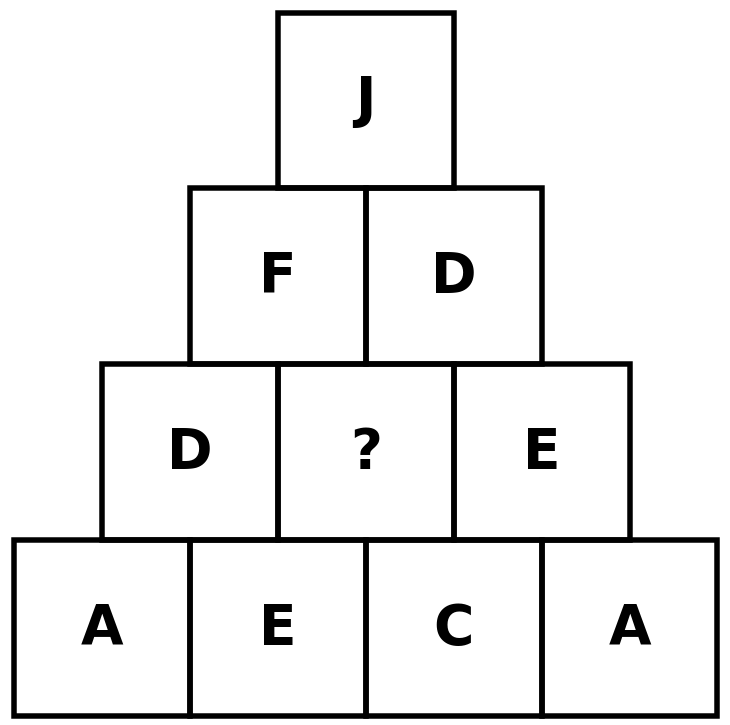
The given pattern consists of a pyramid structure with letters. Our task is to identify the letter that can replace the question mark (?) based on the pattern observed in the diagram.
Correct Option: A) A
The problem is a coding-decoding question. We need to identify the pattern or rule used to transform the given words into their coded forms and then apply the same rule to the target word.
The pattern observed here is that each letter in the word is shifted forward by 2 positions in the English alphabet.
The pattern holds true for the second example as well.
So, FLOWER will be coded as HNQYGT.
A) HNQYGT is the correct code obtained by applying the +2 shift to each letter of FLOWER.
The problem involves calculating the principal amount borrowed based on simple interest applied at different rates for different periods. We need to calculate the total interest accumulated over eleven years by summing up the interest from each period and then equate it to the given total interest to find the principal.
Correct Option: B) ₹8,000
The problem states that Tony failed by 30 marks despite scoring 120 marks, and that 40% of the total marks are required to pass. We need to find the total marks. We can first determine the passing marks and then use the percentage information to calculate the total marks.
Tony scored 120 marks and failed by 30 marks. This means if he had scored 30 more marks, he would have passed.
\[ \text{Passing Marks} = \text{Marks Obtained} + \text{Marks Failed By} \]\[ \text{Passing Marks} = 120 + 30 = 150 \]The problem states that 40% of the total marks are required to pass.
\[ 40\% \text{ of Total Marks} = \text{Passing Marks} \]\[ 0.40 \times \text{Total Marks} = 150 \]To find the total marks, divide the passing marks by the passing percentage (as a decimal).
\[ \text{Total Marks} = \frac{150}{0.40} \]\[ \text{Total Marks} = \frac{150}{\frac{40}{100}} \]\[ \text{Total Marks} = \frac{150 \times 100}{40} \]\[ \text{Total Marks} = \frac{15000}{40} \]\[ \text{Total Marks} = 375 \]So, the total marks are 375.
Correct Option: C) 375
The question asks to identify the scientist who proposed the ten percent law of energy transfer in an ecosystem. This is a fundamental concept in ecology.
B) Raymond Lindeman is correctly identified as the scientist who proposed the ten percent law of energy transfer. His work laid the foundation for understanding energy flow in ecosystems.
The question asks to identify the largest producer of wine in the year 2019 among the given options. This requires knowledge of global agricultural production statistics, specifically related to viticulture and winemaking.
According to the International Organisation of Vine and Wine (OIV) and other agricultural statistics, Italy consistently ranks as one of the top wine producers globally. In 2019, Italy maintained its position as the largest wine producer by volume.
A) Italy: In 2019, Italy was indeed the largest producer of wine globally, producing approximately 47.5 million hectoliters (Mhl) of wine. This figure placed it ahead of other major wine-producing nations.
The question asks to identify the type of computer network that is confined to a relatively small space. We need to understand the definitions and characteristics of different network types to determine the correct answer.
A) Local Area Network is correct because a LAN is specifically designed to connect devices within a limited geographical area, such as a single building, office, or home. This fits the description of being "confined to a relatively small space."
The value of \((35.7-\left(3+\frac{1}{3+\frac{1}{3}}\right)-\left(2+\frac{1}{2+\frac{1}{2}}\right))\) is:
To solve this problem, we need to simplify the nested fractions (continued fractions) first, then perform the subtractions from the initial decimal number. We will simplify each parenthesized term separately and then combine the results.
The first term inside the parentheses is \[\left(3+\frac{1}{3+\frac{1}{3}}\right)\].
First, simplify the innermost part: \[3+\frac{1}{3} = \frac{9+1}{3} = \frac{10}{3}\].
Now substitute this back into the expression:
\[ 3+\frac{1}{\frac{10}{3}} = 3+\frac{3}{10} = \frac{30+3}{10} = \frac{33}{10} \]So, the first parenthesized term is \(\frac{33}{10} = 3.3\).
The second term inside the parentheses is \[\left(2+\frac{1}{2+\frac{1}{2}}\right)\].
First, simplify the innermost part: \[2+\frac{1}{2} = \frac{4+1}{2} = \frac{5}{2}\].
Now substitute this back into the expression:
\[ 2+\frac{1}{\frac{5}{2}} = 2+\frac{2}{5} = \frac{10+2}{5} = \frac{12}{5} \]So, the second parenthesized term is \(\frac{12}{5} = 2.4\).
The original expression is \[(35.7-\left(3+\frac{1}{3+\frac{1}{3}}\right)-\left(2+\frac{1}{2+\frac{1}{2}}\right))\].
Substitute the simplified values:
\[ 35.7 - 3.3 - 2.4 \]First subtraction:
\[ 35.7 - 3.3 = 32.4 \]Second subtraction:
\[ 32.4 - 2.4 = 30.0 \]Thus, the value of the expression is \(30\).
D) 30. The step-by-step calculation shows that the value of the given expression is 30.