
This is an analogy question where you need to identify the relationship between the first pair of terms and then apply the same relationship to the third term to find the fourth term.
D) Library — Just as 'Steps' are components that make up a 'Staircase', 'Books' are components that make up a 'Library' (specifically, a library's collection).
The question asks to identify the location in India known for Stone Age rock paintings. This requires knowledge of prominent archaeological sites in India and their historical significance.
Correct Option: D) Bhimbetka
The Bhimbetka rock shelters in Madhya Pradesh, India, are an archaeological site exhibiting the earliest traces of human life on the Indian subcontinent and thus the beginning of the Stone Age in India. They are famous for their numerous rock paintings, which date back to the Paleolithic and Mesolithic periods, making them a prime example of Stone Age art.
A and B can complete a task in 60 days and 40 days respectively. If C, who can complete the same task alone in 30 days, joins A & B working together after 3 days, then the number of days taken to complete the remaining task after C joins will be:
11 \( \frac{2}{3} \)
11
11 \( \frac{1}{3} \)
11 \( \frac{4}{3} \)
This problem involves calculating work rates and combining them. We'll first find the individual work rates of A, B, and C. Then, we'll calculate the work done by A and B in the initial 3 days. Finally, we'll determine the remaining work and the time taken by A, B, and C together to complete it.
Correct Option: A) 11 \( \frac{2}{3} \)
The problem involves calculating the distance covered by Sujal while running back and then determining his final position relative to his starting point A. We need to convert time to hours to match the speed unit and then subtract the distance run from the initial distance walked.
Correct Option: C) 7 km
To find the product of the first five whole numbers, we first need to identify what whole numbers are and then list the first five of them. After that, we will multiply these numbers together.
Correct Option: B) 0 is the correct answer because the set of whole numbers includes 0, and any product that includes 0 as a factor will always result in 0.
The question asks to identify who among the given options was NOT a member of the Simon Commission. To answer this, one needs to recall the composition of the Simon Commission, which was an all-British parliamentary group.
Correct Option: D) James A Scott was not a member of the Simon Commission. He is historically known for an incident where he ordered a lathi charge against Lala Lajpat Rai during a protest against the Simon Commission in Lahore.
If x% of y is 2000 and y% of z is 4000, the relation between x and z will be:
The problem provides two percentage relations and asks for a relationship between 'x' and 'z'. We will convert the percentage statements into algebraic equations and then manipulate them to eliminate 'y' and find the relation between 'x' and 'z'.
Convert the first statement into an equation:
"x% of y is 2000" can be written as:
Convert the second statement into an equation:
"y% of z is 4000" can be written as:
Express 'y' from Equation 1:
From Equation 1, we can express 'y' in terms of 'x':
Substitute 'y' into Equation 2:
Substitute the expression for 'y' from Equation 3 into Equation 2:
Simplify and find the relation between 'x' and 'z':
Now, we simplify the equation to find the relationship between 'x' and 'z':
D) z = 2x is the correct relation derived from the given statements.
This question tests the understanding of definitions of prime numbers and odd numbers. We need to evaluate the truthfulness of both the assertion (A) and the reason (R) independently, and then determine if R correctly explains A.
A prime number is a natural number greater than 1 that has no positive divisors other than 1 and itself.
Examples of prime numbers are 2, 3, 5, 7, 11, etc.
An odd number is an integer that is not divisible by 2. Examples are 1, 3, 5, 7, etc.
The number 2 is a prime number, but it is an even number, not an odd number. Since there is one prime number (2) that is not odd, the assertion "All prime numbers are odd numbers" is false.
This statement is the definition of a prime number. By definition, a prime number is a natural number greater than 1 that has exactly two distinct positive divisors: 1 and itself.
Therefore, the reason (R) is true.
Since Assertion (A) is false and Reason (R) is true, we look for the option that reflects this relationship.
Correct Option: B) A is false but R is true.
The assertion that all prime numbers are odd is incorrect because 2 is a prime number and it is even. The reason provided is the correct definition of a prime number.
What is the sum of all angles of all triangles in the given figure?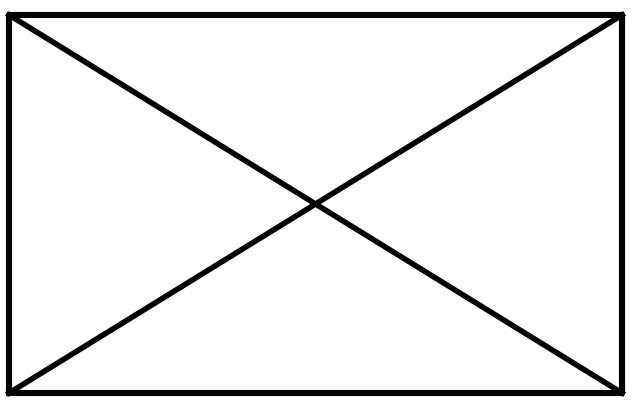
The problem requires calculating the sum of all angles in the triangles formed within the given figure. The figure consists of a large rectangle divided into several triangles.
Therefore, the total sum of all angles in the triangles is:
\[ 4 \times 180^\circ = 720^\circ \]However, since each triangle is counted twice due to overlapping (as the diagonals divide the rectangle into four triangles but also share angles), the correct calculation should be:
\[ 8 \times 180^\circ = 1440^\circ \]Thus, the sum of all angles of all triangles in the given figure is \(1440^\circ\).
Correct Option: D) 1440°
The problem asks us to identify two "odd ones out" from a given list of numbers. This typically implies finding numbers that do not share a common property with the majority of the other numbers. In number series questions, common properties often relate to whether numbers are prime, composite, even, odd, perfect squares, etc.
Correct Option: B) 57, 91