The question asks to identify which of the given SAARC Centres is located in India. This requires knowledge of the locations of various SAARC specialized bodies.
Correct Option: D) SAARC Disaster Management Centre (SDMC)
The SAARC Disaster Management Centre (SDMC) is indeed located in Gandhinagar, Gujarat, India. It was established in 2006 to provide policy advice and technical support on disaster risk reduction to SAARC member states.
If a₁, a₂, a₃, …… aₙ ∈ R, then (x - a₁\( )^{2} + (x - a \)₂\( )^{2} + \) …… + (x - aₙ\( )^{2} \) assumes its least value at:
x = \(\frac{a_1+a_2+a_3+\cdots+a_n}{n}\)
x = 2(a₁+a₂+a₃+…+aₙ)
x = n(a₁+a₂+a₃+…aₙ)
x = 2\(\frac{a_1+a_2+a_3+\cdots+a_n}{n}\)
To find the value of \(x\) for which the given sum of squares is minimized, we can use calculus. We will define the given expression as a function of \(x\), find its first derivative with respect to \(x\), set the derivative to zero to find critical points, and then verify that this point corresponds to a minimum using the second derivative test.
Let the given expression be \(f(x)\):
\[ f(x) = (x - a_1)^2 + (x - a_2)^2 + \cdots + (x - a_n)^2 \]To find the minimum value, we need to find the first derivative of \(f(x)\) with respect to \(x\) and set it to zero. Using the chain rule, the derivative of \((x - a_i)^2\) is \(2(x - a_i)\).
\[ f'(x) = \frac{d}{dx} \left[ \sum_{i=1}^{n} (x - a_i)^2 \right] \]\[ f'(x) = \sum_{i=1}^{n} \frac{d}{dx} (x - a_i)^2 \]\[ f'(x) = \sum_{i=1}^{n} 2(x - a_i) \]Now, set \(f'(x) = 0\) to find the critical points:
\[ \sum_{i=1}^{n} 2(x - a_i) = 0 \]\[ 2 \sum_{i=1}^{n} (x - a_i) = 0 \]\[ \sum_{i=1}^{n} (x - a_i) = 0 \]Expand the summation:
\[ (x - a_1) + (x - a_2) + \cdots + (x - a_n) = 0 \]\[ (x + x + \cdots + x) - (a_1 + a_2 + \cdots + a_n) = 0 \]\[ nx - \sum_{i=1}^{n} a_i = 0 \]Solve for \(x\):
\[ nx = \sum_{i=1}^{n} a_i \]\[ x = \frac{\sum_{i=1}^{n} a_i}{n} \]\[ x = \frac{a_1 + a_2 + a_3 + \cdots + a_n}{n} \]To confirm this is a minimum, we can find the second derivative \(f''(x)\):
\[ f''(x) = \frac{d}{dx} \left[ \sum_{i=1}^{n} 2(x - a_i) \right] \]\[ f''(x) = \sum_{i=1}^{n} 2 \]\[ f''(x) = 2n \]Since \(n\) is the number of terms and \(n \ge 1\), \(2n\) is always positive. A positive second derivative indicates that the critical point corresponds to a local minimum.Correct Option: A) \(x = \frac{a_1+a_2+a_3+\cdots+a_n}{n}\)
This value of \(x\) is the arithmetic mean of \(a_1, a_2, \ldots, a_n\), which is indeed where the sum of squared differences is minimized.
If the system of equation 3x - 2y = 8, 2ax + (a-b)y = 48 has infinitely many solutions then:
For a system of linear equations to have infinitely many solutions, the ratios of the coefficients of \(x\), \(y\), and the constant terms must be equal. We will set up these ratios and solve for the relationship between \(a\) and \(b\).
Identify the given system of equations:
\[ 3x - 2y = 8 \quad \text{(1)} \] \[ 2ax + (a-b)y = 48 \quad \text{(2)} \]Recall the condition for infinitely many solutions for a system of linear equations \(A_1x + B_1y = C_1\) and \(A_2x + B_2y = C_2\):
\[ \frac{A_1}{A_2} = \frac{B_1}{B_2} = \frac{C_1}{C_2} \]From the given equations, we have:
Apply the condition for infinitely many solutions:
\[ \frac{3}{2a} = \frac{-2}{a-b} = \frac{8}{48} \]Simplify the ratio of the constant terms:
\[ \frac{8}{48} = \frac{1}{6} \]Now, equate the first ratio to \(\frac{1}{6}\):
\[ \frac{3}{2a} = \frac{1}{6} \]Cross-multiply to solve for \(a\):
\[ 3 \times 6 = 2a \times 1 \] \[ 18 = 2a \] \[ a = \frac{18}{2} \] \[ a = 9 \]Next, equate the second ratio to \(\frac{1}{6}\):
\[ \frac{-2}{a-b} = \frac{1}{6} \]Cross-multiply:
\[ -2 \times 6 = 1 \times (a-b) \] \[ -12 = a-b \]Substitute the value of \(a=9\) into the equation \(-12 = a-b\):
\[ -12 = 9 - b \]Solve for \(b\):
\[ b = 9 + 12 \] \[ b = 21 \]Check the given options with \(a=9\) and \(b=21\):
Correct Option: C) b - a = 12
The question asks to find the relationship between the third and fourth terms based on the relationship between the first and second terms. This is an analogy question where we need to identify the core concept linking the given pair and apply it to the third term.
Correct Option: A) Milk
We need to calculate the total marks of the group at different stages to find the marks of the student who left and the student who joined. We will use the formula: \(\text{Total Marks} = \text{Number of Students} \times \text{Average Marks}\).
Initial total marks: Initially, there were 45 students with an average of 16.2 marks.
\[ \text{Initial Total Marks} = 45 \times 16.2 = 729 \]
Total marks after one student left: One student left, so the number of students became \(45 - 1 = 44\). The average of the remaining students rose to 16.5.
\[ \text{Total Marks (after 1 left)} = 44 \times 16.5 = 726 \]
Marks of the student who left: To find the marks of the student who left, subtract the total marks after the student left from the initial total marks.
\[ \text{Marks of student who left} = \text{Initial Total Marks} - \text{Total Marks (after 1 left)} \]
\[ \text{Marks of student who left} = 729 - 726 = 3 \]
Total marks after another student joined: Another student joined, so the number of students became \(44 + 1 = 45\). The average marks of the group became 16.4.
\[ \text{Total Marks (after 1 joined)} = 45 \times 16.4 = 738 \]
Marks of the student who joined: To find the marks of the student who joined, subtract the total marks after the first student left (before the new student joined) from the total marks after the new student joined.
\[ \text{Marks of student who joined} = \text{Total Marks (after 1 joined)} - \text{Total Marks (after 1 left)} \]
\[ \text{Marks of student who joined} = 738 - 726 = 12 \]
Average marks of the student who left and the one who joined: Now, calculate the average of the marks of these two students.
\[ \text{Average} = \frac{\text{Marks of student who left} + \text{Marks of student who joined}}{2} \]
\[ \text{Average} = \frac{3 + 12}{2} = \frac{15}{2} = 7.5 \]
Correct Option: D) 7.5
The question asks to identify the Founder Director of ISRO's Human Space Flight Centre (HSFC). This requires knowledge of key personnel in India's space program, specifically related to human spaceflight initiatives.
A) Dr. S Unnikrishnan Nair is the Founder Director of ISRO's Human Space Flight Centre (HSFC). He was appointed to this position when the centre was established in January 2019.
This problem involves analyzing logical statements using Venn diagrams or deductive reasoning to determine which conclusions do not logically follow from the given statements. We will represent each statement and then check the validity of each option.
Correct Option: D) Some batmen are both men and rabbits.
A cylindrical vessel of inner radius 4 cm contains water up to some height. A solid sphere of radius 3 cm is lowered into the water until it is completely immersed. The water level in the vessel will rise by:
\( \frac{9}{2} \) cm
\( \frac{2}{9} \) cm
\( \frac{9}{4} \) cm
\( \frac{4}{9} \) cm
The question asks for the launch year of EDUSAT (GSAT-3), a satellite dedicated to the educational sector by ISRO. This requires knowledge of specific historical events in India's space program.
Correct Option: B) 2004 — EDUSAT (GSAT-3) was successfully launched by ISRO on September 20, 2004, from the Satish Dhawan Space Centre, Sriharikota, using the Geosynchronous Satellite Launch Vehicle (GSLV-F01). It was India's first thematic satellite exclusively dedicated to serving the educational sector.
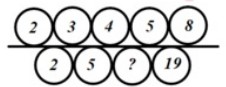
Study the given pattern carefully and select the number that can replace the question mark (?) in it.