
In a bucket, milk and water are mixed in the ratio 2 : 1. If the ratio of milk to water is to be 1 : 2, the quantity of water to be added to the mixture is:
\( \frac{1}{3} \) of the bucket
one full bucket
\( \frac{1}{4} \) of the bucket
half of the bucket
The problem asks us to identify which assumption(s) are implicit in the given statement. An implicit assumption is something that is taken for granted or understood without being explicitly stated. We need to analyze each assumption in relation to the statement: "Chain snatching incidents are increasing day-by-day."
Correct Option: B) Only assumption II is implicit
We are given the expressions for the sides of a parallelogram, its perimeter, and its area. We need to find the value of the acute angle between its sides. First, we will use the perimeter to find the actual lengths of the sides. Then, using the area formula for a parallelogram, which involves the lengths of the sides and the sine of the angle between them, we can calculate the sine of the angle and subsequently the angle itself.
Find the lengths of the sides:
Let the sides of the parallelogram be \(a\) and \(b\). We are given:
\[ a = 3x + 2 \]\[ b = 5x + 4 \]The perimeter of a parallelogram is given by \(P = 2(a + b)\). We are given \(P = 44 \text{ cm}\).\[ 44 = 2((3x + 2) + (5x + 4)) \]\[ 44 = 2(8x + 6) \]\[ 44 = 16x + 12 \]\[ 16x = 44 - 12 \]\[ 16x = 32 \]\[ x = \frac{32}{16} \]\[ x = 2 \]Now, substitute \(x = 2\) back into the expressions for the sides:\[ a = 3(2) + 2 = 6 + 2 = 8 \text{ cm} \]\[ b = 5(2) + 4 = 10 + 4 = 14 \text{ cm} \]Calculate the acute angle:
The area of a parallelogram is given by \(A = ab \sin\theta\), where \(a\) and \(b\) are the lengths of the adjacent sides and \(\theta\) is the angle between them. We are given \(A = 64 \text{ cm}^2\).
\[ 64 = (8)(14) \sin\theta \]\[ 64 = 112 \sin\theta \]\[ \sin\theta = \frac{64}{112} \]To simplify the fraction, divide both numerator and denominator by their greatest common divisor, which is 16:\[ \sin\theta = \frac{64 \div 16}{112 \div 16} \]\[ \sin\theta = \frac{4}{7} \]Now, we need to find the angle \(\theta\). We know that \(\sin\theta = \frac{4}{7} \approx 0.5714\).Check the options:
The calculated angle \(\theta \approx 34.85^\circ\) falls into the range "between 30° and 60°".
B) between 30° and 60° — The calculated angle is approximately \(34.85^\circ\), which lies in this range.
How many doors are fish? 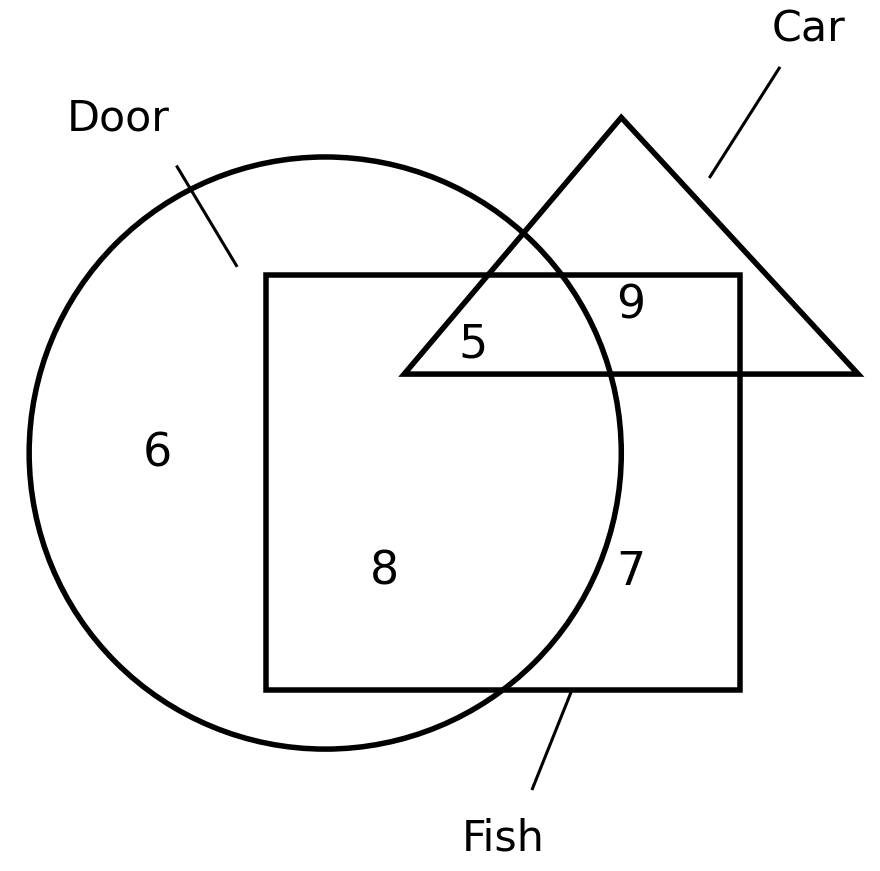
To solve the problem, we need to determine the number of elements that are categorized as both "Door" and "Fish" according to the Venn diagram provided.
\[ 5 + 8 = 13 \]
Thus, there are 13 elements that are both "Door" and "Fish."
Correct Option: B) 13
The problem requires us to find the integral part of the diagonal of a rectangle given conditions about its length, width, perimeter, and area. We will set up equations based on the given information, solve for the dimensions of the rectangle, and then calculate its diagonal.
Define variables: Let the width of the rectangle be \(w\) meters. Given that the length is 3 m more than its width, the length \(l\) will be \(l = w + 3\) meters.
Formulate expressions for perimeter and area: The perimeter \(P\) of a rectangle is given by \(P = 2(l + w)\). Substituting \(l = w + 3\), we get: \[ P = 2((w + 3) + w) = 2(2w + 3) = 4w + 6 \] The area \(A\) of a rectangle is given by \(A = l \times w\). Substituting \(l = w + 3\), we get: \[ A = (w + 3)w = w^2 + 3w \]
Use the given condition: The problem states that the perimeter is numerically equal in value to its area. So, \(P = A\). \[ 4w + 6 = w^2 + 3w \] Rearrange the equation to form a quadratic equation: \[ w^2 + 3w - 4w - 6 = 0 \] \[ w^2 - w - 6 = 0 \]
Solve the quadratic equation for \(w\): Factor the quadratic equation: \[ (w - 3)(w + 2) = 0 \] This gives two possible values for \(w\): \(w = 3\) or \(w = -2\). Since width cannot be negative, we take \(w = 3\) meters.
Calculate the length \(l\): Using \(l = w + 3\): \[ l = 3 + 3 = 6 \text{ meters} \] So, the dimensions of the rectangle are length \(6\) m and width \(3\) m.
Calculate the diagonal \(d\): The diagonal of a rectangle can be found using the Pythagorean theorem: \[ d = \sqrt{l^2 + w^2} \] Substitute the values of \(l\) and \(w\): \[ d = \sqrt{6^2 + 3^2} \] \[ d = \sqrt{36 + 9} \] \[ d = \sqrt{45} \]
Find the integral part of the diagonal: To find the integral part of \(\sqrt{45}\), we can estimate its value: We know that \(6^2 = 36\) and \(7^2 = 49\). Since \(36 < 45 < 49\), it follows that \(6 < \sqrt{45} < 7\). Therefore, the value of \(\sqrt{45}\) is approximately 6.something. The integral part of \(\sqrt{45}\) is 6.
Correct Option: C) 6
To find the ratio of two numbers in their lowest terms, we need to divide both numbers by their Greatest Common Divisor (GCD). We can use the Euclidean algorithm to find the GCD of 4767 and 11123.
The Euclidean algorithm states that for two positive integers \(a\) and \(b\) with \(a > b\), the GCD of \(a\) and \(b\) is the same as the GCD of \(b\) and \(a \pmod b\).
Step 1: Divide 11123 by 4767.
\[ 11123 = 4767 \times 2 + 1589 \]Step 2: Divide 4767 by the remainder 1589.
\[ 4767 = 1589 \times 3 + 0 \]Since the remainder is 0, the GCD is the last non-zero remainder, which is 1589.
So, \(\text{GCD}(4767, 11123) = 1589\).
Divide 4767 by 1589:
\[ \frac{4767}{1589} = 3 \]Divide 11123 by 1589:
\[ \frac{11123}{1589} = 7 \]Therefore, the ratio of 4767 and 11123 in lowest terms is \(3 : 7\).
Correct Option: D) 3 : 7
To solve this problem, we need to apply the order of operations, commonly remembered by the acronym PEMDAS/BODMAS. This stands for Parentheses/Brackets, Exponents/Orders, Multiplication and Division (from left to right), and Addition and Subtraction (from left to right).
D) \([\{(16 \div 4) \times 2\} - 5] + 1\)
Since Option D evaluates to \(4\), it is equal to the original expression.
The question asks about the president of the Indian National Congress when the Poorna Swaraj resolution was passed in Lahore on December 19, 1929. This is a direct factual question from modern Indian history.
Correct Option: B) Jawahar Lal Nehru was the president of the Indian National Congress when the Poorna Swaraj resolution was passed at the Lahore Session in 1929.
The question asks to identify the river that is different from the rest based on a certain shared characteristic. We need to analyze the origin and flow direction of each river mentioned in the options.
Correct Option: B) Godavari — The Godavari is a Peninsular river, originating in the Western Ghats and flowing eastward into the Bay of Bengal. It is distinct from the other three, which are Himalayan rivers.
The problem presents a relationship between two sets of numbers. We need to identify the pattern or rule that transforms the first set into the second set and then apply the same rule to find the missing set of numbers.
3 8 4 6 : 9 64 16 36.? : 25 1 64 49. This means the numbers in the unknown set, when squared, should result in 25, 1, 64, and 49 respectively.5 1 8 7.A) 5 1 8 7 — This matches our derived set of numbers by taking the square root of each number in the given result set.