
The question asks to identify a metalloid from the given options. Metalloids are elements that exhibit properties intermediate between those of metals and non-metals. To answer this, one needs to recall the classification of elements in the periodic table.
C) Germanium is a well-known metalloid. It is located in Group 14 of the periodic table, below silicon, and exhibits properties characteristic of both metals (like electrical conductivity, though less than metals) and non-metals (like being a semiconductor).
The question asks about the launch date of the Air Quality Index (AQI) under the Clean India Mission by the Ministry of Environment, Forest and Climate Change. This requires knowledge of specific dates related to key government initiatives.
Correct Option: A) October 2014
The Air Quality Index (AQI) was launched by the Ministry of Environment, Forest and Climate Change on October 17, 2014, as part of the broader Clean India Mission.
The question asks for the location of the Sangeet Natak Akademi, which is India's national academy for music, dance, and drama. This is a factual question related to Indian cultural institutions.
Correct Option: B) New Delhi is the correct answer. The Sangeet Natak Akademi, the national academy for music, dance, and drama, is headquartered in New Delhi, the capital of India. It was inaugurated on January 28, 1953, by the then President of India, Dr. Rajendra Prasad.
Study the given diagram and answer the question that follows.
The hexagon represents Females.
The circle represents Writers.
The quadrilateral represents Bengali.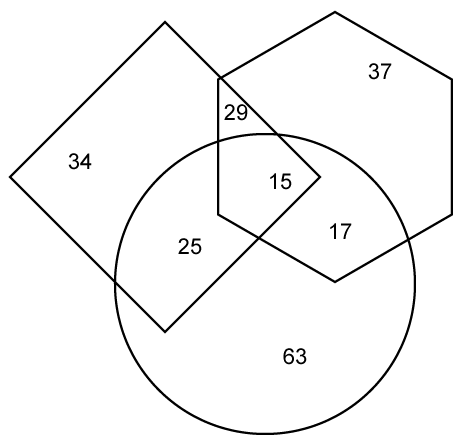
How many female writers are Bengali?
To find the number of female writers who are Bengali, we need to identify the intersection of the hexagon, circle, and quadrilateral in the diagram.
Correct Option: D) 15
The problem asks us to identify which of the given options is NOT a unit of work. We need to recall the definition of work and its standard units, then analyze the dimensions of each option.
The SI unit of force (\(F\)) is Newton (N), and the SI unit of distance (\(d\)) is meter (m).
Therefore, the SI unit of work is Newton-meter (N \(\cdot\) m).
According to Newton's second law, Force (\(F\)) = mass (\(m\)) \(\times\) acceleration (\(a\)).
The SI unit of mass is kilogram (kg).
The SI unit of acceleration is meters per second squared (m/s²).
So, \(1 \text{ Newton} = 1 \text{ kg} \cdot \text{m/s}^2\).
Since \(1 \text{ Joule} = 1 \text{ Newton} \cdot \text{meter}\), substituting the fundamental units for Newton:
\[ 1 \text{ Joule} = (1 \text{ kg} \cdot \text{m/s}^2) \cdot \text{m} = 1 \text{ kg} \cdot \text{m}^2/\text{s}^2 \]B) Kgm/sec² is the unit of force (Newton), not work. Therefore, it is NOT a unit of work.
To find the average percentage increase of population per year, we first calculate the total percentage increase over the decade. Then, we divide this total percentage increase by the number of years in a decade (which is 10) to get the average annual percentage increase.
Initial population = 1,85,500
Final population = 2,22,600
\[ \text{Increase in population} = \text{Final population} - \text{Initial population} \]\[ \text{Increase in population} = 2,22,600 - 1,85,500 = 37,100 \]The percentage increase is calculated with respect to the initial population.
\[ \text{Percentage increase} = \left( \frac{\text{Increase in population}}{\text{Initial population}} \right) \times 100 \]\[ \text{Percentage increase} = \left( \frac{37,100}{1,85,500} \right) \times 100 \]\[ \text{Percentage increase} = \frac{371}{1855} \times 100 \]\[ \text{Percentage increase} = 0.2 \times 100 = 20\% \]A decade consists of 10 years.
\[ \text{Average percentage increase per year} = \frac{\text{Total percentage increase}}{\text{Number of years}} \]\[ \text{Average percentage increase per year} = \frac{20\%}{10} = 2\% \]Correct Option: D) 2%
The problem asks us to identify the odd one out from a given set of letter sequences. This type of question typically involves finding a pattern or rule that applies to most of the sequences, and then identifying the sequence that does not follow that rule.
A) GHI — This option consists of consecutive letters in the alphabet (G, H, I), where the difference between successive letters is 1. All other options (KMO, ACE, PRT) follow a pattern where there is a difference of 2 between successive letters. Therefore, GHI is the odd one out.
The question asks to identify the former Indian Test cricketer who was NOT known for wicket-keeping among the given options. This requires knowledge of the primary roles of these cricketers in Test matches.
Correct Option: A) B. S. Chandrasekhar was a renowned leg-spin bowler and not a wicket-keeper.
The question asks to identify the type of network used within an organization to provide connectivity to its staff. This requires understanding the definitions and typical uses of different network types.
Correct Option: C) intranet
An intranet is a private network contained within an enterprise that is used to securely share company information and computing resources among employees. It is designed for internal use by the organization's staff.
To answer this question, we need to recall the major sugarcane producing states in India and their relative production volumes for the year 2019. This is a factual question based on agricultural statistics.
Correct Option: B) B, C, A