Five persons A, B, C, D and E are taking part in a race, each with a car of different colour, i.e. black, white, blue, yellow, red, not necessarily in same order. Blue car is leading in the race and A is the slowest person in the race. The one that has red car is just behind E. B has a white car and it needs to cross just one person to be at the second position. C is just behind D. The one who is at the second last position does not drive black car. Who is driving yellow car and what is its position in the race?
In a parallelogram, consecutive angles are supplementary, and opposite angles are equal. We can use these properties to set up an equation based on the given relationship between one angle and the smallest angle, and then find the largest angle.
Let the smallest angle of the parallelogram be \(x\). Since consecutive angles in a parallelogram are supplementary, the other angle adjacent to \(x\) must be \(180^\circ - x\). The angles of a parallelogram are \(x\), \(180^\circ - x\), \(x\), and \(180^\circ - x\).
The problem states that one angle of the parallelogram is \(12^\circ\) less than twice the smallest angle. There are two possibilities for "one angle": it could be the smallest angle itself, or the larger angle.
Case 1: If the angle referred to is the smallest angle, \(x\). Then, according to the problem statement:
\[ x = 2x - 12^\circ \]\[ 12^\circ = 2x - x \]\[ x = 12^\circ \]If \(x = 12^\circ\), then the other angle would be \(180^\circ - 12^\circ = 168^\circ\). In this case, \(x\) is indeed the smallest angle. Let's check the condition: \(12^\circ\) less than twice the smallest angle is \(2(12^\circ) - 12^\circ = 24^\circ - 12^\circ = 12^\circ\). This matches \(x\). So, the angles are \(12^\circ\) and \(168^\circ\).
Case 2: If the angle referred to is the larger angle, \(180^\circ - x\). Then, according to the problem statement:
\[ 180^\circ - x = 2x - 12^\circ \]\[ 180^\circ + 12^\circ = 2x + x \]\[ 192^\circ = 3x \]\[ x = \frac{192^\circ}{3} \]\[ x = 64^\circ \]If \(x = 64^\circ\), then the other angle would be \(180^\circ - 64^\circ = 116^\circ\). In this case, \(x = 64^\circ\) is the smallest angle. Let's check the condition: \(12^\circ\) less than twice the smallest angle is \(2(64^\circ) - 12^\circ = 128^\circ - 12^\circ = 116^\circ\). This matches the larger angle \(180^\circ - x\). So, the angles are \(64^\circ\) and \(116^\circ\).
Both cases yield valid sets of angles for a parallelogram. However, the question asks for the largest angle of the parallelogram. Let's examine the largest angle in each case:
In Case 1, the angles are \(12^\circ\) and \(168^\circ\). The largest angle is \(168^\circ\).
In Case 2, the angles are \(64^\circ\) and \(116^\circ\). The largest angle is \(116^\circ\).
The options provided are \(116^\circ\), \(106^\circ\), \(136^\circ\), \(86^\circ\). Only \(116^\circ\) from our derived values is present in the options.
Therefore, the largest angle of the parallelogram is \(116^\circ\).
A) \(116^\circ\) is the largest angle derived from the second case, which is consistent with the given options.
A person invested \( \frac{1}{4} \) of his capital at 3 \( \frac{1}{2} \)%, \( \frac{1}{3} \) at 7 \( \frac{1}{2} \)% and the remaining at 8% simple interest. If the amount of the yearly simple interest is ₹2,576 then what is the amount of the capital?
To find the total capital, we need to calculate the weighted average interest rate based on the fractions of capital invested at different rates. Then, using the formula for simple interest, we can determine the principal (capital) given the total yearly simple interest.
C) ₹38,400
This question is based on letter coding and decoding through rearrangement of letter groups. We must identify how DUMBLED ORE is transformed into DOREELDUMB and how INDIVIDUAL is transformed into DUALIVINDI. The coding pattern involves dividing a ten-letter word into three groups containing four, two, and four letters, respectively. The groups are rearranged in reverse order, and the middle group is also reversed.
The word DUMBLED ORE, written without spaces as DUMBLED ORE, contains ten letters.
Divide the word into three groups:
DUMB | LE | DORE
Reverse the order of the groups:
DORE | LE | DUMB
Reverse the middle group LE to EL:
DORE | EL | DUMB
Combining the groups gives DOREELDUMB, matching the given code.
Divide INDIVIDUAL into groups of four, two, and four letters:
INDI | VI | DUAL
Reverse the order of the groups:
DUAL | VI | INDI
Reverse the middle group VI to IV:
DUAL | IV | INDI
Combining the groups gives DUALIVINDI, which matches the given example.
The coding rule consists of the following operations:
APPENDICES contains ten letters.
Divide the word into three groups:
APPE | ND | ICES
Reverse the order of the groups:
ICES | ND | APPE
Reverse the middle group ND to DN:
ICES | DN | APPE
Joining ICES, DN, and APPE gives:
APPENDICES → ICESDNAPPE
Therefore, the correct answer is option D.
Correct Option: D) ICESDNAPPE
The word APPENDICES is divided into APPE, ND, and ICES. Reversing the order of the groups gives ICES, ND, and APPE. Reversing the middle group ND to DN produces ICESDNAPPE. Therefore, option D is correct.
This is a linear arrangement puzzle. We need to deduce the seating order of eight people (A to H) based on the given clues. We will build the arrangement step-by-step, starting with the most definitive clues and then incorporating others to fill in the gaps and resolve ambiguities.
Total number of persons: There are 8 persons (A to H).
Let's represent the positions as 1 2 3 4 5 6 7 8 from left to right.
Clue 1: E is the fifth from the left.
_ _ _ _ E _ _ _
Positions: 1 2 3 4 5 6 7 8
Clue 2: A is the fifth from the right.
Counting from the right, the 5th position is the 4th position from the left.
_ _ _ A E _ _ _
Positions: 1 2 3 4 5 6 7 8
Clue 3: H is at one end.
This means H is either at position 1 or position 8.
Clue 4: There are two persons between E and G.
Since E is at position 5, G can be at position 2 (E _ _ G) or position 8 (E _ _ G).
Clue 5: A is between C and E.
We know A is at position 4 and E is at position 5. For A to be between C and E, C must be at position 3.
_ _ C A E _ _ _
Positions: 1 2 3 4 5 6 7 8
Combining Clues 4 and 5:
If G is at position 2 (from Clue 4), then the arrangement becomes:
_ G C A E _ _ _
Positions: 1 2 3 4 5 6 7 8
If G is at position 8 (from Clue 4), then the arrangement becomes:
_ _ C A E _ _ G
Positions: 1 2 3 4 5 6 7 8
Clue 6: There are three persons between A and D.
A is at position 4. So D must be at position 8 (4 + 3 + 1 = 8) or position 0 (4 - 3 - 1 = 0, which is not possible).
So, D is at position 8.
This contradicts Case 2 where G is at position 8. Therefore, Case 2 is eliminated, and G must be at position 2.
The arrangement so far is: _ G C A E _ _ D
Positions: 1 2 3 4 5 6 7 8
Revisiting Clue 3: H is at one end.
Since D is at position 8, H must be at position 1.
H G C A E _ _ D
Positions: 1 2 3 4 5 6 7 8
Clue 7: H is not a neighbour of D.
This is consistent with our current arrangement (H is at 1, D is at 8).
Clue 8: B and D are adjacent to each other.
D is at position 8. So B must be at position 7.
H G C A E _ B D
Positions: 1 2 3 4 5 6 7 8
Filling the remaining position:
The only person left is F, and the only position left is 6.
The final arrangement is: H G C A E F B D
Positions: 1 2 3 4 5 6 7 8
Answering the question: Who is the third to the left of the person sitting fourth to the right of C?
Therefore, A is the person sitting third to the left of the person sitting fourth to the right of C.
B) A is the correct answer, as determined by the step-by-step deduction of the seating arrangement.
To solve this problem, we need to follow the order of operations, often remembered by the acronym PEMDAS/BODMAS (Parentheses/Brackets, Exponents/Orders, Multiplication and Division (from left to right), Addition and Subtraction (from left to right)). In this equation, we have multiplication and division operations. We will perform them from left to right.
\(0.5 \times 0.5 = 0.25\)
The division part is \(0.5 \div 5 \div 0.5\).
First, calculate \(0.5 \div 5\):
\[ 0.5 \div 5 = \frac{0.5}{5} = 0.1 \]Now, take the result from the previous step and divide by \(0.5\):
\[ 0.1 \div 0.5 = \frac{0.1}{0.5} = \frac{1}{5} = 0.2 \]The equation now becomes:
\[ 0.25 - 0.2 \]Thus, the solution to the equation is \(0.05\).
D) 0.05 is the correct answer, as derived from following the order of operations.
The question asks to identify the politician who has never served as the Leader of the House in the Lok Sabha. This requires knowledge of the parliamentary roles held by prominent Indian politicians.
C) Shri Manmohan Singh — Shri Manmohan Singh served as Prime Minister of India, but he was always a member of the Rajya Sabha during his premiership. Therefore, he never held the position of Leader of the House in the Lok Sabha. Instead, Shri Pranab Mukherjee served as the Leader of the House in the Lok Sabha during a significant part of Manmohan Singh's prime ministership.
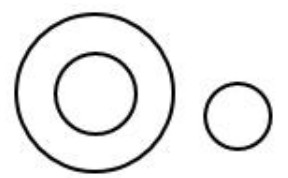
Select the Venn diagram that best represents the relationship between the following classes.
Birds, Ostriches, Bats
To determine the correct Venn diagram, we need to understand the relationships between the classes: Birds, Ostriches, and Bats.
Birds are a broad class that includes Ostriches, but Bats are not birds. Therefore, Ostriches are a subset of Birds, while Bats are separate.
Correct Option: D) The diagram correctly represents Ostriches as a subset of Birds and Bats as separate.
The problem requires us to find which two mathematical signs, when interchanged in the given equation, will make the equation correct. We will test each option by interchanging the specified signs and then evaluating the expression using the BODMAS/PEMDAS rule.
The given equation is:
\[ 24 + 3 \times 4 - 30 \div 10 = 12 \]Let's evaluate the original equation first to see if it's already correct:
Since \(33 \neq 12\), the original equation is incorrect. Now, let's test the options.
B) + and ÷
Interchange '+' and '÷' in the original equation:
\[ 24 \div 3 \times 4 - 30 + 10 = 12 \]Since \(12 = 12\), the equation becomes correct after interchanging '+' and '÷'.
A) ÷ and ×
Interchange '÷' and '×' in the original equation:
\[ 24 + 3 \div 4 - 30 \times 10 = 12 \]Since \(-275.25 \neq 12\), this option is incorrect.
C) ÷ and –
Interchange '÷' and '–' in the original equation:
\[ 24 + 3 \times 4 \div 30 - 10 = 12 \]Since \(14.4 \neq 12\), this option is incorrect.
D) + and –
Interchange '+' and '–' in the original equation:
\[ 24 - 3 \times 4 + 30 \div 10 = 12 \]Since \(15 \neq 12\), this option is incorrect.
The problem presents a coding pattern where letters within a word are rearranged. We need to identify this rearrangement pattern by comparing the original words with their coded forms and then apply the same pattern to the given word EKSEKTRA.
D) KEESTKAR is the correct answer, derived by applying the pattern of swapping adjacent letters in pairs.