
The problem asks us to identify the number-pair that is different from the rest, given four number-pairs. We need to find a common pattern or relationship between the numbers in three of the pairs and identify the one that does not follow this pattern.
B) 23 : 539 — In this pair, \(23^2 = 529\), but the given second number is 539. Thus, it does not follow the pattern where the second number is the square of the first number.
The question asks to identify the astrophysicist who first theorized the solar wind and was the first living individual to have a NASA spacecraft named after them. This requires knowledge of prominent figures in space science and their contributions.
Correct Option: A) Eugene Parker
Eugene Parker was an American astrophysicist who, in 1958, developed the theory of the supersonic solar wind and predicted the spiral shape of the solar magnetic field in the outer solar system. In 2018, NASA launched the Parker Solar Probe, which was named after him, making him the first living individual to have a NASA spacecraft named in their honor.
In the given Δ KMN, PQ is parallel to MN. If \( \frac{KP}{PM} \) = \( \frac{4}{13} \) and KN = 20.4 cm, find KQ.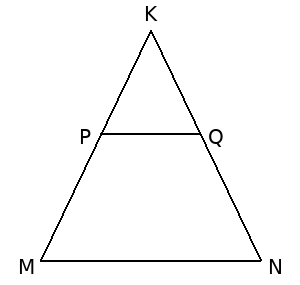
We need to find the length of segment KQ using the properties of similar triangles. Since PQ is parallel to MN, triangles KPM and KQN are similar by the Basic Proportionality Theorem.
Correct Option: B) 4.8 cm
The problem asks us to find three numbers given their ratio and their Highest Common Factor (HCF). We know that if numbers are in a certain ratio, they can be expressed as multiples of a common factor. When the HCF is given, this common factor is precisely the HCF itself.
Let the three numbers be \(N_1\), \(N_2\), and \(N_3\).
The ratio of the three numbers is given as \(3 : 4 : 5\). This means we can write the numbers as \(3x\), \(4x\), and \(5x\) for some common factor \(x\).
The HCF (Highest Common Factor) of these three numbers is given as 7.
The HCF of \(3x\), \(4x\), and \(5x\) is \(x \times \text{HCF}(3, 4, 5)\). Since 3, 4, and 5 are coprime (their HCF is 1), the HCF of \(3x\), \(4x\), and \(5x\) is simply \(x\).
Therefore, we have \(x = 7\).
Now, substitute the value of \(x\) back into the expressions for the three numbers:
So, the three numbers are 21, 28, and 35.
C) 21; 28; 35 — This matches our calculated numbers.
To find the remainder when one polynomial is divided by another, we use polynomial long division. The goal is to divide the given polynomial \( P(x) = 6x^{4} + 8x^{3} + 17x^{2} + 21x + 7 \) by \( D(x) = 3x^{2} + 4x + 1 \) and express the result in the form \( P(x) = Q(x)D(x) + R(x) \), where \( R(x) \) is the remainder. We will then compare the obtained remainder with \( ax + b \) to find the values of \( a \) and \( b \).
Set up the long division:
\[ \begin{array}{c|cc cc cc} \multicolumn{2}{r}{2x^2} & \quad & +5 \\ \cline{2-6} 3x^2+4x+1 & 6x^4 & +8x^3 & +17x^2 & +21x & +7 \\ \multicolumn{2}{r}{-(6x^4} & +8x^3 & +2x^2) \\ \cline{2-4} \multicolumn{2}{r}{0} & 0 & 15x^2 & +21x & +7 \\ \multicolumn{2}{r}{} & \multicolumn{2}{r}{-(15x^2} & +20x & +5) \\ \cline{4-6} \multicolumn{2}{r}{} & \multicolumn{2}{r}{} & x & +2 \\ \end{array} \]Divide the leading terms: Divide \( 6x^4 \) by \( 3x^2 \) to get \( 2x^2 \). Multiply \( 2x^2 \) by the divisor \( (3x^2 + 4x + 1) \) to get \( 6x^4 + 8x^3 + 2x^2 \). Subtract this from the dividend.
\[ (6x^4 + 8x^3 + 17x^2) - (6x^4 + 8x^3 + 2x^2) = 15x^2 \]Bring down the next terms \( +21x + 7 \). The new dividend is \( 15x^2 + 21x + 7 \).
Repeat the process: Divide the leading term of the new dividend, \( 15x^2 \), by the leading term of the divisor, \( 3x^2 \), to get \( 5 \). Multiply \( 5 \) by the divisor \( (3x^2 + 4x + 1) \) to get \( 15x^2 + 20x + 5 \). Subtract this from the current dividend.
\[ (15x^2 + 21x + 7) - (15x^2 + 20x + 5) = x + 2 \]Identify the remainder: The degree of the resulting polynomial \( x + 2 \) is 1, which is less than the degree of the divisor \( 3x^2 + 4x + 1 \) (which is 2). Therefore, \( x + 2 \) is the remainder.
Compare with \( ax + b \): We are given that the remainder is \( ax + b \). By comparing \( x + 2 \) with \( ax + b \), we find that \( a = 1 \) and \( b = 2 \).
Correct Option: C) a = 1; b = 2
The question asks for the location of the International Court of Justice (ICJ). This is a factual question about international organizations and their headquarters. Recalling the established location of the ICJ is key to answering this question.
Correct Option: C) The Hague is the correct answer. The International Court of Justice (ICJ), the principal judicial organ of the United Nations, is permanently seated in the Peace Palace in The Hague, Netherlands.
To find which number completely divides the given expression, we need to simplify the expression by factoring out the common term. Once simplified, we can check its divisibility by the given options.
Identify the given expression:
\[ (4^{61} + 4^{62} + 4^{63} + 4^{64}) \]Factor out the smallest power of 4, which is \(4^{61}\), from each term:
\[ 4^{61} (1 + 4^1 + 4^2 + 4^3) \]Calculate the sum inside the parenthesis:
So, the sum is \(1 + 4 + 16 + 64 = 85\).
Substitute this sum back into the expression:
\[ 4^{61} \times 85 \]Now, we need to find which of the given options completely divides \(4^{61} \times 85\). Let's analyze the factors of 85:
\[ 85 = 5 \times 17 \]So the expression becomes:
\[ 4^{61} \times 5 \times 17 \]Check the divisibility by each option:
Therefore, the number that completely divides the given expression is 10.
Correct Option: A) 10
The problem presents an analogy where the relationship between the first pair of numbers (14 : 210) needs to be identified and then applied to the third number (16) to find the missing fourth number. We need to find a mathematical operation or pattern that connects 14 to 210.
A) 240. The relationship is that the second number is obtained by multiplying the first number by 15. For the first pair, \(14 \times 15 = 210\). Applying the same rule to the third number, \(16 \times 15 = 240\).
The question asks to identify the cell organelle responsible for waste disposal and digestion of foreign materials and worn-out organelles. This points to the organelle known as the "suicidal bag" or "waste disposal system" of the cell.
Correct Option: A) Lysosomes are membrane-bound organelles that contain hydrolytic enzymes capable of breaking down various biomolecules. They function as the cell's waste disposal system, digesting foreign substances (like bacteria and viruses) and old or damaged cell parts, thereby keeping the cell clean and recycling cellular components.
When a metal cube is completely immersed in water, the volume of water displaced is equal to the volume of the cube. This displaced water causes the water level in the cylindrical container to rise. We can calculate the volume of the cube and then use this volume to find the rise in the water level in the cylinder.
Correct Option: B) 1.6 cm