
What is the value of the following expression?
\(\frac{(2.7)^2-(0.8)^2}{2.7-0.8}\)
The problem asks us to evaluate a given algebraic expression. We can simplify the expression by recognizing a common algebraic identity, specifically the difference of squares formula: \(a^2 - b^2 = (a - b)(a + b)\). This will allow us to cancel out a term and simplify the calculation significantly.
Identify the form of the numerator. The numerator is \((2.7)^2 - (0.8)^2\). This is in the form \(a^2 - b^2\), where \(a = 2.7\) and \(b = 0.8\).
Apply the difference of squares formula to the numerator:
\[ a^2 - b^2 = (a - b)(a + b) \]\[ (2.7)^2 - (0.8)^2 = (2.7 - 0.8)(2.7 + 0.8) \]Substitute this back into the original expression:
\[ \frac{(2.7)^2 - (0.8)^2}{2.7 - 0.8} = \frac{(2.7 - 0.8)(2.7 + 0.8)}{2.7 - 0.8} \]Cancel out the common term \((2.7 - 0.8)\) from the numerator and the denominator. Note that \(2.7 - 0.8 = 1.9\), which is not zero, so cancellation is valid.
\[ \frac{\cancel{(2.7 - 0.8)}(2.7 + 0.8)}{\cancel{2.7 - 0.8}} = 2.7 + 0.8 \]Perform the addition:
\[ 2.7 + 0.8 = 3.5 \]Thus, the value of the expression is \(3.5\).
Correct Option: C) 3.5
If '+' means '÷', '−' means '×', '÷' means '+' and '×' means '−', then find the value of the following expression.
11 − 2 × 4 ÷ 12 + 4
This problem involves substituting new meanings for mathematical operators and then evaluating the expression according to the order of operations (BODMAS/PEMDAS).
Given Expression:
\(11 - 2 \times 4 \div 12 + 4\)
New Operator Meanings:
Step 1: Substitute the new operators into the expression.
Original expression: \(11 - 2 \times 4 \div 12 + 4\)
Applying the substitutions:
The expression becomes:
\(11 \times 2 - 4 + 12 \div 4\)
Step 2: Evaluate the modified expression using the BODMAS/PEMDAS rule.
The order of operations is Division, Multiplication, Addition, Subtraction.
The expression is now: \(11 \times 2 - 4 + 3\)
The expression is now: \(22 - 4 + 3\)
\(22 - 4 = 18\)
\(18 + 3 = 21\)
Thus, the value of the expression is \(21\).
C) 21
The question asks to identify which of the given options is NOT a wired broadband technology. To answer this, we need to understand the fundamental difference between wired and wireless communication methods for internet access.
Correct Option: C) Satellite is a wireless broadband technology. It transmits data via radio waves to and from satellites in orbit, making it distinct from wired connections that rely on physical cables.
To find the ratio of increased seats, we first need to determine the new number of seats for each subject after the proposed percentage increase. We will then simplify the ratio of these new numbers.
Initial Ratio: The initial ratio of seats for Mathematics, Physics, and Chemistry is given as \(7 : 8 : 9\). Let the initial number of seats be \(7x\), \(8x\), and \(9x\) respectively, where \(x\) is a common multiplier.
Percentage Increase:
Calculate New Seats for Each Subject:
Mathematics: Initial seats \( = 7x \). Increase \( = 30\% \) of \( 7x \).
\[ \text{New Math Seats} = 7x + (0.30 \times 7x) = 7x + 2.1x = 9.1x \]Physics: Initial seats \( = 8x \). Increase \( = 40\% \) of \( 8x \).
\[ \text{New Physics Seats} = 8x + (0.40 \times 8x) = 8x + 3.2x = 11.2x \]Chemistry: Initial seats \( = 9x \). Increase \( = 50\% \) of \( 9x \).
\[ \text{New Chemistry Seats} = 9x + (0.50 \times 9x) = 9x + 4.5x = 13.5x \]Form the Ratio of Increased Seats:
The ratio of new seats for Mathematics : Physics : Chemistry is \(9.1x : 11.2x : 13.5x\).
Simplify the Ratio:
Divide each term by \(x\): \(9.1 : 11.2 : 13.5\).
To remove decimals, multiply each term by 10:
\[ 9.1 \times 10 : 11.2 \times 10 : 13.5 \times 10 \]\[ 91 : 112 : 135 \]Correct Option: A) The ratio of increased seats will be \(91 : 112 : 135\).
The question asks to identify the first discovered site of the Indus Valley Civilisation. This requires knowledge of the historical timeline of archaeological discoveries related to this ancient civilization.
Correct Option: B) Harappa was the first site of the Indus Valley Civilisation to be discovered and excavated in 1921, marking the beginning of the recognition of this ancient civilization.
Select the Venn diagram that best represents the relationship between the following classes.
Wheat, Rice, Grain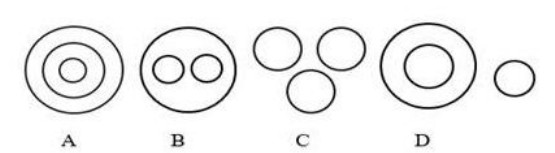
To determine the correct Venn diagram that represents the relationship between Wheat, Rice, and Grain, we need to understand the hierarchical relationship among these classes.
Correct Option: B) The diagram with two smaller circles within a larger circle correctly represents Wheat and Rice as subsets of Grain.
The question asks for the year in which the UN Peacekeeping forces were awarded the Nobel Prize for Peace. This is a factual question related to international organizations and their recognition.
Correct Option: C) 1988 — The UN Peacekeeping forces were awarded the Nobel Prize for Peace in 1988 for their collective efforts in promoting peace and stability across the globe.
The question asks about Dhanurveda, an Upaveda of the Yajurveda, and its subject matter. To answer this, one needs to recall the traditional classification of Upavedas and their associated fields of knowledge.
Correct Option: A) art of warfare. Dhanurveda is traditionally known as the science of archery and warfare, making this the correct answer.
The question asks to identify the first rapper who won the Pulitzer Prize for Music. This is a factual question related to awards in the music industry, specifically the Pulitzer Prize, which is a prestigious award in the United States.
Correct Option: C) Kendrick Lamar is the first rapper to win the Pulitzer Prize for Music. He received the award in 2018 for his album "DAMN.", making history as the first hip-hop artist to be honored with this prestigious award.
The question asks to identify the nation with one of the largest domestic communication satellite systems in the Asia-Pacific region. This requires knowledge of the space programs and satellite capabilities of the listed countries.
B) India has a highly advanced and extensive domestic communication satellite system (INSAT/GSAT series) managed by ISRO, making it one of the largest in the Asia-Pacific region.