
The value of \(\frac{32\div4-5\times8\div3}{5\times3-(6+3)}\) is:
−\( \frac{8}{9} \)
\( \frac{1}{9} \)
\( \frac{8}{9} \)
\( \frac{4}{9} \)
To solve this problem, we need to apply the order of operations, often remembered by the acronym BODMAS/PEMDAS. This means we perform operations in the following order: Brackets (Parentheses), Orders (Exponents/Powers), Division and Multiplication (from left to right), and Addition and Subtraction (from left to right).
Let's evaluate the given expression:
\[ \frac{32\div4-5\times8\div3}{5\times3-(6+3)} \]First, we evaluate the numerator and the denominator separately.
Now, substitute the calculated values back into the original fraction:
\[ \frac{\text{Numerator}}{\text{Denominator}} = \frac{-\frac{16}{3}}{6} \]To simplify this complex fraction, we can write it as:
\[ -\frac{16}{3} \div 6 = -\frac{16}{3} \times \frac{1}{6} \]Multiply the numerators and the denominators:
\[ -\frac{16 \times 1}{3 \times 6} = -\frac{16}{18} \]Simplify the fraction by dividing both the numerator and the denominator by their greatest common divisor, which is 2:
\[ -\frac{16 \div 2}{18 \div 2} = -\frac{8}{9} \]Thus, the value of the expression is \(-\frac{8}{9}\).
Correct Option: A) \(-\frac{8}{9}\)
The problem asks us to find a relationship between the first pair of numbers (2 : 32) and apply the same relationship to the third number (4) to find the missing fourth number. We need to identify the mathematical operation or pattern connecting 2 and 32.
We need to find how 32 is related to 2. Let's consider common mathematical operations:
So, we can see that \(32 = 2^5\). This looks like a strong candidate for the pattern.
The relationship seems to be that the second number is the first number raised to the power of 5. That is, if the first number is \(N\), the second number is \(N^5\).
Using the identified rule, if the third number is 4, the fourth number should be \(4^5\).
\[ 4^5 = 4 \times 4 \times 4 \times 4 \times 4 \] \[ 4^5 = 16 \times 4 \times 4 \times 4 \] \[ 4^5 = 64 \times 4 \times 4 \] \[ 4^5 = 256 \times 4 \] \[ 4^5 = 1024 \]The calculated value is 1024, which matches option B.
Correct Option: B) 1024
If 0.75 : x :: 25 : 8, then what is the value of x?
The problem presents a proportion, which is an equality between two ratios. We need to find the unknown value \(x\) by setting up the ratios as fractions and solving the resulting equation.
Understand the proportion notation: The notation \(a : b :: c : d\) means that \(a\) is to \(b\) as \(c\) is to \(d\). This can be written as an equality of two fractions:
\[ \frac{a}{b} = \frac{c}{d} \]Apply to the given problem: Given the proportion \(0.75 : x :: 25 : 8\), we can write it as:
\[ \frac{0.75}{x} = \frac{25}{8} \]Solve for \(x\): To solve for \(x\), we can cross-multiply:
\[ 0.75 \times 8 = x \times 25 \]Calculate the left side:
\[ 0.75 \times 8 = 6 \]Substitute back into the equation:
\[ 6 = 25x \]Isolate \(x\): Divide both sides by 25:
\[ x = \frac{6}{25} \]Correct Option: D) \( \frac{6}{25} \)
What is the value of x, if −3 × \(\sqrt{196}\)+ \(\sqrt{x}\) = 8 × 3 − 2?
To find the value of \(x\), we need to solve the given algebraic equation. This involves simplifying both sides of the equation, isolating the term with \(\sqrt{x}\), and then squaring both sides to find \(x\).
Write down the given equation:
\[ -3 \times \sqrt{196} + \sqrt{x} = 8 \times 3 - 2 \]Calculate the square root of 196:
\[ \sqrt{196} = 14 \]Substitute the value of \(\sqrt{196}\) into the equation:
\[ -3 \times 14 + \sqrt{x} = 8 \times 3 - 2 \]Perform the multiplications on both sides:
\[ -42 + \sqrt{x} = 24 - 2 \]Simplify the right side of the equation:
\[ -42 + \sqrt{x} = 22 \]Isolate the term with \(\sqrt{x}\) by adding 42 to both sides of the equation:
\[ \sqrt{x} = 22 + 42 \]\[ \sqrt{x} = 64 \]To find \(x\), square both sides of the equation:
\[ (\sqrt{x})^2 = (64)^2 \]\[ x = 64 \times 64 \]Calculate \(64 \times 64\):
\[ 64 \times 64 = 4096 \]A) 4096 is the correct answer because, by simplifying the equation and solving for \(x\), we find that \(x = 4096\).
How many stars are both Tyres and Pen?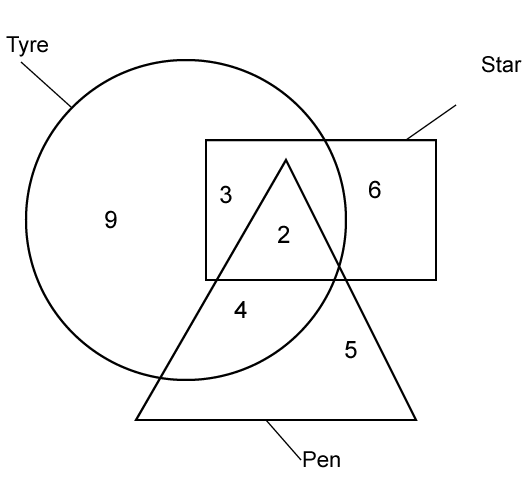
To determine how many stars are both Tyres and Pens, we need to examine the overlapping areas in the Venn diagram provided.
Thus, there are 2 stars that are both Tyres and Pens.
Correct Option: A) 2
When is National Pollution Prevention Day observed in India?
The question asks for the date on which National Pollution Prevention Day is observed in India. This is a factual question related to important days and environmental awareness.
Correct Option: D) December 2 nd
National Pollution Prevention Day is observed annually on December 2nd in India. This day is dedicated to raising awareness about the importance of pollution control and prevention, and to commemorate the victims of the Bhopal Gas Tragedy, which occurred on the night of December 2-3, 1984. The objective is to educate people about the dangers of industrial pollution and the need for stricter environmental regulations.
The question asks about the host nation for the ICC Men's Cricket World Cup in 2023. This requires knowledge of recent major international cricket tournaments and their venues.
Correct Option: C) India
The question asks to identify the industry type where production occurs within the producer's home. We need to recall the definitions and characteristics of each industry type provided in the options.
Correct Option: B) Cottage industry is a small-scale industry where products are made by hand by artisans, often within their own homes, using traditional methods and local resources.
To find the pair of consecutive letters with the least difference in terms of their positions in the English alphabet, we need to assign a numerical value to each letter (A=1, B=2, C=3, etc.) and then calculate the absolute difference between the values of each consecutive pair in the word VIBGYOR.
Correct Option: B) O and R — The absolute difference between the alphabetical positions of O (15) and R (18) is \(|15 - 18| = 3\), which is the least among all consecutive pairs in VIBGYOR.
The question asks to identify the commodity transported by the 'Big Inch' pipeline. This requires knowledge of historical infrastructure projects, specifically those related to energy transportation.
Correct Option: D) Petroleum