
To find the profit percentage when the article is sold at a new price, we first need to determine the Cost Price (CP) of the article. We can find the CP using the initial selling price and the loss percentage. Once the CP is known, we can calculate the profit when sold at the new price and then express it as a percentage of the CP.
Calculate the Cost Price (CP):
Given the selling price (\(\text{SP}_1\)) is ₹31 and the loss is 7%.
If there is a loss of 7%, it means the selling price is \(100\% - 7\% = 93\%\) of the Cost Price.
So, we can write the equation:
\[ \text{SP}_1 = \text{CP} \times (1 - \text{Loss Percentage}) \] \[ 31 = \text{CP} \times (1 - 0.07) \] \[ 31 = \text{CP} \times 0.93 \]Now, solve for CP:
\[ \text{CP} = \frac{31}{0.93} = \frac{31}{93/100} = \frac{31 \times 100}{93} \] \[ \text{CP} = \frac{1 \times 100}{3} = \frac{100}{3} \text{ ₹} \]Calculate the Profit when sold at ₹35:
The new selling price (\(\text{SP}_2\)) is ₹35.
Profit = \(\text{SP}_2 - \text{CP}\)
\[ \text{Profit} = 35 - \frac{100}{3} \] \[ \text{Profit} = \frac{35 \times 3 - 100}{3} = \frac{105 - 100}{3} = \frac{5}{3} \text{ ₹} \]Calculate the Profit Percentage:
Profit Percentage = \( \frac{\text{Profit}}{\text{CP}} \times 100\% \)
\[ \text{Profit Percentage} = \frac{5/3}{100/3} \times 100\% \] \[ \text{Profit Percentage} = \frac{5}{3} \times \frac{3}{100} \times 100\% \] \[ \text{Profit Percentage} = \frac{5}{100} \times 100\% \] \[ \text{Profit Percentage} = 5\% \]Correct Option: B) 5%
Study the given pattern carefully and select the number from among the given options that can replace the question mark (?). 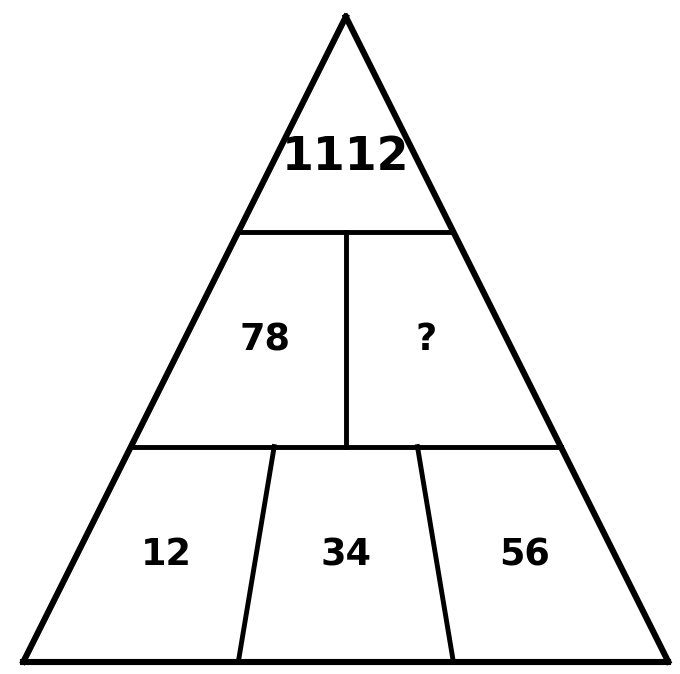
To solve this problem, we need to identify the pattern used in the given diagram to find the missing number. The diagram is a pyramid with numbers arranged in different sections. The goal is to determine the number that replaces the question mark.
Thus, the number that fits the pattern is 910.
Correct Option: C) 910
To find the ratio of the curved surface areas of two cones, we need to use the formula for the curved surface area of a cone, which is \(\pi r l\), where \(r\) is the radius of the base and \(l\) is the slant height. We are given that the diameters of the bases are equal, which implies their radii are also equal. We are also given the ratio of their slant heights.
Correct Option: D) 3 : 4
The question asks to identify the term for unsolicited commercial emails that flood the internet. We need to understand the definitions of the given options to determine the correct answer.
D) Spam — Spam is precisely defined as unsolicited and often commercial emails sent to a large number of recipients, which accurately describes the phenomenon of "unsolicited commercial emails that flood the Internet."
Which of the following has terminal decimal representation?
\( \frac{2}{7} \)
\( \frac{2}{5} \)
\( \frac{2}{3} \)
\( \frac{2}{9} \)
A rational number has a terminal decimal representation if and only if the prime factorization of its denominator (in its simplest form) contains only the primes 2 and/or 5. We will simplify each fraction and check the prime factors of its denominator.
B) \( \frac{2}{5} \) — The denominator is 5, which is a prime factor of 5. Therefore, its decimal representation is terminating (\( 2/5 = 0.4 \)).
The problem asks us to find the value of 'p' given a set of numbers and their arithmetic mean. The arithmetic mean (or average) is calculated by summing all the numbers in the set and then dividing by the count of numbers in the set.
Correct Option: B) 22
The question asks to identify the freedom fighter known by the honorific title "Deshbandhu". This requires knowledge of prominent Indian freedom fighters and their associated titles.
Correct Option: A) Chittaranjan Das was a prominent Indian freedom fighter, political activist, and lawyer. He was affectionately known as "Deshbandhu" (Friend of the Nation) for his selfless dedication to the cause of Indian independence. He played a significant role in the Non-Cooperation Movement and was a co-founder of the Swaraj Party.
To find the total surface area of a hemisphere, we first need to determine its radius from the given diameter. Then, we use the formula for the total surface area of a hemisphere, which includes both the curved surface area and the area of its circular base.
Correct Option: D) 115.50 cm²
The roots of the equation y² - \(\sqrt{5}\) y - y + \(\sqrt{5}\) = 0 are:
\(\sqrt{5}\); -1
\(\sqrt{5}\); 1
-\(\sqrt{5}\); -1
-\(\sqrt{5}\); 1
To find the roots of the given quadratic-like equation, we will first rearrange the terms, then factorize the expression by grouping. Once factored, we can set each factor to zero to find the values of \(y\).
The given equation is \(y^2 - \sqrt{5}y - y + \sqrt{5} = 0\). We can group the terms to facilitate factorization.
Group the first two terms and the last two terms:
\[ (y^2 - \sqrt{5}y) - (y - \sqrt{5}) = 0 \]From the first group, factor out \(y\). From the second group, factor out \(1\).
\[ y(y - \sqrt{5}) - 1(y - \sqrt{5}) = 0 \]Notice that \((y - \sqrt{5})\) is common to both terms.
\[ (y - 1)(y - \sqrt{5}) = 0 \]For the product of two factors to be zero, at least one of the factors must be zero.
\[ y - 1 = 0 \quad \text{or} \quad y - \sqrt{5} = 0 \]From the first equation:
\[ y = 1 \]From the second equation:
\[ y = \sqrt{5} \]Thus, the roots of the equation are \(1\) and \(\sqrt{5}\).
B) \(\sqrt{5}\); 1 — The roots found by factorization are \(1\) and \(\sqrt{5}\).
Four options are given below, of which three are similar in a certain manner while one is different from the rest. Find the odd one.
\(\sqrt{3}\)
\(\sqrt{5}\)
\(\sqrt{7}\)
\(\sqrt{9}\)
The problem asks us to identify the odd one out from a given set of numbers. We need to evaluate each option and determine a common property shared by three options, while one option does not share that property.
Correct Option: D) \(\sqrt{9}\) is the odd one out because it simplifies to 3, which is a rational number. The other options (\(\sqrt{3}\), \(\sqrt{5}\), \(\sqrt{7}\)) are square roots of prime numbers, making them irrational numbers.