
The question asks about the number of articles in the Constitution of India as of October 2020. This requires knowledge of the original structure of the Constitution and the amendments made over time.
B) 448 is the closest and most commonly accepted figure for the total number of articles in the Constitution of India, including those added through amendments, as of October 2020.
Solve the following.
(0.\(\overline{5}\) + 0.\(\overline{6}\) + 0.\(\overline{7}\) + 0.\(\overline{8}\)) = ?
2 \( \frac{4}{9} \)
2 \( \frac{7}{9} \)
2 \( \frac{8}{9} \)
2 \( \frac{5}{9} \)
The problem requires us to sum a series of repeating decimals. The key to solving this is to convert each repeating decimal into its fractional form. A repeating decimal of the form \(0.\overline{d}\) can be written as \(\frac{d}{9}\).
Correct Option: C) 2 \( \frac{8}{9} \)
The problem is a coding-decoding question. We need to identify the pattern used to code "CALM" as "XZON" and then apply the same pattern to code "LOVE". The pattern usually involves alphabetical positions or a reverse alphabetical order.
Correct Option: D) OLEV is the correct code for LOVE based on the opposite letter coding pattern.
The question asks to identify the founder of India's space programme. This is a factual question related to the history of science and technology in India. Recalling key figures in Indian scientific development will lead to the correct answer.
A) Vikram Sarabhai is widely regarded as the Father of the Indian Space Programme. He played a crucial role in establishing the Indian National Committee for Space Research (INCOSPAR) in 1962, which later became the Indian Space Research Organisation (ISRO) in 1969. His vision and efforts laid the foundation for India's achievements in space technology.
The question asks to identify the nature of Phad painting, an art form from Rajasthan. To answer this, one needs to recall the characteristics and themes associated with Phad painting.
C) religious — Phad painting is a religious form of painting because it primarily depicts the epic tales and lives of folk deities and heroes like Pabuji and Devnarayan, which are revered and narrated during religious ceremonies and rituals.
The question asks to identify India's first supercomputer. This is a factual question related to the history of computing in India. Recalling key milestones in Indian technological development is crucial.
India's first indigenous supercomputer was developed by the Centre for Development of Advanced Computing (C-DAC) in Pune. This project was initiated in response to the denial of supercomputer technology to India by other countries. The first machine from this series was launched in the early 1990s.
Correct Option: A) PARAM 8000
PARAM 8000 was India's first indigenous supercomputer, launched in 1991 by C-DAC. It marked a significant achievement in India's technological self-reliance in high-performance computing.
In the given figure, the rectangle shows the number of students in 10th grade of a school. The parallelogram shows the number of girls in the school. The triangle shows the number of tennis playing students and the circle shows the number of boys playing cricket in the school.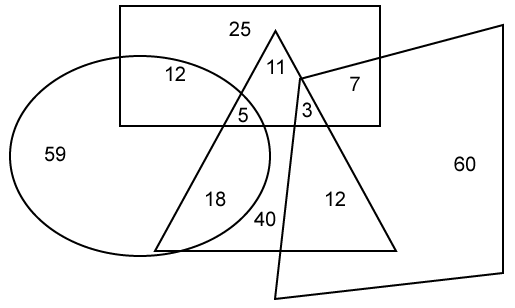
How many total students are there in 10th grade and how many of them play both cricket and tennis?
We need to determine the total number of students in 10th grade and how many of them play both cricket and tennis using the provided Venn diagram.
Therefore, the total number of students in 10th grade is 58, and the number of students who play both cricket and tennis is 5.
Correct Option: A) 63, 5
This problem involves two unknown numbers. We are given two pieces of information: their sum and the difference of their squares. We can set up a system of two equations with two variables and solve for the difference between the numbers using algebraic identities.
Let the two numbers be \(x\) and \(y\).
From the problem statement, the sum of the two numbers is 75. So, we can write the first equation:
\[ x + y = 75 \quad \text{(Equation 1)} \]The difference of their squares is 300. This gives us the second equation:
\[ x^2 - y^2 = 300 \quad \text{(Equation 2)} \]Recall the algebraic identity for the difference of squares:
\[ a^2 - b^2 = (a - b)(a + b) \]Apply this identity to Equation 2:
\[ (x - y)(x + y) = 300 \]Now, substitute the value of \((x + y)\) from Equation 1 into the modified Equation 2:
\[ (x - y)(75) = 300 \]To find the difference between the two numbers, \((x - y)\), divide both sides by 75:
\[ x - y = \frac{300}{75} \]Perform the division:
\[ x - y = 4 \]D) 4 — The difference between the two numbers is 4.
The question asks to identify the Indian city whose international airport is named after Dr. B. R. Ambedkar. This requires knowledge of the names of major Indian airports and their associated cities.
Correct Option: A) Nagpur
The problem asks for the difference between the face values of two specific digits (9 and 3) in a given number (3,15,298). It's important to understand the concept of face value versus place value.
Correct Option: B) 6 — The face value of 9 is 9, and the face value of 3 is 3. Their difference is \(9 - 3 = 6\).