
\( \frac{6}{11} \) of the people present in a hall are sitting in \( \frac{9}{14} \) of the chairs available, and the rest are standing. If there are 30 empty chairs, how many people in the hall are standing?
This problem involves fractions and ratios to determine the number of people standing in a hall. We need to find the total number of chairs and people, then calculate the number of people standing based on the given conditions.
The number of people sitting is \( \frac{6}{11} \) of the total people.
\[ \text{People sitting} = \frac{6}{11} P \]The people sitting are occupying \( \frac{9}{14} \) of the total chairs.
\[ \text{Chairs occupied} = \frac{9}{14} C \]Since each person sitting occupies one chair, the number of people sitting is equal to the number of chairs occupied.
\[ \frac{6}{11} P = \frac{9}{14} C \]From this, we can express \(P\) in terms of \(C\):
\[ P = \frac{9}{14} C \times \frac{11}{6} = \frac{99}{84} C = \frac{33}{28} C \]There are 30 empty chairs. The number of empty chairs is the total chairs minus the occupied chairs.
\[ \text{Empty chairs} = C - \text{Chairs occupied} \] \[ 30 = C - \frac{9}{14} C \] \[ 30 = \left(1 - \frac{9}{14}\right) C \] \[ 30 = \frac{5}{14} C \]So, there are 84 chairs in total.
Using the relation \( P = \frac{33}{28} C \):
\[ P = \frac{33}{28} \times 84 = 33 \times 3 = 99 \]So, there are 99 people in the hall.
The number of people standing is the total number of people minus the number of people sitting.
\[ \text{People standing} = P - \text{People sitting} = 99 - 54 = 45 \]Correct Option: C) 45
The problem asks us to identify the term that does not fit a pattern followed by the other three terms. This is a common type of question in competitive exams, often involving letter series, number series, or a combination of both. We need to analyze the relationship between the letters and numbers in each option.
Correct Option: B) C6J
The question asks to identify what 'NavIC' stands for. This requires knowledge of India's space and navigation programs.
Correct Option: B) 'NavIC' stands for Navigation with Indian Constellation. It is India's independent regional navigation satellite system, developed by the Indian Space Research Organisation (ISRO). It provides accurate real-time positioning and timing services over India and a region extending up to 1,500 km around the Indian mainland. It is designed to provide two types of services: Standard Positioning Service (SPS) for civilian users and Restricted Service (RS) for authorized users (military).
The problem involves calculating the profit distribution in a partnership where one partner receives a fixed monthly salary in addition to their share of the profit. We need to first determine the total amount Radha received as salary, then subtract it from her total earnings to find her share of the actual profit. Once Radha's share of the profit is known, we can find the total profit based on the investment ratio, and finally calculate Vatsal's share of that profit.
Radha received ₹637.50 extra every month for running the business. The business ran for 3 years.
\[ \text{Total months} = 3 \text{ years} \times 12 \text{ months/year} = 36 \text{ months} \]Radha's total salary over 3 years:
\[ \text{Radha's total salary} = \text{₹}637.50 \times 36 = \text{₹}22,950 \]Radha received a total of ₹31,500. This includes her salary and her share of the profit.
\[ \text{Radha's share of profit} = \text{Total amount Radha received} - \text{Radha's total salary} \]Radha's share of profit:
\[ \text{Radha's share of profit} = \text{₹}31,500 - \text{₹}22,950 = \text{₹}8,550 \]Radha invested ₹36,000 and Vatsal invested ₹42,000.
\[ \text{Investment ratio (Radha : Vatsal)} = 36,000 : 42,000 \]Simplify the ratio by dividing by 1,000, then by 6:
\[ 36 : 42 = 6 : 7 \]Radha's share of the profit is ₹8,550, and her share in the ratio is 6 parts. Let the total profit be \(P\).
\[ \frac{\text{Radha's share}}{\text{Total profit}} = \frac{\text{Radha's ratio part}}{\text{Total ratio parts}} \]Total ratio parts \( = 6 + 7 = 13 \).
\[ \frac{8,550}{P} = \frac{6}{13} \]Solve for \(P\):
\[ P = \frac{8,550 \times 13}{6} = 1,425 \times 13 = \text{₹}18,525 \]Vatsal's share of the profit is 7 parts of the total profit.
\[ \text{Vatsal's profit} = \text{Total profit} - \text{Radha's share of profit} \]Alternatively, using the ratio:
\[ \text{Vatsal's profit} = \frac{7}{13} \times \text{Total profit} \]Using the first method:
\[ \text{Vatsal's profit} = \text{₹}18,525 - \text{₹}8,550 = \text{₹}9,975 \]Correct Option: A) ₹9,975
The question asks for the year in which the Reserve Bank of India (RBI) was established. This is a factual question related to the history of India's central banking institution.
Correct Option: A) 1935
The Reserve Bank of India was set up in 1935, as per the Reserve Bank of India Act, 1934.
The problem asks us to find a relationship between the first pair of numbers (555 and 125) and apply the same relationship to the third number (777) to find the missing fourth number. This is a common type of analogy question in competitive exams, often involving arithmetic operations, digit manipulation, or number properties.
Observe the number 555. It is a three-digit number where all digits are the same. The number 125 is \(5^3\).
The first number is 555. If we take the repeating digit, which is 5, and cube it, we get:
\[ 5^3 = 5 \times 5 \times 5 = 125 \]The relationship is that the second number is the cube of the repeating digit of the first number.
The third number is 777. The repeating digit in this number is 7.
Following the established pattern, we need to cube the repeating digit 7:
\[ 7^3 = 7 \times 7 \times 7 = 49 \times 7 = 343 \]The missing number is 343.
D) 343 is the correct answer because \(7^3 = 343\).
Which of the following Venn diagrams represents the given statements?
All engineers are professionals.
No professional is a doctor.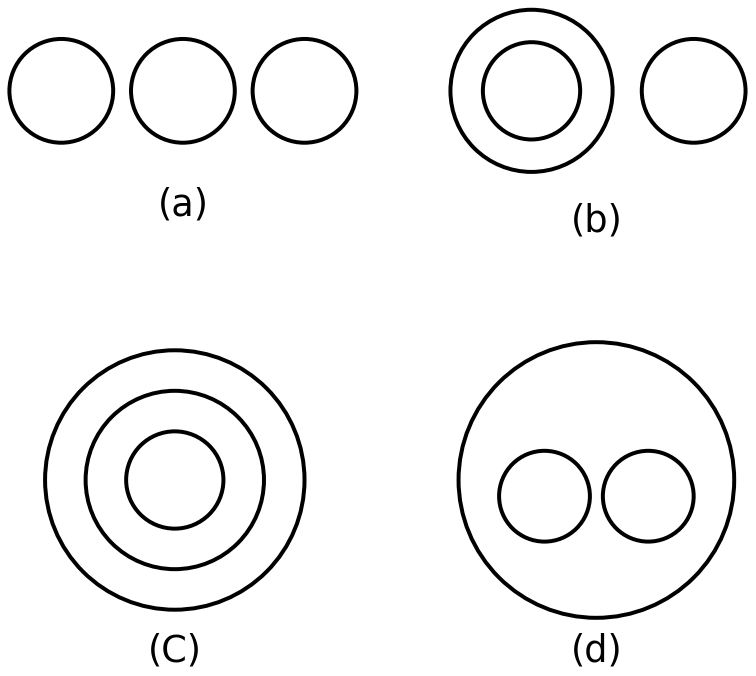
To solve this problem, we need to understand the relationships between the categories: engineers, professionals, and doctors. The statements given are:
We will use these statements to determine which Venn diagram correctly represents these relationships.
The correct diagram should show three circles: one circle inside another, and a third circle completely separate from these two.
Correct Option: C) The diagram shows a small circle (engineers) inside a medium circle (professionals), and both are separate from a large circle (doctors).
To answer this question, one needs to recall the chronological order of the prominent Mughal emperors who ruled India. The Mughal dynasty had a well-defined succession line, and knowing the sequence of rulers like Akbar, Jahangir, Shah Jahan, and Aurangzeb is fundamental for Indian history examinations.
Correct Option: B) Akbar - Jahangir - Shah Jahan - Aurangzeb
The question asks for the district in Rajasthan where the Indian nuclear test site, Pokhran, is located. This is a factual question related to Indian geography and history, specifically concerning India's nuclear program.
B) Jaisalmer — Pokhran is indeed located in the Jaisalmer district of Rajasthan. This is a widely known fact regarding India's nuclear test sites.
In the given circle, chords AB and CD intersect internally at P. If \(\overline{CP}\) = 3 cm and \(\overline{DP}\) = 8 cm, and the numerical values of the lengths of \(\overline{AP}\) and \(\overline{BP}\) are both natural numbers, then which of the following options CANNOT be the length of \(\overline{AB}\)?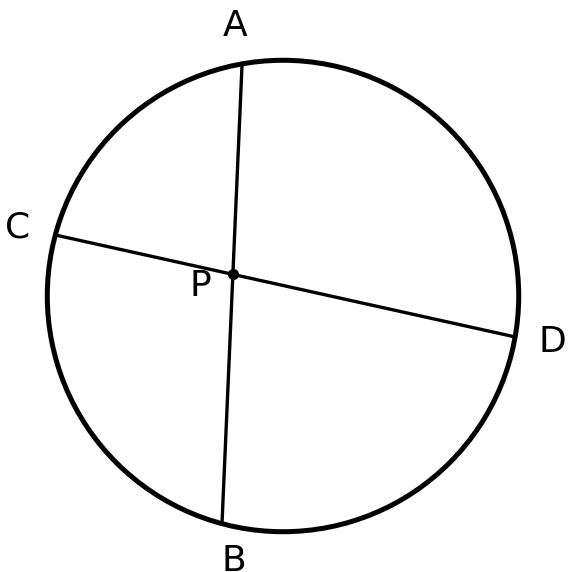
To solve this problem, we use the intersecting chords theorem, which states that if two chords intersect inside a circle, the products of the lengths of the segments of each chord are equal.
According to the theorem:
\[ \overline{AP} \times \overline{BP} = \overline{CP} \times \overline{DP} \]Substitute the given values:
\[ \overline{CP} = 3 \text{ cm}, \quad \overline{DP} = 8 \text{ cm} \] \[ \overline{AP} \times \overline{BP} = 3 \times 8 = 24 \]Thus, the possible lengths for \(\overline{AB}\) are 10 cm, 11 cm, and 14 cm.
Correct Option: B) 20 cm