
The question asks to identify the characteristic of non-volatile memory regarding its ability to retain information. We need to understand the definition of non-volatile memory and how it differs from volatile memory.
Correct Option: D) not powered
Non-volatile memory is specifically designed to retain stored information even when the computer or device is not powered. This is its defining characteristic, allowing data to be saved permanently (or semi-permanently) without continuous electricity.
To find the breadth of the rectangular field, we first need to determine its perimeter. The total cost of fencing and the cost per meter are given, which allows us to calculate the perimeter. Once the perimeter is known, we can use the formula for the perimeter of a rectangle, along with the given length, to find the breadth.
Calculate the perimeter of the field:
The total cost of fencing is ₹1,920, and the cost per meter is ₹24.
The perimeter is the total length of the fence.
\[ \text{Perimeter} = \frac{\text{Total cost of fencing}}{\text{Cost per meter}} \] \[ \text{Perimeter} = \frac{1920}{24} = 80 \text{ m} \]Use the perimeter formula for a rectangle:
The formula for the perimeter of a rectangle is:
\[ \text{Perimeter} = 2 \times (\text{Length} + \text{Breadth}) \]We know the perimeter is 80 m and the length is 23 m. Let the breadth be \(B\).
\[ 80 = 2 \times (23 + B) \]Solve for the breadth:
Divide both sides by 2:
\[ \frac{80}{2} = 23 + B \] \[ 40 = 23 + B \]Subtract 23 from both sides:
\[ B = 40 - 23 \] \[ B = 17 \text{ m} \]C) 17 m — The calculated breadth of the rectangular field is 17 m, which matches this option.
The question asks about the origin of the Khilafat Movement. This requires knowledge of the historical context and the primary cause of the movement, which was related to the status of the Ottoman Caliphate after World War I.
Correct Option: C) Turkey. The Khilafat Movement originated from concerns about the fate of the Ottoman Caliphate, which was based in Turkey, after World War I.
The problem asks us to identify which statement(s) are sufficient to determine the shortest person among A, B, C, D, and E. We need to analyze each statement individually and in combination to establish the height order of all five individuals.
Arun ranks 27th in the class. Vijay is 7 ranks ahead of Arun. Vijay's rank from the last is 36th. How many students are there in the class?
The problem involves determining the total number of students in a class based on the ranks of two individuals, Arun and Vijay. We need to use the given information about their ranks from the top and Vijay's rank from the last to find the total strength of the class.
Arun's rank from the top is 27th.
Vijay is 7 ranks ahead of Arun. This means Vijay's rank is better (lower number) than Arun's.
\[ \text{Vijay's rank from top} = \text{Arun's rank from top} - 7 \]\[ \text{Vijay's rank from top} = 27 - 7 = 20 \]We know Vijay's rank from the top is 20th.
We are given Vijay's rank from the last is 36th.
The total number of students in a row or class can be found using the formula:
\[ \text{Total students} = (\text{Rank from top} + \text{Rank from last}) - 1 \]Substitute Vijay's ranks into the formula:
\[ \text{Total students} = (20 + 36) - 1 \]\[ \text{Total students} = 56 - 1 \]\[ \text{Total students} = 55 \]Therefore, there are 55 students in the class.
Correct Option: D) 55
To find the least number that must be subtracted from 1391 such that the remainder, when divided by 7, 9, and 11, leaves the same remainder 3, we first need to find a number that leaves a remainder of 3 when divided by 7, 9, and 11. This number will be of the form \(k \times \text{LCM}(7, 9, 11) + 3\). We then find the largest such number less than or equal to 1391 and subtract it from 1391.
Since 7, 9, and 11 are pairwise coprime numbers (they share no common factors other than 1), their LCM is simply their product.
\[ \text{LCM}(7, 9, 11) = 7 \times 9 \times 11 = 63 \times 11 = 693 \]We are looking for a number, let's call it \(N\), such that when \(N\) is divided by 7, 9, or 11, the remainder is always 3. This means \(N\) can be expressed in the form:
\[ N = K \times \text{LCM}(7, 9, 11) + 3 \]\[ N = 693K + 3 \]We need to find the largest value of \(N\) (of the form \(693K + 3\)) that is less than or equal to 1391. Let's test values for \(K\):
So, the largest number of the form \(693K + 3\) that is less than or equal to 1391 is 1389.
The question asks for the least number that must be subtracted from 1391 so that the remainder is 1389. Let the number to be subtracted be \(x\).
\[ 1391 - x = 1389 \]\[ x = 1391 - 1389 \]\[ x = 2 \]D) 2 is the correct answer. When 2 is subtracted from 1391, the result is 1389. Dividing 1389 by 7 gives a remainder of 3 (\(1389 = 7 \times 198 + 3\)). Dividing 1389 by 9 gives a remainder of 3 (\(1389 = 9 \times 154 + 3\)). Dividing 1389 by 11 gives a remainder of 3 (\(1389 = 11 \times 126 + 3\)).
The problem presents a numerical series, and we need to find the missing term. We will analyze the relationship between consecutive terms to identify the pattern and then apply it to find the next number in the series.
Correct Option: B) 720
Study the given pattern carefully and select the number that can replace the question mark (?) in it.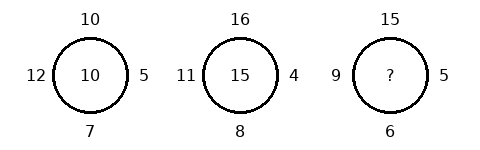
The problem involves identifying a pattern in the given circles and using it to find the missing number. Each circle has numbers around it, and a central number. The goal is to determine the relationship between these numbers.
Correct Option: C) 13
This problem involves setting up and solving a system of linear equations based on the given age relationships. We will define variables for the present ages of Lima and her father and then translate the given conditions into algebraic equations. Finally, we will solve these equations to find the father's present age.
Define variables for present ages:
Let Lima's present age be \(L\) years.
Let her father's present age be \(F\) years.
Formulate the first equation from the first condition:
"Lima's father is four times as old as Lima."
This translates to:
Determine ages four years ago:
Four years ago, Lima's age was \(L - 4\) years.
Four years ago, her father's age was \(F - 4\) years.
Formulate the second equation from the second condition:
"Four years ago, his father was six times as old as he was then."
This translates to:
Solve the system of equations:
Substitute Equation 1 into Equation 2:
Isolate \(L\):
Subtract \(4L\) from both sides:
Add \(24\) to both sides:
\[ 20 = 2L \]Divide by \(2\):
\[ L = 10 \]Find the father's present age (\(F\)):
Substitute the value of \(L\) back into Equation 1:
So, the present age of Lima's father is 40 years.
A) 40 years is the correct answer, as calculated from the given conditions.
The question asks to identify the option that does NOT support rural development. We need to evaluate each option to determine its relevance to improving rural areas.
Based on this analysis, 'Urban credit' is the option that does not directly support rural development.
Correct Option: B) Urban credit