
Which of the following is a rational number?
\((\sqrt{2}+\sqrt{5})^2\)
2 +\(\sqrt{5}\)
2 -\(\sqrt{5}\)
\(\left(\sqrt{2}+\frac{1}{\sqrt{8}}\right)^2\)
To identify the rational number among the given options, we need to simplify each expression. A rational number is any number that can be expressed as a fraction \(\frac{p}{q}\) where \(p\) and \(q\) are integers and \(q \neq 0\). An irrational number cannot be expressed in this form and typically involves non-repeating, non-terminating decimals, often arising from square roots of non-perfect squares.
Option A: \((\sqrt{2}+\sqrt{5})^2\)
Using the formula \((a+b)^2 = a^2 + 2ab + b^2\):
\[ (\sqrt{2}+\sqrt{5})^2 = (\sqrt{2})^2 + 2(\sqrt{2})(\sqrt{5}) + (\sqrt{5})^2 \] \[ = 2 + 2\sqrt{10} + 5 \] \[ = 7 + 2\sqrt{10} \]Since \(\sqrt{10}\) is an irrational number, \(7 + 2\sqrt{10}\) is also an irrational number.
Option B: \(2 + \sqrt{5}\)
Here, \(2\) is a rational number, but \(\sqrt{5}\) is an irrational number. The sum of a rational number and an irrational number is always an irrational number. Therefore, \(2 + \sqrt{5}\) is irrational.
Option C: \(2 - \sqrt{5}\)
Similar to Option B, \(2\) is rational and \(\sqrt{5}\) is irrational. The difference between a rational number and an irrational number is always an irrational number. Therefore, \(2 - \sqrt{5}\) is irrational.
Option D: \(\left(\sqrt{2}+\frac{1}{\sqrt{8}}\right)^2\)
First, simplify the term \(\frac{1}{\sqrt{8}}\):
\[ \frac{1}{\sqrt{8}} = \frac{1}{\sqrt{4 \times 2}} = \frac{1}{2\sqrt{2}} \]Rationalize the denominator:
\[ \frac{1}{2\sqrt{2}} = \frac{1}{2\sqrt{2}} \times \frac{\sqrt{2}}{\sqrt{2}} = \frac{\sqrt{2}}{2 \times 2} = \frac{\sqrt{2}}{4} \]Now substitute this back into the expression:
\[ \left(\sqrt{2}+\frac{\sqrt{2}}{4}\right)^2 \]Combine the terms inside the parenthesis:
\[ \left(\frac{4\sqrt{2}}{4}+\frac{\sqrt{2}}{4}\right)^2 = \left(\frac{5\sqrt{2}}{4}\right)^2 \]Now square the expression:
\[ \left(\frac{5\sqrt{2}}{4}\right)^2 = \frac{(5\sqrt{2})^2}{4^2} = \frac{5^2 \times (\sqrt{2})^2}{16} \] \[ = \frac{25 \times 2}{16} = \frac{50}{16} \]Simplify the fraction:
\[ \frac{50}{16} = \frac{25}{8} \]Since \(\frac{25}{8}\) can be expressed as a fraction of two integers (25 and 8) where the denominator is not zero, it is a rational number.
D) \(\left(\sqrt{2}+\frac{1}{\sqrt{8}}\right)^2\) simplifies to \(\frac{25}{8}\), which is a rational number.
The Vijayanagara empire was founded in the:
15th century
14th century
13th century
16th century
The question asks for the century in which the Vijayanagara empire was founded. This requires recalling the historical period of its establishment.
Correct Option: B) The Vijayanagara empire was founded in 1336 CE, which falls in the 14th century.
India secured the _____ rank on Global Innovation Index 2020.
The question asks for India's rank on the Global Innovation Index (GII) in 2020. This requires recalling specific factual information related to international reports and rankings.
Correct Option: D) 48 th
Study the following information carefully and answer the question that follows.
The following are the eligibility criteria for becoming a member of a library.
(i) The applicant should be able to pay a one-time membership fee of ₹10,000 and contribute two books worth ₹500.
(ii) The one-time membership fee is relaxed up to 50% if the applicant donates books worth ₹5,000 in total.
(iii) For school students, membership fee is relaxed till the age of 18 years.
(iv) Serving school teachers are required to pay only ₹2,000 if they help 20 students to become members of the library.
(v) Only for serving Defence personnel and their wards, the membership of the library is free of cost.
Data/information about an individual is given. You have to decide, based on the information provided, under which criterion/criteria is the individual eligible, if so, to get a membership. Please note that an individual can be eligible under more than one criteria. You are not to assume anything other than the information provided in each question.
Mr. A is 30-years-old and the son of a retired army officer. He is ready to pay a membership fee of ₹10,000 and contribute two books worth ₹500.
Eligible only under (v)
Not eligible
Eligible only under (i)
Eligible only under (ii) and (v)
We need to evaluate Mr. A's eligibility against each of the given criteria based on the provided information about him. We will check each criterion one by one to see if he meets the requirements.
Correct Option: C) Eligible only under (i)
In the following Venn diagram, the rectangle represents engineers, the circle represents the people who live in urban areas and the triangle represents the people who are in government jobs. Which letter represents engineers who live in urban areas and are in government jobs?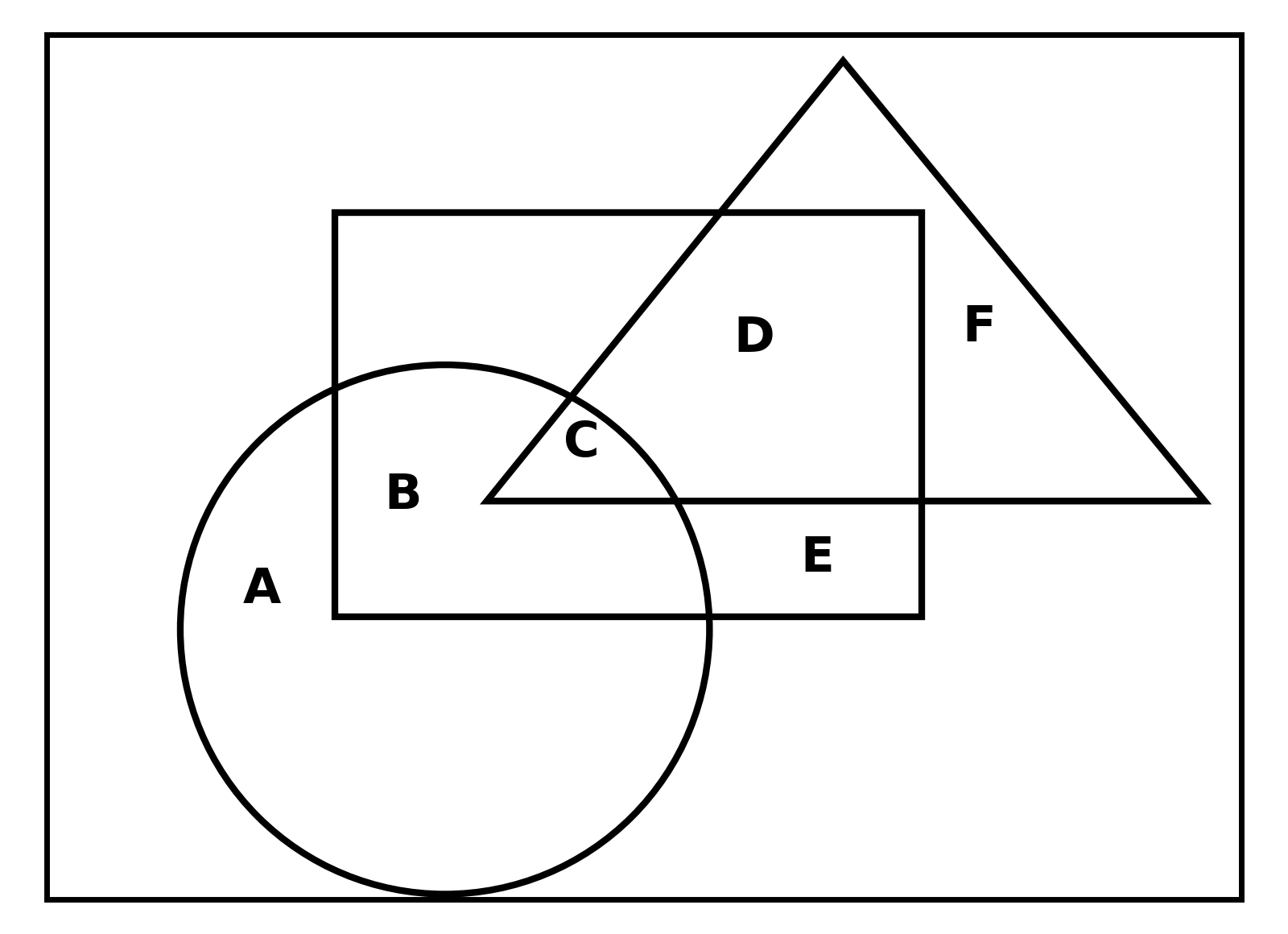
The Venn diagram consists of three shapes: a rectangle, a circle, and a triangle. Each shape represents a different group: engineers, people living in urban areas, and people in government jobs, respectively. We need to identify the region where all three groups overlap.
Correct Option: A) C
To find the HCF (Highest Common Factor) of decimal numbers, we first convert them into fractions with a common denominator. Then, we find the HCF of the numerators and the LCM (Lowest Common Multiple) of the denominators. The HCF of the decimal numbers will be the HCF of the numerators divided by the LCM of the denominators. Alternatively, we can express all numbers as integers by multiplying by a suitable power of 10, find their HCF, and then divide the result by the same power of 10.
Correct Option: C) 0.15
The question asks for the year in which the National Green Tribunal (NGT) Act was passed in India. This is a factual question related to environmental law and governance in India, which is a common topic in competitive exams.
Correct Option: B) 2010
The National Green Tribunal Act was passed in India in the year 2010. This Act led to the establishment of the National Green Tribunal, a specialized body for effective and expeditious disposal of cases relating to environmental protection and conservation of forests and other natural resources.
The problem involves simple interest. We are given the rate of interest, the time period, and a relationship between the simple interest earned and the principal (sum lent). We need to find the principal amount. We will use the formula for simple interest and set up an equation based on the given relationship.
Let the sum lent (Principal) be \(P\).
The rate of simple interest (\(R\)) is 4% per annum.
The time period (\(T\)) is 8 years.
The formula for Simple Interest (SI) is:
\[ \text{SI} = \frac{P \times R \times T}{100} \]Substitute the given values into the SI formula:
\[ \text{SI} = \frac{P \times 4 \times 8}{100} \]\[ \text{SI} = \frac{32P}{100} \]\[ \text{SI} = \frac{8P}{25} \]According to the problem statement, the interest amounted to ₹340 less than the sum lent. So, we can write the equation:
\[ \text{SI} = P - 340 \]Now, equate the two expressions for SI:
\[ \frac{8P}{25} = P - 340 \]To solve for \(P\), first multiply both sides by 25 to eliminate the denominator:
\[ 8P = 25(P - 340) \]\[ 8P = 25P - 25 \times 340 \]\[ 8P = 25P - 8500 \]Rearrange the terms to isolate \(P\):
\[ 8500 = 25P - 8P \]\[ 8500 = 17P \]Divide by 17 to find the value of \(P\):
\[ P = \frac{8500}{17} \]\[ P = 500 \]Therefore, the sum lent is ₹500.
Correct Option: C) ₹500
A vehicle before overhauling requires \( \frac{5}{6} \) h service time every 90 days, while after overhauling it requires \( \frac{5}{6} \) h service time every 120 days. What fraction of the pre-overhauling services time is saved in the latter case?
\( \frac{1}{4} \)
\( \frac{1}{6} \)
\( \frac{1}{3} \)
\( \frac{1}{2} \)
To find the fraction of service time saved, we need to calculate the service time required over a common period (e.g., a year or the least common multiple of 90 and 120 days) both before and after overhauling. Then, we can determine the saving and express it as a fraction of the pre-overhauling service time.
The least common multiple (LCM) of 90 and 120 is 360 days. We will calculate the service time over 360 days.
Each service takes \( \frac{5}{6} \) h.
\[ \text{Total service time (before)} = 4 \text{ services} \times \frac{5}{6} \text{ h/service} = \frac{20}{6} \text{ h} = \frac{10}{3} \text{ h} \]Each service takes \( \frac{5}{6} \) h.
\[ \text{Total service time (after)} = 3 \text{ services} \times \frac{5}{6} \text{ h/service} = \frac{15}{6} \text{ h} = \frac{5}{2} \text{ h} \]A) \( \frac{1}{4} \) is the correct fraction of service time saved, as calculated in the step-by-step explanation.
The question asks to identify the personality who attended all three Round Table Conferences held in London. This requires knowledge of the participants in these historical events.
Correct Option: A) B.R. Ambedkar is the correct answer because he was a delegate to all three Round Table Conferences (1930, 1931, and 1932) and strongly advocated for the rights of the depressed classes.