
To solve this problem, we need to find a number that, when subtracted from each of the given numbers (23, 40, 57, and 108), makes the resulting numbers proportional. If four numbers \(a, b, c, d\) are in proportion, then \[\frac{a}{b} = \frac{c}{d}\]. We can set up an equation based on this condition and solve for the unknown number.
Let the number to be subtracted from each of the given numbers be \(x\).
After subtracting \(x\), the new numbers will be:
For these numbers to be in proportion, the ratio of the first two must be equal to the ratio of the last two. So, we can write the equation:
\[ \frac{23 - x}{40 - x} = \frac{57 - x}{108 - x} \]Now, we cross-multiply to solve for \(x\):
\[ (23 - x)(108 - x) = (57 - x)(40 - x) \]Expand both sides of the equation:
Left side:
\[ 23 \times 108 - 23x - 108x + x^2 = 2484 - 131x + x^2 \]Right side:
\[ 57 \times 40 - 57x - 40x + x^2 = 2280 - 97x + x^2 \]Set the expanded expressions equal to each other:
\[ 2484 - 131x + x^2 = 2280 - 97x + x^2 \]Subtract \(x^2\) from both sides:
\[ 2484 - 131x = 2280 - 97x \]Rearrange the terms to solve for \(x\). Move \(x\) terms to one side and constants to the other:
\[ 2484 - 2280 = 131x - 97x \] \[ 204 = 34x \]Divide by 34 to find \(x\):
\[ x = \frac{204}{34} \] \[ x = 6 \]Alternatively, we can test the options. Let's test \(x=6\):
Check the proportion:
\[ \frac{17}{34} = \frac{1}{2} \] \[ \frac{51}{102} = \frac{1}{2} \]Since \[\frac{1}{2} = \frac{1}{2}\], the numbers are in proportion when 6 is subtracted.
Correct Option: D) 6
Select the Venn diagram that best represents the relationship between Currency, Economy, Rupee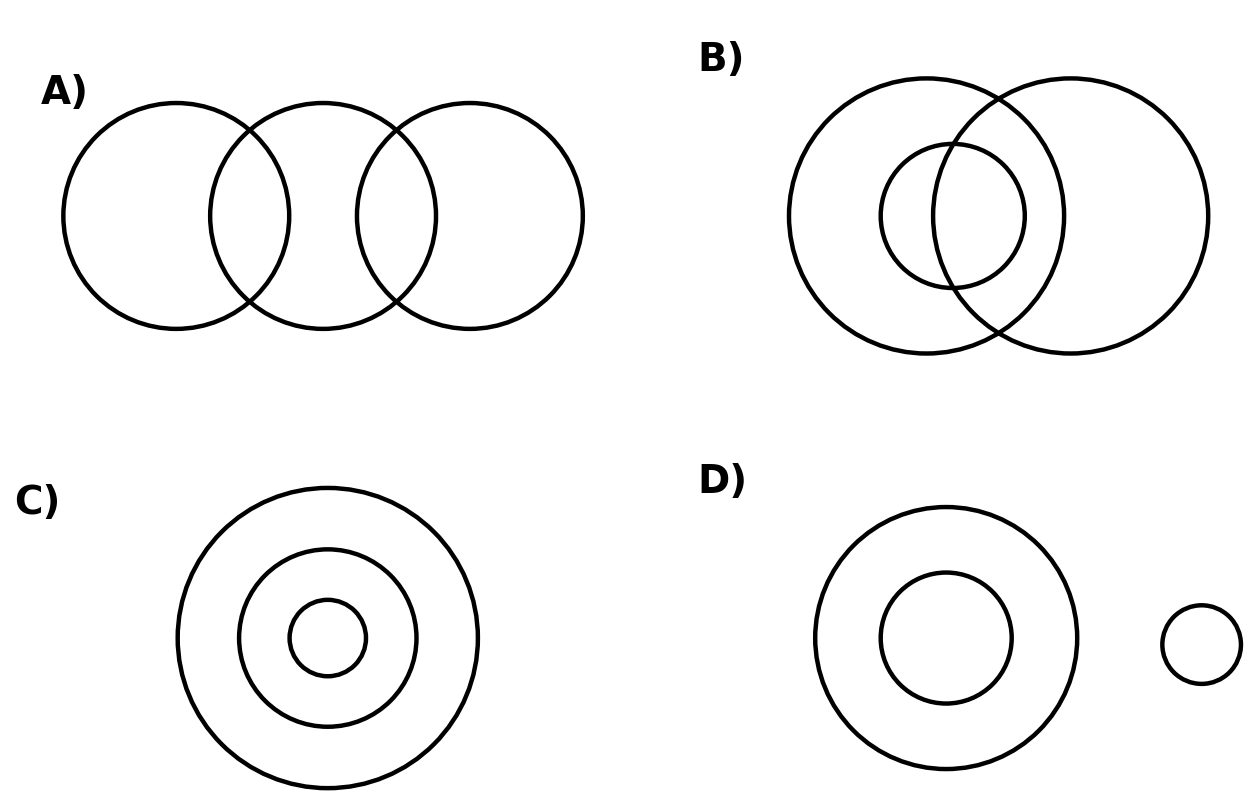
To determine the correct Venn diagram representing the relationship between Currency, Economy, and Rupee, we need to understand how these elements are interconnected. The Rupee is a type of Currency, and Currency is a part of the Economy.
Correct Option: C) Option C accurately represents the nested relationship between Rupee, Currency, and Economy.
We need to find the count of 3-digit numbers that leave a remainder of 1 when divided by 7. This means we are looking for numbers of the form \(7k + 1\), where \(k\) is an integer. We will identify the smallest and largest 3-digit numbers that satisfy this condition and then count them.
Identify the range of 3-digit numbers:
The smallest 3-digit number is 100.
The largest 3-digit number is 999.
Find the smallest 3-digit number that leaves a remainder of 1 when divided by 7:
We need to find the smallest integer \(N\) such that \(100 \le N \le 999\) and \(N = 7k + 1\).
Let's check numbers starting from 100:
A simpler way: Find the smallest 3-digit number divisible by 7. \(100 \div 7 = 14\) with remainder \(2\). So, \(100 - 2 = 98\) is divisible by 7. The next number divisible by 7 is \(98 + 7 = 105\).
For a number to leave a remainder of 1 when divided by 7, it must be of the form \(7k + 1\).
So, the smallest 3-digit number is \(105 + 1 = 106\). (Check: \(106 \div 7 = 15\) with remainder \(1\)).
Thus, the first term is \(a_1 = 106\).
Find the largest 3-digit number that leaves a remainder of 1 when divided by 7:
We need to find the largest integer \(N\) such that \(N \le 999\) and \(N = 7k + 1\).
Let's divide 999 by 7:
\[ 999 \div 7 = 142 \text{ with a remainder of } 5 \]This means \(999 = 7 \times 142 + 5\).
To get a remainder of 1, we need to subtract \(5 - 1 = 4\) from 999.
So, the largest number is \(999 - 4 = 995\). (Check: \(995 \div 7 = 142\) with remainder \(1\)).
Thus, the last term is \(a_n = 995\).
Count the numbers:
The numbers form an arithmetic progression: \(106, 113, 120, \dots, 995\), with a common difference of 7.
We use the formula for the \(n\)-th term of an arithmetic progression: \(a_n = a_1 + (n-1)d\).
Here, \(a_n = 995\), \(a_1 = 106\), and \(d = 7\).
\[ 995 = 106 + (n-1)7 \]\[ 995 - 106 = (n-1)7 \]\[ 889 = (n-1)7 \]\[ \frac{889}{7} = n-1 \]\[ 127 = n-1 \]\[ n = 127 + 1 \]\[ n = 128 \]Therefore, there are 128 such 3-digit numbers.
Correct Option: C) 128
The question asks to identify the Viceroy responsible for the partition of Bengal in 1905. This is a direct factual question from modern Indian history, specifically related to the British Raj period. Recalling the key events and the Viceroys associated with them is crucial.
Correct Option: A) Lord Curzon was the Viceroy who ordered the partition of Bengal in 1905. His tenure as Viceroy (1899-1905) is famously associated with this controversial decision.
Select the Venn diagram that best represents the relationship between Building, House, Field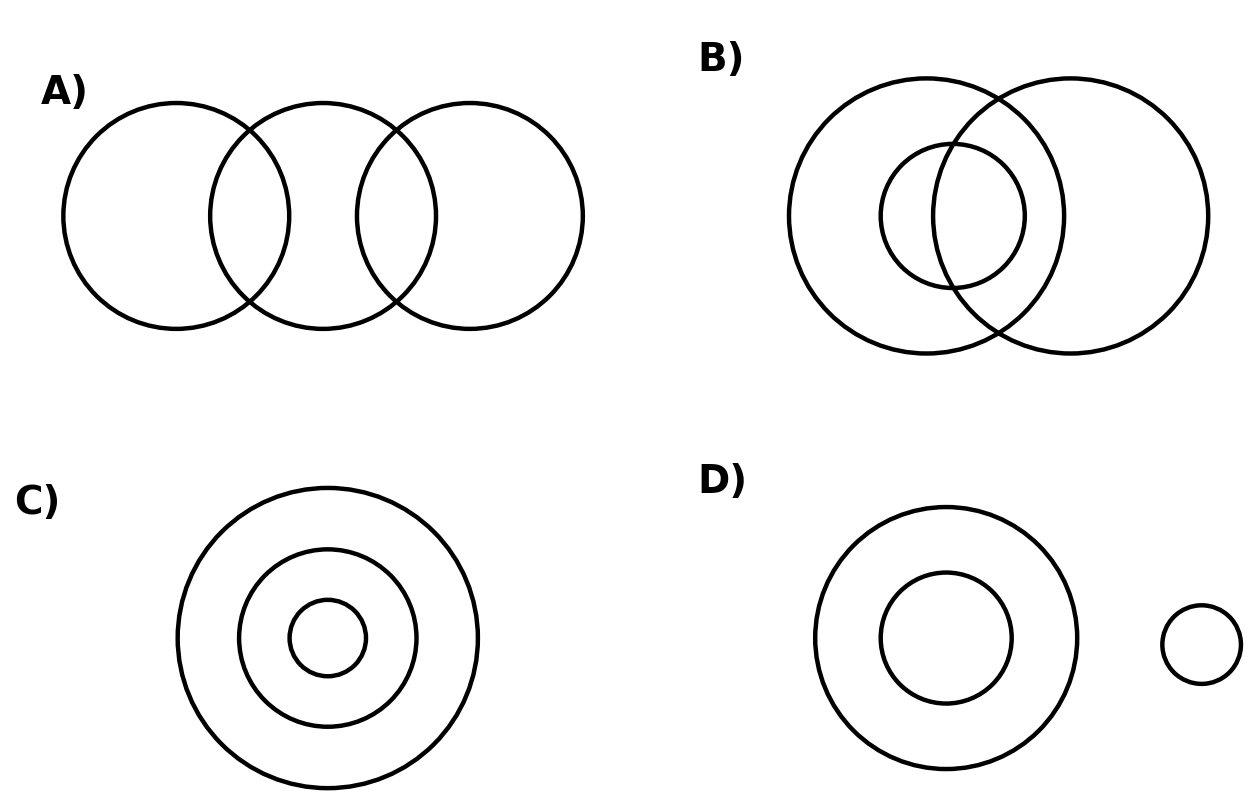
To solve this problem, we need to understand the relationship between the terms "Building," "House," and "Field." A house is a type of building, and a field is unrelated to both buildings and houses.
Correct Option: B) The diagram shows a small circle within a larger circle, and another separate circle, correctly representing the relationships.
The question asks to identify the individual who was NOT a member of the Cabinet Mission. This requires knowledge of the composition of the Cabinet Mission to India in 1946.
A) Sir John Simon
Sir John Simon was the chairman of the Simon Commission, which visited India in 1928 to study constitutional reforms. He was not a member of the Cabinet Mission in 1946.
This problem involves decoding relationships based on given symbols and then determining which option correctly represents "M is the daughter of N". We will analyze each option step-by-step to establish the gender and relationship between M and N.
Let's define the given symbols:
We need to find the option where M is the daughter of N. This means M must be female and N must be M's parent.
Correct Option: D) M/P*N
Simplify the given expression: 4 \(\frac{1}{10}-\left[2\frac{1}{2}-\left\{\frac{5}{6}-\left(\frac{2}{5}+\frac{3}{10}\right)\right\}\right]\)
\( \frac{19}{15} \)
\( \frac{12}{25} \)
\( \frac{26}{15} \)
\( \frac{31}{25} \)
To simplify the given expression, we will follow the order of operations (BODMAS/PEMDAS), starting with the innermost parentheses, then brackets, and finally the curly braces, converting mixed fractions to improper fractions at each step.
The given expression is:
\[ 4\frac{1}{10}-\left[2\frac{1}{2}-\left\{\frac{5}{6}-\left(\frac{2}{5}+\frac{3}{10}\right)\right\}\right] \]\[ = \frac{41}{10}-\left[\frac{5}{2}-\left\{\frac{5}{6}-\left(\frac{2}{5}+\frac{3}{10}\right)\right\}\right] \]First, calculate the sum inside the parentheses:
\[ \left(\frac{2}{5}+\frac{3}{10}\right) \]Find a common denominator, which is 10:
\[ = \left(\frac{2 \times 2}{5 \times 2}+\frac{3}{10}\right) \]\[ = \left(\frac{4}{10}+\frac{3}{10}\right) \]\[ = \frac{4+3}{10} \]\[ = \frac{7}{10} \]Now substitute this value back into the expression:
\[ \frac{41}{10}-\left[\frac{5}{2}-\left\{\frac{5}{6}-\frac{7}{10}\right\}\right] \]\[ \left\{\frac{5}{6}-\frac{7}{10}\right\} \]Find a common denominator for 6 and 10, which is 30:
\[ = \left\{\frac{5 \times 5}{6 \times 5}-\frac{7 \times 3}{10 \times 3}\right\} \]\[ = \left\{\frac{25}{30}-\frac{21}{30}\right\} \]\[ = \frac{25-21}{30} \]\[ = \frac{4}{30} \]\[ = \frac{2}{15} \]Now substitute this value back into the expression:
\[ \frac{41}{10}-\left[\frac{5}{2}-\frac{2}{15}\right] \]\[ \left[\frac{5}{2}-\frac{2}{15}\right] \]Find a common denominator for 2 and 15, which is 30:
\[ = \left[\frac{5 \times 15}{2 \times 15}-\frac{2 \times 2}{15 \times 2}\right] \]\[ = \left[\frac{75}{30}-\frac{4}{30}\right] \]\[ = \frac{75-4}{30} \]\[ = \frac{71}{30} \]Finally, perform the last subtraction:
\[ \frac{41}{10}-\frac{71}{30} \]Find a common denominator for 10 and 30, which is 30:
\[ = \frac{41 \times 3}{10 \times 3}-\frac{71}{30} \]\[ = \frac{123}{30}-\frac{71}{30} \]\[ = \frac{123-71}{30} \]\[ = \frac{52}{30} \]\[ = \frac{26}{15} \]Correct Option: C) \( \frac{26}{15} \)
The problem presents a series of letter-clusters. We need to identify the pattern in the sequence of letters within each cluster and the pattern between consecutive clusters to find the missing cluster.
D) TUV — This option fits both patterns: the first letter is T (which is 4 letters after P), and the letters within the cluster (T, U, V) are consecutive.
The problem asks us to identify the odd one out from four given letter-clusters. We need to find a pattern or rule that applies to three of the clusters and not to the fourth one. This type of problem usually involves analyzing the alphabetical positions of the letters or the sequence in which they appear.
Comparing the patterns:
Therefore, MNQ is the odd one out.
C) MNQ — This cluster does not follow the pattern of consecutive letters. While M and N are consecutive, Q is not immediately after N. There are two letters (O, P) between N and Q.