The question asks to identify the individual who served as the President of the Indian National Congress for two consecutive years, 1938 and 1939. This requires knowledge of the history of the Indian National Congress and its presidential elections during that period.
Correct Option: D) Subhash Chandra Bose was elected President of the Indian National Congress in 1938 (Haripura Session) and again in 1939 (Tripuri Session).
This question tests knowledge about the institutional mechanisms and their leadership within the Indian government, specifically focusing on committees related to trade and economic relations. Identifying the head of such a high-level committee requires understanding the hierarchy and functional roles of key government positions.
Correct Option: A) Prime Minister
The question asks to identify the UNESCO World Heritage site that was removed from the "World Heritage in Danger" list in 2019. This requires knowledge of specific UNESCO decisions regarding heritage sites.
Correct Option: C) Birthplace of Jesus in Bethlehem — This site was removed from UNESCO's "World Heritage in Danger" list in 2019 after successful restoration efforts, particularly on the Church of the Nativity.
The question asks to identify the region where the 'Ryotwari settlement' revenue system was primarily introduced. This requires knowledge of British colonial land revenue systems in India and their geographical implementation.
Correct Option: C) The Ryotwari settlement was primarily introduced in the Madras and Bombay Presidencies. The Bombay Deccan region was a significant area where this system was implemented, making the cultivators (ryots) directly responsible for paying land revenue to the British government.
The question asks to identify which observation indicates that a chemical reaction has NOT occurred. A chemical reaction involves the formation of new substances with different chemical properties. We need to distinguish between physical changes and chemical changes.
Correct Option: B) Change in size
The question asks to identify the factor that does NOT contribute to speciation. Speciation is the evolutionary process by which new biological species arise from existing ones. This typically involves reproductive isolation and genetic divergence.
Re-evaluation: Divergent evolution is the process *of* speciation, where populations diverge. The other options (Genetic drift, Variation, Geographic isolation) are mechanisms or conditions that *drive* or *enable* this divergence. Therefore, divergent evolution is the overarching process, not a separate contributing factor in the same sense as the others.
A) Divergent evolution is the process by which populations accumulate differences and evolve into new species. It is the outcome or the phenomenon of speciation itself, rather than a distinct contributing factor or mechanism that *causes* the divergence in the same way genetic drift, variation, or geographic isolation do. The other options are mechanisms or necessary conditions for divergent evolution to occur, which then leads to speciation.
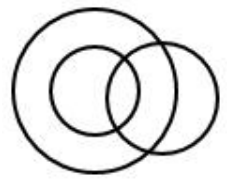
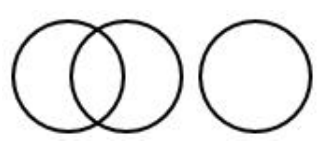
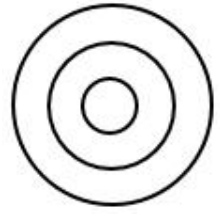
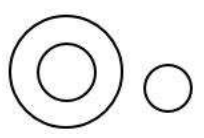
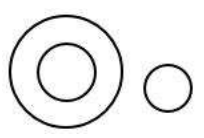
Which of the following Venn diagrams best represents the relationship between the classes: Cows, Ducks, Birds
To determine the correct Venn diagram representation, we need to understand the relationship between the classes: Cows, Ducks, and Birds.
Correct Option: D) The Venn diagram correctly represents Ducks as a subset of Birds, with Cows separate.
Study the given pattern carefully and select the number that can replace the question mark (?) in it.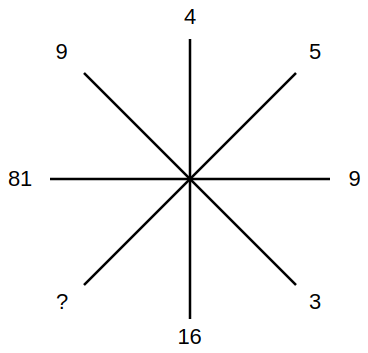
The diagram shows a pattern with numbers arranged around a central point. The goal is to identify the relationship between these numbers and find the missing number represented by a question mark.
The number that replaces the question mark is \(25\).
Correct Option: B) 25
A pillar is divided into three parts. The first part is \( \frac{1}{4} \) of the whole, second part is \( \frac{4}{8} \) of the first, and the third is 10 m. The length of the pillar is:
Let the total length of the pillar be \(L\). We are given the lengths of three parts of the pillar in terms of fractions of the total length or of other parts, and the absolute length of the third part. We will express the lengths of all parts in terms of \(L\) and then sum them up to equate to \(L\) to find the total length.
Let the total length of the pillar be \(L\) meters.
The first part of the pillar is \( \frac{1}{4} \) of the whole.
\[ \text{Length of first part} = \frac{1}{4} L \]The second part is \( \frac{4}{8} \) of the first part. Note that \( \frac{4}{8} \) simplifies to \( \frac{1}{2} \).
\[ \text{Length of second part} = \frac{1}{2} \times (\text{Length of first part}) \]\[ \text{Length of second part} = \frac{1}{2} \times \left(\frac{1}{4} L\right) \]\[ \text{Length of second part} = \frac{1}{8} L \]The third part is given as 10 m.
\[ \text{Length of third part} = 10 \text{ m} \]The sum of the lengths of all three parts must equal the total length of the pillar, \(L\).
\[ \text{Length of first part} + \text{Length of second part} + \text{Length of third part} = L \]\[ \frac{1}{4} L + \frac{1}{8} L + 10 = L \]Combine the terms with \(L\):
\[ \left(\frac{1}{4} + \frac{1}{8}\right) L + 10 = L \]\[ \left(\frac{2}{8} + \frac{1}{8}\right) L + 10 = L \]\[ \frac{3}{8} L + 10 = L \]Now, solve for \(L\):
\[ 10 = L - \frac{3}{8} L \]\[ 10 = \left(1 - \frac{3}{8}\right) L \]\[ 10 = \left(\frac{8}{8} - \frac{3}{8}\right) L \]\[ 10 = \frac{5}{8} L \]Multiply both sides by \( \frac{8}{5} \) to find \(L\):
\[ L = 10 \times \frac{8}{5} \]\[ L = 2 \times 8 \]\[ L = 16 \text{ m} \]Thus, the length of the pillar is 16 m.
Correct Option: C) 16 m
The problem involves calculating simple interest for three different investments and finding the ratio of these investments given that the interest earned from each scheme is the same. We will use the formula for simple interest: \(I = \frac{P \times R \times T}{100}\), where \(I\) is the interest, \(P\) is the principal investment, \(R\) is the rate of interest, and \(T\) is the time period.
Let the three investments be \(P_1\), \(P_2\), and \(P_3\).
The given data for the three schemes are:
The simple interest for each scheme is given by:
According to the problem, the interest earned from each scheme is the same. So, \(I_1 = I_2 = I_3\).
\[ \frac{60 P_1}{100} = \frac{120 P_2}{100} = \frac{180 P_3}{100} \]
We can cancel out the denominator 100 from all terms:
\[ 60 P_1 = 120 P_2 = 180 P_3 \]
To find the ratio \(P_1 : P_2 : P_3\), we can divide all terms by the greatest common divisor (GCD) of 60, 120, and 180. The GCD of 60, 120, and 180 is 60.
Dividing by 60:
\[ \frac{60 P_1}{60} = \frac{120 P_2}{60} = \frac{180 P_3}{60} \]
\[ P_1 = 2 P_2 = 3 P_3 \]
Now, we need to express this relationship as a ratio. Let \(P_1 = 2 P_2 = 3 P_3 = k\) (where \(k\) is a constant).
The ratio \(P_1 : P_2 : P_3\) is:
\[ k : \frac{k}{2} : \frac{k}{3} \]
To remove the fractions, multiply all terms by the least common multiple (LCM) of the denominators (2 and 3), which is 6.
\[ 6 \times k : 6 \times \frac{k}{2} : 6 \times \frac{k}{3} \]
\[ 6k : 3k : 2k \]
Dividing by \(k\), we get the ratio:
\[ 6 : 3 : 2 \]
Correct Option: C) 6:3:2