
Study the given pattern carefully and select the number that can replace the question mark (?) in it.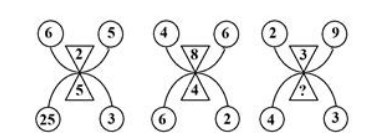
The given diagram consists of three sets of numbers arranged in a triangular pattern. We need to identify the rule governing the numbers and apply it to find the missing number represented by a question mark.
Correct Option: C) 2
This is a blood relation problem. To solve such problems, we break down the complex statement into smaller, simpler relationships, starting from the end of the statement and working backward to the beginning. This helps in identifying the direct relationship between the two individuals mentioned.
Let's re-break down: "the only brother/sister of your brother's wife."
Ramesh's brother's wife = Sister-in-law of Ramesh.
The only brother/sister of Ramesh's sister-in-law. This person is either the brother of Ramesh's sister-in-law OR the sister of Ramesh's sister-in-law.
If it's the brother of Ramesh's sister-in-law, he is Ramesh's brother-in-law (from his sister-in-law's side).
If it's the sister of Ramesh's sister-in-law, she is also Ramesh's sister-in-law (from his sister-in-law's side).
The problem states "the ONLY nephew of..." This implies the person in the next step is male. So, we are looking for the "only nephew" of the person identified in step 2. This means the person in step 2 must have a sibling who has a son. Let's trace it again.
Let's simplify the chain from Ramesh's side:
1. "your brother's wife" \(\rightarrow\) Ramesh's Sister-in-law.
2. "the only brother/sister of your brother's wife" \(\rightarrow\) The only sibling of Ramesh's Sister-in-law. This person could be Ramesh's Sister-in-law's brother (i.e., Ramesh's Brother-in-law) OR Ramesh's Sister-in-law's sister (i.e., Ramesh's Sister-in-law).
3. "the only nephew of the only brother/sister of your brother's wife" \(\rightarrow\) The only nephew of the person identified in step 2. For someone to have an "only nephew", they must have a sibling who has a son. Given the context of blood relations, this usually refers to the son of the sibling of the person in step 2.
Let's consider the two cases for step 2:
In both plausible interpretations of "only brother/sister of your brother's wife", the "only nephew" refers to Ramesh's Nephew (son of Ramesh's brother).
4. "I am the grandfather of the only nephew of the only brother/sister of your brother's wife." \(\rightarrow\) Sultan is the grandfather of Ramesh's Nephew. This means Sultan is the father of Ramesh's brother, or the father of Ramesh. Since Sultan is the grandfather of Ramesh's nephew, and Ramesh's nephew is the son of Ramesh's brother, Sultan must be the father of Ramesh's brother. Therefore, Sultan is also the father of Ramesh.
Thus, Sultan is Ramesh's father.
D) Son — If Sultan is Ramesh's father, then Ramesh is Sultan's son.
If a = \( \frac{b^2}{b-a} \), then the value of \( a^{3} + b^{3} \) is:
The problem provides an equation relating variables \(a\) and \(b\). We need to find the value of the expression \(a^3 + b^3\). The key is to manipulate the given equation algebraically to simplify it and then substitute or recognize a standard algebraic identity.
Start with the given equation:
\[ a = \frac{b^2}{b-a} \]Multiply both sides by \((b-a)\) to eliminate the denominator:
\[ a(b-a) = b^2 \]Distribute \(a\) on the left side:
\[ ab - a^2 = b^2 \]Rearrange the terms to bring all terms to one side. We want to see if this resembles any known identity or can be manipulated further:
\[ 0 = b^2 + a^2 - ab \]Now, consider the expression we need to evaluate: \(a^3 + b^3\). This is a standard algebraic identity:
\[ a^3 + b^3 = (a+b)(a^2 - ab + b^2) \]From step 4, we found that \(a^2 - ab + b^2 = 0\). Substitute this into the identity for \(a^3 + b^3\):
\[ a^3 + b^3 = (a+b)(0) \]Any number multiplied by zero is zero:
\[ a^3 + b^3 = 0 \]C) 0 — By manipulating the given equation \(a = \frac{b^2}{b-a}\), we derived \(a^2 - ab + b^2 = 0\). Substituting this into the algebraic identity for the sum of cubes, \(a^3 + b^3 = (a+b)(a^2 - ab + b^2)\), directly yields \(a^3 + b^3 = (a+b)(0) = 0\).
The question asks to identify the first Indian athlete to win a medal at the IAAF World Championships in Athletics in 2003. This requires knowledge of Indian sports history, specifically achievements in international athletics.
A) Anju Bobby George — Anju Bobby George created history by winning a bronze medal in the long jump at the 2003 IAAF World Championships in Athletics held in Paris. Her jump of 6.70 meters secured India's first-ever medal at this prestigious global athletics event.
The question asks to identify the city where a statue of Lal Bahadur Shastri is located at its airport. This is a factual question related to general knowledge about prominent Indian personalities and their memorials.
D) Varanasi — Varanasi International Airport is named after Lal Bahadur Shastri, and a statue of him is present at the airport, honoring his legacy. This makes Varanasi the correct answer.
The question asks to identify an ancient underground water channel system designed for irrigation, where water flows by gravity using a slope. We need to evaluate each option based on this description.
B) Qanats — Qanats are indeed ancient underground water channels, developed in arid regions, that tap into groundwater and transport it via a gentle slope using gravity for irrigation and other uses. This system minimizes water loss due to evaporation.
The question asks for the year when James Prinsep deciphered the Ashokan edicts written in the Brahmi script. This is a direct factual question from ancient Indian history, specifically related to the decipherment of ancient scripts.
Correct Option: C) 1837
To find the missing number in the series, we need to identify the pattern or relationship between consecutive terms. We will calculate the differences between adjacent numbers to see if there is a constant difference or a pattern in the differences.
Correct Option: C) 315
Study the given pattern carefully and select the number that can replace the question mark (?) in it.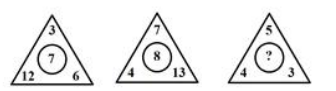
The problem involves finding a pattern among numbers arranged in a triangular format with a central circle. Each triangle has three numbers on its vertices and a number inside the circle. We need to identify the pattern to determine the missing number in the circle of the third triangle.
Correct Option: D) 4
The problem is based on a coding-decoding pattern. We need to identify the rule used to transform "DRAGON" into "BPYEML" and then apply the same rule to "STARK" to find its coded form.
Let's write down the letters of DRAGON and BPYEML and their corresponding positions in the alphabet (A=1, B=2, ...).
Observe the change in position for each letter:
The pattern is consistent: each letter is shifted two positions backward in the alphabet.
Now, apply the "minus 2" rule to each letter of STARK:
Combining the coded letters, STARK becomes QRYPI.
C) QRYPI is the correct answer as it matches the derived coded word.