
The question asks for the location of the Tata Institute of Fundamental Research (TIFR). This is a factual question requiring knowledge of prominent research institutions in India and their geographical locations.
Correct Option: A) Mumbai is the correct location for the main campus of the Tata Institute of Fundamental Research (TIFR).
The problem describes a coding language where 'PQRS' is coded as 'HIJK'. We need to find the code for 'XYZA' using the same logic. This is a letter coding problem, which typically involves finding a pattern in the alphabetical positions or a transformation rule between the given letters.
D) PQRS — As derived in the step-by-step explanation, applying the backward shift of 8 positions to each letter of 'XYZA' results in 'PQRS'.
This is a syllogism problem. We need to analyze the given statements and determine if the conclusions logically follow. We can use Venn diagrams to visualize the relationships between the categories mentioned in the statements.
Analyze Statement I: All cars are eatable goods.
This means that the set of "Cars" is entirely contained within the set of "Eatable Goods".
Analyze Statement II: All geysers are eatable goods.
This means that the set of "Geysers" is entirely contained within the set of "Eatable Goods".
Visualize with Venn Diagrams:
Imagine a large circle representing "Eatable Goods". Inside this large circle, there are two smaller circles: one for "Cars" and one for "Geysers".
Based on the statements, we know that both the "Cars" circle and the "Geysers" circle are inside the "Eatable Goods" circle. However, the statements do not provide any information about the relationship between "Cars" and "Geysers".
The "Cars" circle could be completely separate from the "Geysers" circle, or they could partially overlap, or one could be entirely inside the other (though this is less likely given the general nature of these items). Since no direct relationship is stated, we cannot assume any overlap.
Evaluate Conclusion (i): Some cars are geysers.
This conclusion implies that there is an overlap between the set of "Cars" and the set of "Geysers". As discussed in step 3, the statements only place both "Cars" and "Geysers" within "Eatable Goods". They do not provide any information about their intersection. Therefore, we cannot conclude that "Some cars are geysers".
Evaluate Conclusion (ii): Some geysers are cars.
This conclusion is essentially the same as conclusion (i), just rephrased. If "Some cars are geysers" is not true, then "Some geysers are cars" also cannot be true. Again, the statements do not provide any information about the overlap between "Geysers" and "Cars".
Final Decision:
Since neither conclusion (i) nor conclusion (ii) can be logically derived from the given statements, neither conclusion follows.
Correct Option: D) Neither conclusion (i) nor (ii) follows.
The question asks to identify the device used as a lie detector. This requires knowledge of various scientific instruments and their functions.
Correct Option: D) A polygraph is an instrument that measures and records several physiological indices such as blood pressure, pulse, respiration, and skin conductivity while a person is asked and answers a series of questions. The belief is that deceptive answers will produce physiological responses that can be differentiated from those associated with non-deceptive answers.
If tan 15° = 2-\(\sqrt{3}\), what is the value of tan 15° cot 75° + tan 75° cot 15°.
The problem asks us to evaluate an expression involving trigonometric ratios of 15° and 75°. We are given the value of \(\tan 15^\circ\). We will use trigonometric identities to simplify the expression and substitute the given value.
First, let's recall the relationship between tangent and cotangent: \(\cot \theta = \frac{1}{\tan \theta}\). Also, we know that \(\tan (90^\circ - \theta) = \cot \theta\).
Let's express \(\cot 75^\circ\) in terms of tangent:
\[ \cot 75^\circ = \tan (90^\circ - 75^\circ) = \tan 15^\circ \]Similarly, let's express \(\tan 75^\circ\) in terms of cotangent of 15° or tangent of 15°:
\[ \tan 75^\circ = \cot (90^\circ - 75^\circ) = \cot 15^\circ \]\[ \tan 75^\circ = \frac{1}{\tan 15^\circ} \]Now substitute these into the given expression: \(\tan 15^\circ \cot 75^\circ + \tan 75^\circ \cot 15^\circ\).
Using the identities from step 2 and 3:
\[ \tan 15^\circ \cot 75^\circ + \tan 75^\circ \cot 15^\circ = \tan 15^\circ (\tan 15^\circ) + (\cot 15^\circ) \cot 15^\circ \]\[ = \tan^2 15^\circ + \cot^2 15^\circ \]We are given \(\tan 15^\circ = 2 - \sqrt{3}\). So, \(\cot 15^\circ = \frac{1}{\tan 15^\circ}\).
\[ \cot 15^\circ = \frac{1}{2 - \sqrt{3}} \]Rationalize the denominator for \(\cot 15^\circ\):
\[ \cot 15^\circ = \frac{1}{2 - \sqrt{3}} \times \frac{2 + \sqrt{3}}{2 + \sqrt{3}} = \frac{2 + \sqrt{3}}{2^2 - (\sqrt{3})^2} = \frac{2 + \sqrt{3}}{4 - 3} = 2 + \sqrt{3} \]Now substitute the values of \(\tan 15^\circ\) and \(\cot 15^\circ\) into the expression \(\tan^2 15^\circ + \cot^2 15^\circ\):
\[ \tan^2 15^\circ = (2 - \sqrt{3})^2 = 2^2 - 2(2)(\sqrt{3}) + (\sqrt{3})^2 = 4 - 4\sqrt{3} + 3 = 7 - 4\sqrt{3} \]\[ \cot^2 15^\circ = (2 + \sqrt{3})^2 = 2^2 + 2(2)(\sqrt{3}) + (\sqrt{3})^2 = 4 + 4\sqrt{3} + 3 = 7 + 4\sqrt{3} \]Add these two values:
\[ \tan^2 15^\circ + \cot^2 15^\circ = (7 - 4\sqrt{3}) + (7 + 4\sqrt{3}) = 7 - 4\sqrt{3} + 7 + 4\sqrt{3} = 14 \]B) The calculated value of the expression is 14.
The question asks for the geographical location of the Sahara Desert. This requires general knowledge of world geography, specifically the major deserts and their continental placements.
The Sahara Desert is famously located across a vast expanse of North Africa, covering much of the northern part of the continent.
B) North Africa - The Sahara Desert spans across eleven countries in North Africa, making it the largest hot desert in the world. Its immense size and location are fundamental geographical facts.
The question asks to identify the primary memory of a computer. We need to understand the different types of computer memory and their roles to determine which one is considered primary memory.
A) RAM (Random Access Memory) is the primary memory of a computer. It is directly accessed by the CPU and holds data and instructions that are actively being used.
Study the given pattern carefully and select the letter that can replace the question mark (?) in it. 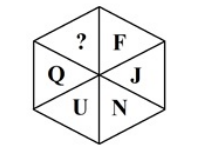
To solve this problem, we need to identify the pattern or sequence in the given diagram and determine which letter should replace the question mark.
Correct Option: C) M
If 0.02x = 0.5y, then find the value of \(\frac{x-y}{x+y}\) is:
\( \frac{13}{12} \)
\( \frac{11}{12} \)
\( \frac{12}{13} \)
\( \frac{11}{13} \)
The problem asks us to find the value of an expression involving \(x\) and \(y\), given a relationship between \(x\) and \(y\). The key is to first establish the ratio of \(x\) to \(y\) from the given equation and then substitute this ratio into the expression we need to evaluate.
Establish the relationship between \(x\) and \(y\):
We are given the equation:
\[ 0.02x = 0.5y \]Convert decimals to fractions (optional but can simplify calculations):
Rewrite the decimals as fractions:
\[ \frac{2}{100}x = \frac{5}{10}y \]\[ \frac{1}{50}x = \frac{1}{2}y \]Find the ratio \(\frac{x}{y}\):
To find the ratio \(\frac{x}{y}\), we can rearrange the equation:
\[ \frac{x}{y} = \frac{1/2}{1/50} \]\[ \frac{x}{y} = \frac{1}{2} \times 50 \]\[ \frac{x}{y} = 25 \]Express \(x\) in terms of \(y\) (or vice versa):
From \(\frac{x}{y} = 25\), we get \(x = 25y\).
Substitute the value of \(x\) into the expression \(\frac{x-y}{x+y}\):
Substitute \(x = 25y\) into the given expression:
\[ \frac{x-y}{x+y} = \frac{25y - y}{25y + y} \]\[ = \frac{24y}{26y} \]Simplify the expression:
Cancel out \(y\) from the numerator and denominator (assuming \(y \neq 0\), which must be true for the initial equation to hold meaningfully for \(x\)):
\[ = \frac{24}{26} \]\[ = \frac{12}{13} \]C) \( \frac{12}{13} \) is the correct answer, as derived from the step-by-step calculation.
The rectangle represents a set of calculations that are common across all the given equations. Identify the calculations involved and solve the third equation on the same basis: 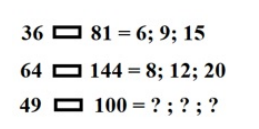
The problem involves identifying a pattern or calculation that links the numbers in each equation. We need to apply the same pattern to solve the third equation.
Correct Option: D) 7; 10; 17