
The question asks to identify the sport in which Meena Kumari Maisnam won a gold medal in Germany in April 2019. This is a factual question related to sports and current affairs.
Correct Option: A) Boxing
This question presents a series of alphanumeric clusters. To find the missing cluster, we need to identify the pattern for each component: the first letter, the number, and the second letter.
The first letter is M, the number is 25, and the second letter is L. Therefore, the missing cluster is M25L.
A) M25L is the correct cluster, as it follows all three identified patterns for the letters and the number.
To find the selling price when there is a loss, we first calculate the amount of loss based on the given percentage and cost price. Then, we subtract this loss amount from the cost price to get the selling price.
Correct Option: C) ₹63 is the selling price when the cost price is ₹70 and the loss is 10%.
Study the given pattern carefully and select the letter that can replace the question mark (?) in it.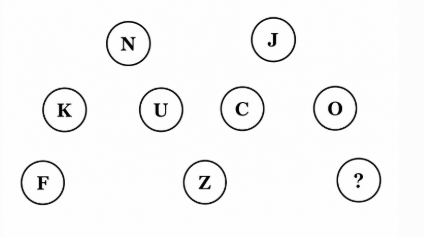
To solve this problem, we need to identify the pattern in the sequence of letters shown in the diagram. Each letter corresponds to a position in the alphabet, and the goal is to find the relationship between these positions to determine the missing letter.
Correct Option: B) R
The question asks to identify the first Guru of the Sikh religion. This is a direct factual question related to the history of Sikhism. Recalling the lineage of the Sikh Gurus is essential to answer this question correctly.
Correct Option: B) Shri Guru Nanak Dev Ji is universally recognized as the founder of Sikhism and the first of the ten Sikh Gurus. He established the core principles of the faith.
The question asks to identify the first crewed spacecraft to land on the Moon. This is a direct factual recall question related to space exploration history. We need to recall the details of the Apollo program and the Soviet Luna program.
Correct Option: C) Apollo 11 was the first crewed spacecraft to successfully land on the Moon on July 20, 1969, as part of NASA's Apollo program. Astronauts Neil Armstrong and Buzz Aldrin were the first two humans to walk on the lunar surface.
The question asks to identify the Indian who received the Nobel Prize in Economic Sciences. This requires knowledge of Nobel laureates from India, specifically in the field of economics.
Correct Option: D) Amartya Sen was awarded the Nobel Memorial Prize in Economic Sciences in 1998 for his contributions to welfare economics and social choice theory, and for his interest in the problems of society's poorest members.
To solve this problem, we first need to find the original number. We are given a fraction of the number and its value. We can set up an equation to find the number and then calculate one-fifth of that number.
Let the number be \(x\).
"One-fourth of one-eighth of a number is 300" can be written as:
\[ \frac{1}{4} \times \frac{1}{8} \times x = 300 \]Multiply both sides by 32:
\[ x = 300 \times 32 \] \[ x = 9600 \]Now we need to find one-fifth of \(x\):
\[ \frac{1}{5} \times x = \frac{1}{5} \times 9600 \] \[ \frac{9600}{5} = 1920 \]Correct Option: D) 1920
To solve the given expression, we need to perform the division operations in the correct order, from left to right. Remember that dividing by a decimal number like \(0.5\) is equivalent to multiplying by its reciprocal, which is \(2\).
Let's execute the steps:
Given expression:
\[ 684 \div 9 \div 0.5 \]Step 1: Divide \(684\) by \(9\).
\[ 684 \div 9 = 76 \]Step 2: Divide the result (\(76\)) by \(0.5\).
Dividing by \(0.5\) is the same as multiplying by \(2\).
\[ 76 \div 0.5 = 76 \times \frac{1}{0.5} = 76 \times 2 \]\[ 76 \times 2 = 152 \]Thus, the value of the expression is \(152\).
C) 152 — The calculation \(684 \div 9 = 76\), and then \(76 \div 0.5 = 76 \times 2 = 152\), is correct.
The question asks for the state where the archaeological site of Surkotada is located. This requires knowledge of major Harappan (Indus Valley Civilization) sites and their geographical distribution within modern Indian states.
Correct Option: B) Gujarat
Surkotada is an archaeological site belonging to the Indus Valley Civilization (Harappan Civilization). It is located in the Kutch district of Gujarat, India. This site is significant for providing evidence of horse remains from the Harappan period and for its unique town planning, which included a fortified citadel and a lower town.