
The question asks about the meaning of "L1" in the context of the Aditya-L1 mission. This requires knowledge of space mission terminology, specifically related to orbital mechanics and points of gravitational equilibrium.
Correct Option: B) Lagrangian point 1
The "L1" in Aditya-L1 stands for the first Lagrangian point. This is a specific location in space where the gravitational forces of the Sun and Earth, along with the centrifugal force, balance out, allowing a spacecraft to remain relatively stationary with respect to both bodies. This position provides an uninterrupted view of the Sun, which is crucial for the mission's scientific goals.
Find the value of sin 420°
\(\frac{3}{\sqrt{2}}\)
\(\frac{\sqrt{3}}{2}\)
\(\frac{2}{\sqrt{3}}\)
\(\frac{1}{\sqrt{3}}\)
To find the value of \(\sin 420^\circ\), we need to use the periodicity of the sine function. The sine function has a period of \(360^\circ\), which means \(\sin(\theta + n \cdot 360^\circ) = \sin \theta\) for any integer \(n\). We will reduce the given angle to an equivalent angle within the range of \(0^\circ\) to \(360^\circ\) (or \(0^\circ\) to \(90^\circ\) for standard values) and then find its sine value.
Identify the periodicity of the sine function: The sine function repeats its values every \(360^\circ\). So, for any angle \(\theta\), \(\sin(\theta) = \sin(\theta + 360^\circ n)\) where \(n\) is an integer.
Reduce the angle: We have the angle \(420^\circ\). We can write \(420^\circ\) as a sum of a multiple of \(360^\circ\) and a smaller angle:
\[ 420^\circ = 1 \cdot 360^\circ + 60^\circ \]Apply the periodicity property: Using the property \(\sin(\theta + 360^\circ n) = \sin \theta\), we can write:
\[ \sin 420^\circ = \sin (360^\circ + 60^\circ) = \sin 60^\circ \]Recall the standard value: The value of \(\sin 60^\circ\) is a standard trigonometric value:
\[ \sin 60^\circ = \frac{\sqrt{3}}{2} \]Conclusion: Therefore, \(\sin 420^\circ = \frac{\sqrt{3}}{2}\).
Correct Option: B) \(\frac{\sqrt{3}}{2}\)
The question asks about the significance of a specific date, 22 July 1947, in the context of India's national symbols and independence. To answer this, one needs to recall key historical events related to the adoption of national symbols.
B) Present National flag adopted
On 22 July 1947, the Constituent Assembly of India adopted the 'Tiranga' (tricolour) as the National Flag of free India. This occurred just weeks before India gained independence on 15 August 1947. The flag was designed by Pingali Venkayya.
This problem can be solved by setting up a system of two linear equations with two variables, where the variables represent the cost of one chair and one table. We can then use methods like substitution or elimination to find the values of these variables.
Define variables:
Let \(C\) be the cost of one chair (in ₹).
Let \(T\) be the cost of one table (in ₹).
Formulate equations from the given information:
From the first statement, "2 chairs and 1 table cost ₹880":
\[ 2C + 1T = 880 \quad \text{(Equation 1)} \]From the second statement, "1 chair and 2 tables cost ₹980":
\[ 1C + 2T = 980 \quad \text{(Equation 2)} \]Solve the system of equations using the elimination method:
To eliminate \(C\), multiply Equation 2 by 2:
\[ 2 \times (C + 2T) = 2 \times 980 \]\[ 2C + 4T = 1960 \quad \text{(Equation 3)} \]Now, subtract Equation 1 from Equation 3:
\[ (2C + 4T) - (2C + T) = 1960 - 880 \]\[ 2C - 2C + 4T - T = 1080 \]\[ 3T = 1080 \]Divide by 3 to find \(T\):
\[ T = \frac{1080}{3} \]\[ T = 360 \]So, the cost of one table is ₹360.
Substitute the value of \(T\) back into one of the original equations to find \(C\):
Using Equation 1:
\[ 2C + T = 880 \]\[ 2C + 360 = 880 \]Subtract 360 from both sides:
\[ 2C = 880 - 360 \]\[ 2C = 520 \]Divide by 2 to find \(C\):
\[ C = \frac{520}{2} \]\[ C = 260 \]So, the cost of one chair is ₹260.
Verify the solution with Equation 2:
If \(C = 260\) and \(T = 360\):
\[ 1C + 2T = 260 + 2(360) = 260 + 720 = 980 \]This matches the given information, so our values are correct.
The cost of one chair is ₹260 and the cost of one table is ₹360.
C) ₹260 and ₹360 is the correct option, as calculated.
The problem provides the Highest Common Factor (H.C.F) of three numbers and their ratio. We need to find the actual numbers. The key concept here is that if numbers are in a given ratio, and their H.C.F is known, each number can be expressed as the product of the H.C.F and the corresponding ratio part.
Correct Option: C) 15, 30, 45
The problem states that a 10% commission is deducted from the marked price, and the resulting cost is ₹9,090. We need to find the original marked price. We can set up an equation where the marked price minus the commission equals the given cost.
Correct Option: D) ₹10,100.00
The question asks to identify the first Indian cricketer (male or female) to play 100 Twenty20 International (T20I) matches, specifically mentioning October 2019. This requires knowledge of significant milestones in Indian cricket history, particularly in the T20I format.
Correct Option: A) Harmanpreet Kaur became the first Indian cricketer, male or female, to play 100 T20 International matches in October 2019.
The question asks about the gas dissolved in aerated drinks like soda water. This is a common application of gas solubility in liquids, a concept frequently tested in general science sections of competitive exams. We need to identify the specific gas responsible for the fizz and characteristic taste of these beverages.
A) Carbon dioxide — Carbon dioxide is intentionally dissolved in water under high pressure to produce aerated drinks. When the bottle is opened, the pressure drops, and the dissolved \(\text{CO}_2\) escapes as bubbles, creating the fizz.
The following diagram is a combination of four figures, A, B, C and D. Figure A represents the number of people who drink tea. Figure B represents the number of people who drink coffee. Figure C represents the number of people who drink milk. Figure D represents the number of people who drink cold drinks.
How many people do not drink coffee or milk?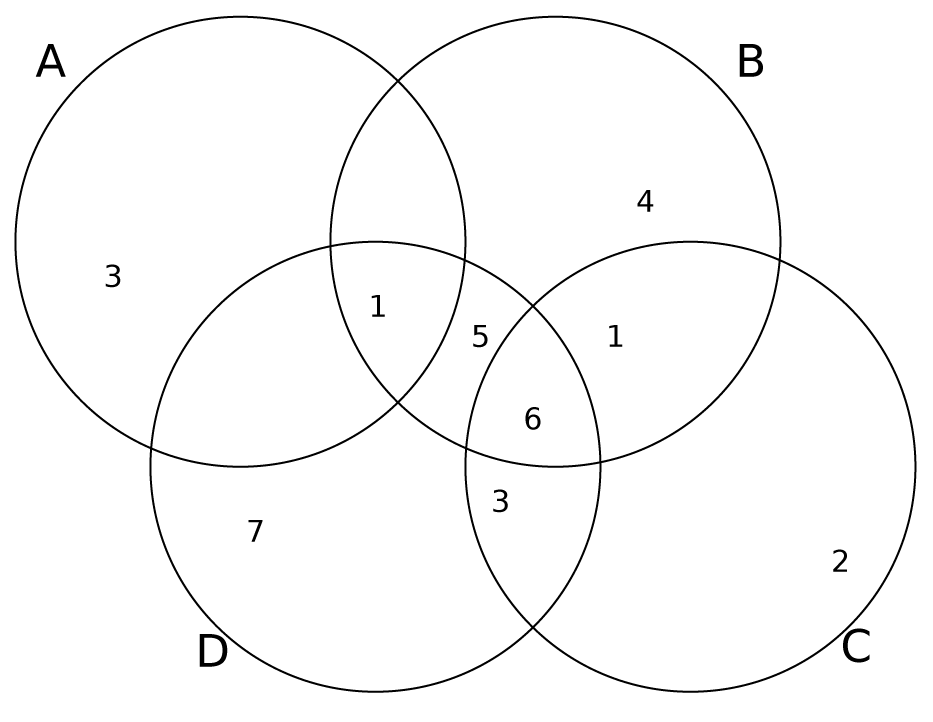
The problem requires identifying the number of people who do not drink coffee or milk. This involves analyzing the Venn diagram and excluding the sections that represent coffee (B) and milk (C).
Therefore, 10 people do not drink coffee or milk.
Correct Option: C) 10
The question asks about the country of origin of Eleanor Roosevelt, who chaired the committee that drafted the Universal Declaration of Human Rights (UDHR). This is a factual question related to international history and human rights.
Correct Option: D) USA
Eleanor Roosevelt was an American political figure, diplomat, and activist. She served as the First Lady of the United States from 1933 to 1945 during her husband President Franklin D. Roosevelt's four terms in office. After her husband's death, she continued to be a prominent figure in American and international politics, most notably serving as the chairperson of the United Nations Human Rights Commission, where she played a pivotal role in drafting the Universal Declaration of Human Rights (UDHR).