To determine which word would come last in an English dictionary, we need to arrange the given words alphabetically. This involves comparing the words letter by letter from left to right.
Therefore, 'Accent' would come last.
A) Accent — As determined by the step-by-step alphabetical comparison, 'Accent' comes last among the given words.
The question asks about a specific upgrade feature of the 'Akash 1S' missile, which is a new version of the Akash surface-to-air defence missile. To answer this, one needs to know the key technological advancements introduced in the Akash 1S variant.
C) a new indigenously-developed seeker. The Akash 1S missile is indeed fitted with a new indigenously-developed seeker. This seeker provides improved accuracy and the ability to engage targets more effectively, especially in a 'kill' mode where the missile can home in on the target independently after launch.
The question asks for the commissioning year of the Thal Heavy Water Plant. This is a factual question related to India's nuclear program and requires knowledge of specific historical dates.
Correct Option: C) 1987 is the correct commissioning year for the Thal Heavy Water Plant.
The question asks to identify which of the given options was NOT a part of the ancient supercontinent Gondwanaland. This requires knowledge of plate tectonics and the historical configuration of continents.
Correct Option: C) France
France is a country located in Western Europe. Europe, along with North America and parts of Asia, was primarily part of the supercontinent Laurasia, which was the northern counterpart to Gondwanaland. Therefore, France was not a part of Gondwanaland.
The question asks for the year in which the Indian Official Secrets Act was passed, an act that significantly restricted the freedom of the press during British rule in India. This requires knowledge of specific historical legislation.
Correct Option: C) 1904
A frequency polygon is a graphical representation used in statistics to visualize the distribution of quantitative data. It is constructed by plotting points that represent the frequency of each class interval and then connecting these points with straight lines. The key is to correctly identify which specific point within each class interval is used for plotting.
Therefore, a frequency polygon is drawn by plotting the midpoints of classes against their frequencies.
Correct Option: C) midpoint of classes and frequencies
Find the value of
18 - [6 ÷ 3 × {8 - (10 × \( \frac{1}{2} \))}].
To solve this problem, we need to apply the BODMAS/PEMDAS rule (Brackets/Parentheses, Orders/Exponents, Division, Multiplication, Addition, Subtraction). This rule dictates the order of operations to ensure a unique and correct solution.
The final value of the expression is 12.
B) 12 is the correct answer, as derived by following the BODMAS rule systematically.
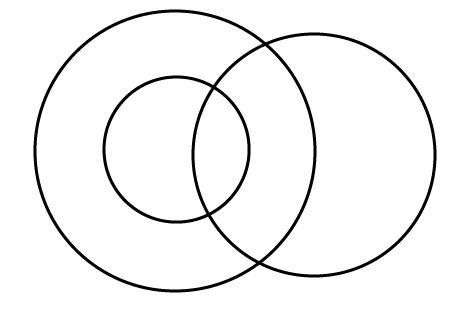
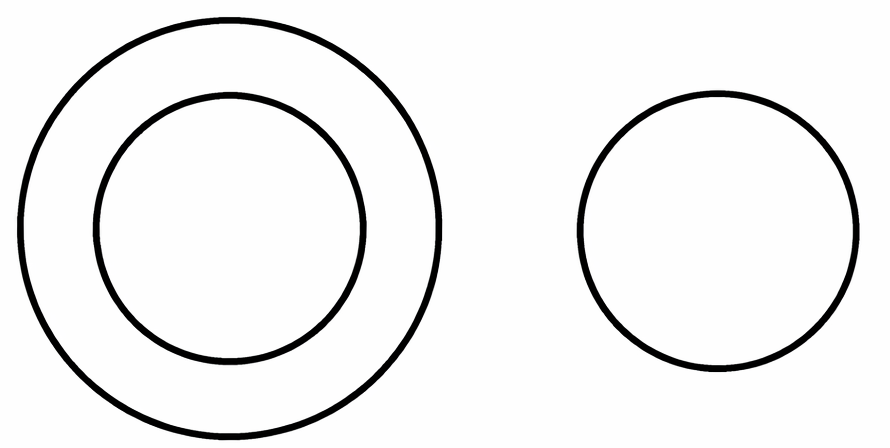
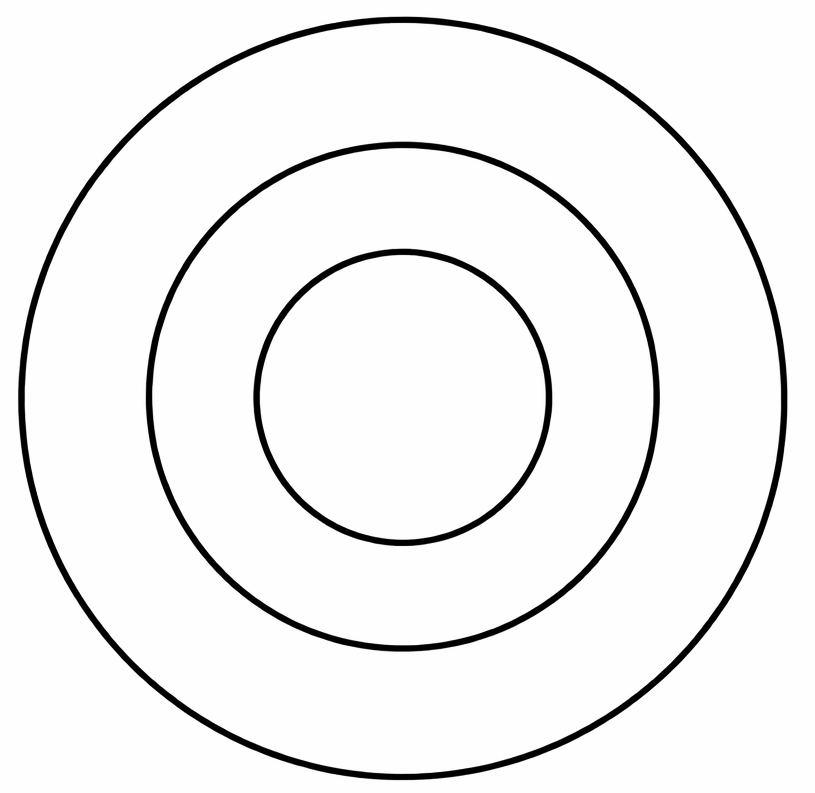
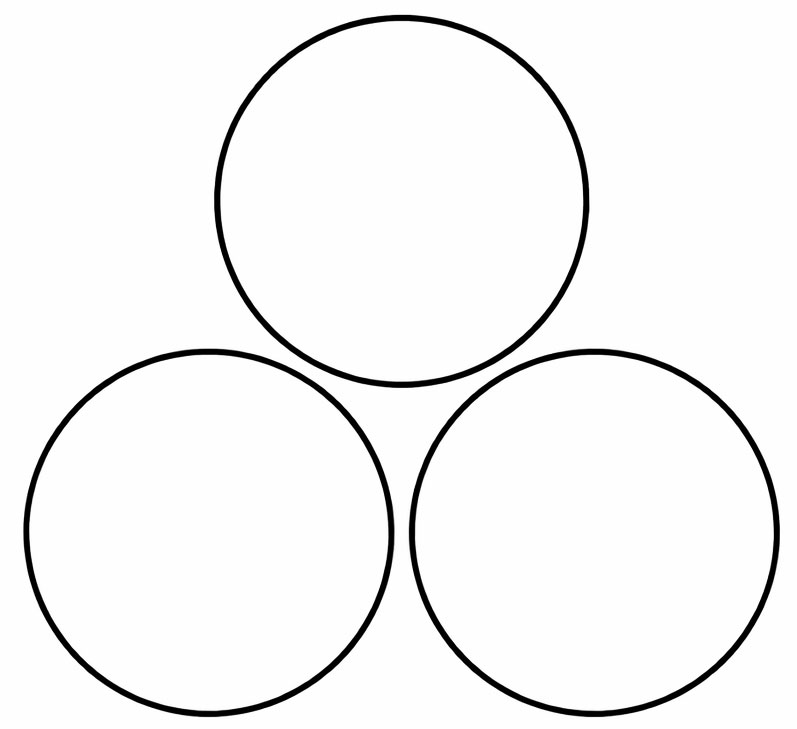
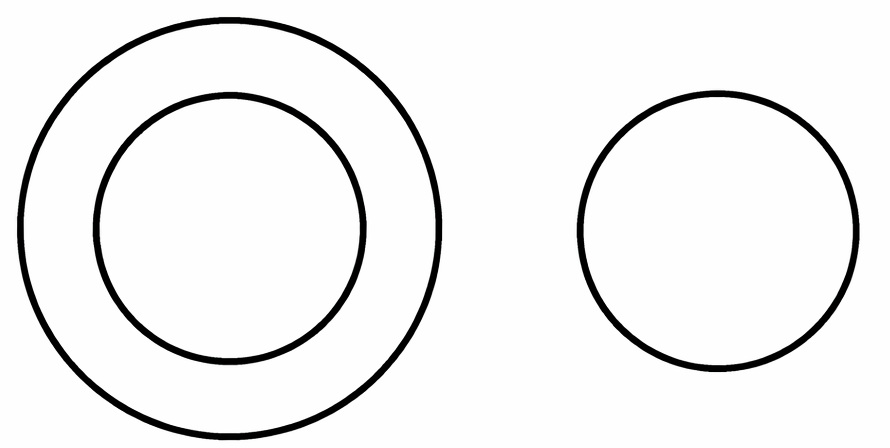
Select the Venn diagram that best represents the relationship between the given set of classes.
Tea, Beverage, Cup
To determine the correct Venn diagram, we need to understand the relationships between the classes: Tea, Beverage, and Cup. Tea is a type of beverage, but a cup is a distinct entity that holds beverages.
Correct Option: B) The diagram shows two concentric circles representing Tea inside Beverage, and a separate circle for Cup.
In ΔABC, \(\overline{PQ}\) ∥ \(\overline{AB}\). P and Q are on BC and CA respectively. If CQ : QA = 1 : 3 and CP = 4, then what is the value of BC?
This problem involves similar triangles formed by a line parallel to one side of a triangle. We will use the Basic Proportionality Theorem (Thales Theorem) and its converse, or directly the property of similar triangles, to find the unknown length.
We are given a triangle \(\Delta ABC\). A line segment \(\overline{PQ}\) is parallel to \(\overline{AB}\), with P on BC and Q on CA.
The ratio of CQ to QA is given as \(CQ : QA = 1 : 3\).
The length of CP is given as \(CP = 4\).
Since \(\overline{PQ} \parallel \overline{AB}\), by the property of parallel lines cutting two transversals (BC and AC), we can conclude that \(\Delta CQP\) is similar to \(\Delta CAB\).
This is because:
Therefore, \(\Delta CQP \sim \Delta CAB\).
For similar triangles, the ratio of their corresponding sides is equal.
\[ \frac{CQ}{CA} = \frac{CP}{CB} = \frac{PQ}{AB} \]We are given \(CQ : QA = 1 : 3\). Let \(CQ = x\) and \(QA = 3x\).
Then, \(CA = CQ + QA = x + 3x = 4x\).
So, the ratio \[\frac{CQ}{CA} = \frac{x}{4x} = \frac{1}{4}\].
From the similar triangles property, we have:
\[ \frac{CP}{CB} = \frac{CQ}{CA} \]We know \(CP = 4\) and \[\frac{CQ}{CA} = \frac{1}{4}\].
\[ \frac{4}{CB} = \frac{1}{4} \]Cross-multiply to find CB:
\[ CB = 4 \times 4 \]\[ CB = 16 \]Thus, the value of BC is 16.
A) 16 — As derived from the properties of similar triangles, the length of BC is 16.
The question asks to identify the finger-like outgrowths found on the inner walls of the small intestine. This is a direct knowledge-based question from human anatomy and physiology, specifically related to the digestive system.
C) villi. The inner walls of the small intestine are characterized by thousands of finger-like projections called villi. These villi significantly increase the surface area available for the absorption of digested nutrients into the bloodstream and lymphatic system.