
The question asks us to identify the odd one out from a given set of words. This is a classification type of question where we need to find a common characteristic among three words and identify the one that does not share that characteristic.
Correct Option: B) Ace is the odd one out because Knight, Pawn, and Bishop are all chess pieces, while Ace is a playing card.
In triangle ABC, lengths of sides opposite respective angles are a = 25, b = 45, c = 30, then the value of cos A is:
\( \frac{20}{27} \)
\( \frac{23}{27} \)
\( \frac{25}{27} \)
\( \frac{21}{27} \)
To find the value of \( \cos A \) in a triangle when all three side lengths are given, we use the Cosine Rule (also known as the Law of Cosines). The Cosine Rule relates the lengths of the sides of a triangle to the cosine of one of its angles.
Correct Option: B) \( \frac{23}{27} \)
Find the minimum number of straight lines in the following figure.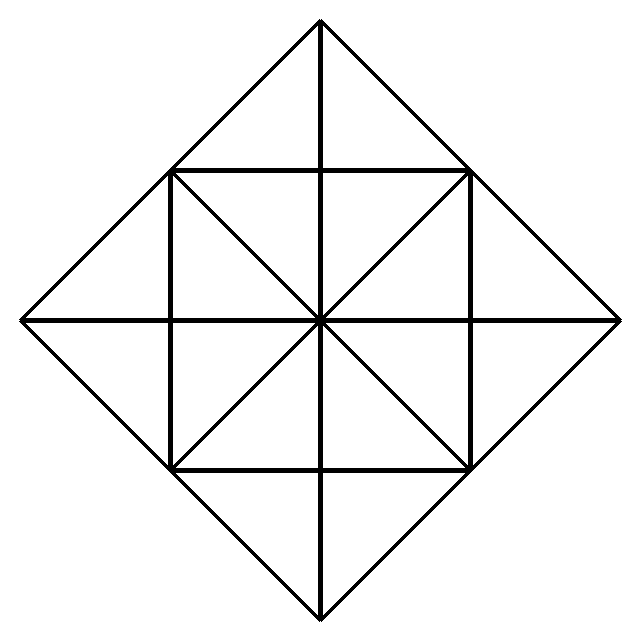
To find the minimum number of straight lines in the given figure, we need to carefully count each distinct line without missing any or counting any twice.
Correct Option: B) 12
If the height of a pole is 6\(\sqrt{3}\) metre and the length of its shadow is 6 metre, then the angle of elevation of the sun is:
This problem involves trigonometry, specifically the concept of the angle of elevation. We can visualize the pole, its shadow, and the line of sight to the sun as forming a right-angled triangle. The height of the pole will be the perpendicular, the length of the shadow will be the base, and the angle of elevation will be the angle between the base and the hypotenuse. We can use the tangent function, which relates the perpendicular and the base, to find the angle.
In a right-angled triangle, the tangent of an angle is defined as the ratio of the length of the opposite side (perpendicular) to the length of the adjacent side (base).
\[ \tan(\theta) = \frac{\text{Perpendicular}}{\text{Base}} = \frac{h}{b} \]We know that \(\tan(60^{\circ}) = \sqrt{3}\).
Therefore,
\[ \theta = 60^{\circ} \]Correct Option: A) 60°
The intercepts made by the plane 3x − 4y − 2z = 6 with the coordinate axis are:
-2, -\( \frac{3}{2} \), 3
2, \( \frac{3}{2} \), -3
-2, \( \frac{3}{2} \), 3
2, -\( \frac{3}{2} \), -3
To find the intercepts made by a plane with the coordinate axes, we need to convert the general equation of the plane into its intercept form. The intercept form of a plane's equation is given by \[\frac{x}{a} + \frac{y}{b} + \frac{z}{c} = 1\], where \( a \), \( b \), and \( c \) are the x-intercept, y-intercept, and z-intercept, respectively.
Given Equation: The equation of the plane is \( 3x - 4y - 2z = 6 \).
Convert to Intercept Form: To convert the given equation into the intercept form \[\frac{x}{a} + \frac{y}{b} + \frac{z}{c} = 1\], we need to divide the entire equation by the constant term on the right-hand side, which is 6.
\[ \frac{3x}{6} - \frac{4y}{6} - \frac{2z}{6} = \frac{6}{6} \]
Simplify the Equation: Simplify each term:
\[ \frac{x}{2} - \frac{2y}{3} - \frac{z}{3} = 1 \]
Rewrite in Standard Intercept Form: To match the standard intercept form \[\frac{x}{a} + \frac{y}{b} + \frac{z}{c} = 1\], we write the negative terms as additions of negative denominators:
\[ \frac{x}{2} + \frac{y}{(-3/2)} + \frac{z}{(-3)} = 1 \]
Here, we have \( a = 2 \), \( b = -\frac{3}{2} \), and \( c = -3 \).
Identify Intercepts: The intercepts with the coordinate axes are \( x = 2 \), \( y = -\frac{3}{2} \), and \( z = -3 \).
Correct Option: D) 2, \( -\frac{3}{2} \), -3
The question asks to identify the personality who famously stated, "Political freedom is the life breath of a nation." This requires knowledge of famous quotes by prominent figures in Indian history, particularly those associated with the freedom struggle.
Correct Option: D) Aurobindo Ghose is credited with this powerful statement. He was an ardent nationalist and philosopher who believed that political freedom was fundamental for the spiritual and cultural resurgence of India. His early political career was marked by revolutionary nationalism, and he consistently advocated for complete independence from British rule, viewing it as essential for the nation's very existence and development.
To find the speed of the cyclist in km/hr, we first need to convert the given distance and time into appropriate units. The distance is given in meters and time in minutes and seconds. We will convert the distance to kilometers and the time to hours, and then use the formula \(\text{Speed} = \frac{\text{Distance}}{\text{Time}}\).
Given distance \( = 650 \text{ m}\). Since \(1 \text{ km} = 1000 \text{ m}\), \[ \text{Distance in km} = \frac{650}{1000} \text{ km} = 0.65 \text{ km} \]
Given time \( = 2 \text{ min } 10 \text{ sec}\). First, convert the entire time into seconds: \[ 2 \text{ min} = 2 \times 60 \text{ sec} = 120 \text{ sec} \] \[ \text{Total time in seconds} = 120 \text{ sec} + 10 \text{ sec} = 130 \text{ sec} \] Now, convert seconds to hours. Since \(1 \text{ hour} = 60 \text{ minutes} = 60 \times 60 \text{ seconds} = 3600 \text{ seconds}\), \[ \text{Time in hours} = \frac{130}{3600} \text{ hours} \]
Using the formula \(\text{Speed} = \frac{\text{Distance}}{\text{Time}}\), \[ \text{Speed} = \frac{0.65 \text{ km}}{\frac{130}{3600} \text{ hours}} \] \[ \text{Speed} = \frac{0.65 \times 3600}{130} \text{ km/hr} \] \[ \text{Speed} = \frac{65 \times 3600}{100 \times 130} \text{ km/hr} \] \[ \text{Speed} = \frac{65 \times 36}{13} \text{ km/hr} \] Since \(65 = 5 \times 13\), \[ \text{Speed} = 5 \times 36 \text{ km/hr} \] \[ \text{Speed} = 18 \text{ km/hr} \]
Correct Option: A) 18
To find the volume of the cylinder, we first need to determine its radius. We are given the height and the curved surface area. We can use the formula for the curved surface area of a cylinder to find the radius, and then use the radius and height to calculate the volume.
Identify the given values:
Recall the formula for the Curved Surface Area of a cylinder:
The formula for the curved surface area of a cylinder is:
\[ \text{CSA} = 2 \pi r h \]where \(r\) is the radius and \(h\) is the height.
Substitute the given values into the CSA formula to find the radius (\(r\)):
\[ 660 = 2 \times \frac{22}{7} \times r \times 14 \]Solve for \(r\):
\[ 660 = 2 \times 22 \times r \times \frac{14}{7} \] \[ 660 = 2 \times 22 \times r \times 2 \] \[ 660 = 88 r \] \[ r = \frac{660}{88} \]Divide both numerator and denominator by 4:
\[ r = \frac{165}{22} \]Divide both numerator and denominator by 11:
\[ r = \frac{15}{2} = 7.5 \text{ cm} \]Recall the formula for the Volume of a cylinder:
The formula for the volume of a cylinder is:
\[ V = \pi r^2 h \]Substitute the values of \(r\) and \(h\) into the volume formula:
\[ V = \frac{22}{7} \times \left(\frac{15}{2}\right)^2 \times 14 \] \[ V = \frac{22}{7} \times \frac{225}{4} \times 14 \]Calculate the volume:
\[ V = 22 \times \frac{225}{4} \times \frac{14}{7} \] \[ V = 22 \times \frac{225}{4} \times 2 \] \[ V = 22 \times \frac{225}{2} \] \[ V = 11 \times 225 \] \[ V = 2475 \text{ cm}^3 \]Correct Option: B) 2475 cm³
The value of 'g' (acceleration due to gravity) on Earth is influenced by several factors, primarily the distance from the Earth's center and the Earth's rotation. We need to analyze how these factors vary across different geographical locations to determine where 'g' is maximum.
where:
2. Effect of Earth's shape (radius R): The Earth is not a perfect sphere; it is an oblate spheroid, meaning it is flattened at the poles and bulges at the equator. This implies that the radius of the Earth is minimum at the poles and maximum at the equator. From the formula \(g = \frac{GM}{R^2}\), a smaller radius \(R\) leads to a larger value of \(g\). Therefore, due to the Earth's shape, 'g' tends to be higher at the poles.
3. Effect of Earth's rotation (\(\omega^2 R \cos^2 \phi\)): The Earth's rotation creates a centrifugal force that acts outwards, effectively reducing the apparent gravitational force. This effect is maximum at the equator (\(\phi = 0^\circ\), so \(\cos^2 \phi = 1\)) and zero at the poles (\(\phi = 90^\circ\), so \(\cos^2 \phi = 0\)).
4. Combining both effects:
5. Conclusion: Both factors (smaller radius and absence of centrifugal force) contribute to making the value of 'g' maximum at the poles.
D) Poles — At the poles, the Earth's radius is smallest, and the effect of the Earth's rotation (centrifugal force) is zero. Both these factors contribute to the acceleration due to gravity ('g') being maximum at the poles.
The question asks to identify the author of the famous novel 'Devdas'. This requires knowledge of prominent Indian authors and their literary works.
Correct Option: C) Sarat Chandra Chattopadhyay is the renowned author of the Bengali novel 'Devdas'. Published in 1917, it tells the tragic love story of Devdas, Paro, and Chandramukhi.