
The question asks to identify which other major movement was combined with the Non-Cooperation Movement in 1920. This requires knowledge of the timeline of Indian nationalist movements and their collaborations.
Correct Option: C) The Khilafat Movement was combined with the Non-Cooperation Movement in 1920. Mahatma Gandhi supported the Khilafat cause and integrated it into the broader Non-Cooperation Movement to foster Hindu-Muslim unity against British rule.
If 6(sec²59° − cot²31°) + \( \frac{2}{3} \)sin90° − 3tan²56° y tan²34° = \( \frac{y}{3} \), then the value of y is:
The problem requires us to find the value of \(y\) from a given trigonometric equation. We will use fundamental trigonometric identities and complementary angle relations to simplify the expression. Key identities are \(\text{sec}^2\theta - \text{tan}^2\theta = 1\), \(\text{cosec}^2\theta - \text{cot}^2\theta = 1\), and complementary angle relations like \(\text{cot}(90^\circ - \theta) = \text{tan}\theta\) and \(\text{tan}(90^\circ - \theta) = \text{cot}\theta\). Also, we know that \(\text{sin}90^\circ = 1\).
The given equation is:
\[ 6(\text{sec}^2 59^\circ - \text{cot}^2 31^\circ) + \frac{2}{3}\text{sin}90^\circ - 3\text{tan}^2 56^\circ y \text{tan}^2 34^\circ = \frac{y}{3} \]Simplify the first term using complementary angles. We know that \(\text{cot}\theta = \text{tan}(90^\circ - \theta)\). So, \(\text{cot}31^\circ = \text{tan}(90^\circ - 31^\circ) = \text{tan}59^\circ\). Therefore, \(\text{cot}^2 31^\circ = \text{tan}^2 59^\circ\).
Substitute this into the first term:
\[ 6(\text{sec}^2 59^\circ - \text{tan}^2 59^\circ) \]Use the identity \(\text{sec}^2\theta - \text{tan}^2\theta = 1\). So, \(\text{sec}^2 59^\circ - \text{tan}^2 59^\circ = 1\).
The first term simplifies to \(6(1) = 6\).
Simplify the second term. We know that \(\text{sin}90^\circ = 1\).
The second term becomes \[\frac{2}{3}(1) = \frac{2}{3}\].
Simplify the third term. We have \(\text{tan}^2 56^\circ y \text{tan}^2 34^\circ\). We know that \(\text{tan}\theta = \text{cot}(90^\circ - \theta)\) or \(\text{tan}\theta \text{tan}(90^\circ - \theta) = 1\). So, \(\text{tan}34^\circ = \text{tan}(90^\circ - 56^\circ) = \text{cot}56^\circ\).
The third term becomes:
\[ 3\text{tan}^2 56^\circ y \text{cot}^2 56^\circ \]\[ 3y (\text{tan}56^\circ \text{cot}56^\circ)^2 \]\[ 3y (1)^2 = 3y \]Substitute the simplified terms back into the original equation:
\[ 6 + \frac{2}{3} - 3y = \frac{y}{3} \]Now, solve for \(y\). Combine the constant terms:
\[ \frac{18}{3} + \frac{2}{3} - 3y = \frac{y}{3} \]\[ \frac{20}{3} - 3y = \frac{y}{3} \]Move all terms involving \(y\) to one side and constants to the other:
\[ \frac{20}{3} = \frac{y}{3} + 3y \]\[ \frac{20}{3} = \frac{y + 9y}{3} \]\[ \frac{20}{3} = \frac{10y}{3} \]Multiply both sides by 3:
\[ 20 = 10y \]Divide by 10:
\[ y = \frac{20}{10} \]\[ y = 2 \]B) The value of \(y\) is 2.
To find the least five-digit number exactly divisible by 472, we first identify the smallest five-digit number. Then, we divide this number by 472 to find the remainder. If the remainder is zero, the number itself is the answer. Otherwise, we subtract the remainder from the divisor and add the result to the original smallest five-digit number.
Identify the smallest five-digit number: The smallest five-digit number is 10000.
Divide the smallest five-digit number by 472: We divide 10000 by 472.
\[ 10000 = 472 \times Q + R \]Where \(Q\) is the quotient and \(R\) is the remainder.
\[ 10000 \div 472 \approx 21.18 \]Let's perform the long division:
\[ \begin{array}{r} 21 \[-3pt] 472 \overline{\smash{)} 10000} \[-3pt] -944 \[-3pt] \hline \[-3pt] 560 \[-3pt] -472 \[-3pt] \hline \[-3pt] 88 \[-3pt] \end{array} \]So, \(10000 = 472 \times 21 + 88\).
The quotient \(Q = 21\) and the remainder \(R = 88\).
Calculate the least number divisible by 472: Since the remainder is 88 (not 0), 10000 is not exactly divisible by 472. To find the next number that is exactly divisible by 472, we need to add the difference between the divisor and the remainder to 10000.
\[ \text{Required number} = \text{Smallest five-digit number} + (\text{Divisor} - \text{Remainder}) \] \[ \text{Required number} = 10000 + (472 - 88) \] \[ \text{Required number} = 10000 + 384 \] \[ \text{Required number} = 10384 \]This number, 10384, is the smallest five-digit number that is exactly divisible by 472.
Correct Option: B) 10384
This is a blood relation problem. We need to establish the relationships between the individuals mentioned and then determine how Rahul is related to Radha. We can use a family tree or symbolic representation to solve this.
Correct Option: A) Son
If Raj is Radha's son, and Rahul is Raj's brother, then Rahul is also Radha's son.
Simplify.
\(\frac{6.25+\frac{5}{7}\times28-5}{\frac{3}{4}\times(15.8-3.4)+5\times2.39}\)
To simplify the given expression, we will follow the order of operations (BODMAS/PEMDAS) for both the numerator and the denominator separately. This involves performing operations in the sequence of Brackets, Orders (powers/roots), Division, Multiplication, Addition, and Subtraction.
The numerator is \(6.25 + \frac{5}{7} \times 28 - 5\).
First, perform the multiplication:
\[ \frac{5}{7} \times 28 = 5 \times \frac{28}{7} = 5 \times 4 = 20 \]Now, substitute this value back into the numerator expression:
\[ 6.25 + 20 - 5 \]Perform addition and subtraction from left to right:
\[ 6.25 + 20 = 26.25 \] \[ 26.25 - 5 = 21.25 \]So, the numerator simplifies to \(21.25\).
The denominator is \(\frac{3}{4} \times (15.8 - 3.4) + 5 \times 2.39\).
First, solve the expression inside the bracket:
\[ 15.8 - 3.4 = 12.4 \]Now, substitute this value back:
\[ \frac{3}{4} \times 12.4 + 5 \times 2.39 \]Next, perform the multiplications:
\[ \frac{3}{4} \times 12.4 = 3 \times \frac{12.4}{4} = 3 \times 3.1 = 9.3 \] \[ 5 \times 2.39 = 11.95 \]Now, substitute these values back into the denominator expression:
\[ 9.3 + 11.95 \]Perform the addition:
\[ 9.3 + 11.95 = 21.25 \]So, the denominator simplifies to \(21.25\).
Now, divide the simplified numerator by the simplified denominator:
\[ \frac{\text{Numerator}}{\text{Denominator}} = \frac{21.25}{21.25} = 1 \]Correct Option: B) 1
Study the given pattern carefully and select the number that can replace the question mark (?) in it.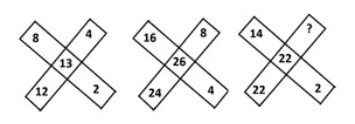
The pattern involves a central number that is derived from the surrounding numbers in a specific way. By analyzing the pattern in the given diagrams, we can determine the rule used to calculate the central number.
Correct Option: D) 6
Name the 17th zone of the Indian Railways, added in December 2010.
Konkan Railway
Delhi Metro
Kolkata Metro
East Central Railway
The question asks to identify the 17th zone of the Indian Railways, which was added in December 2010. This requires knowledge of the history and organization of Indian Railways zones.
Correct Option: C) Kolkata Metro
The problem asks us to identify the odd one out from four given letter pairs. Each pair consists of two sets of three letters, related by a specific logic or rule. We need to find the underlying pattern in three of the pairs and then identify the pair that does not follow this pattern.
The pattern for option A is \(-5, +6, +17\).
The pattern for option B is \(-21, +6, +7\).
The pattern for option C is \(-5, +6, +17\).
The pattern for option D is \(-5, +6, +17\).
Options A, C, and D all follow the same pattern of differences: \(-5, +6, +17\). Option B follows a different pattern: \(-21, +6, +7\). Therefore, option B is the odd one out.
B) ZBN – EHU — This option follows the pattern \(-21, +6, +7\), which is different from the \(-5, +6, +17\) pattern observed in the other options.
Simplify.
\(\frac{46+\frac{3}{4}\times32-6}{37-\frac{3}{4}\times(34-6)}\)
To simplify the given expression, we need to follow the order of operations (BODMAS/PEMDAS) for both the numerator and the denominator separately. BODMAS stands for Brackets, Orders (powers/roots), Division, Multiplication, Addition, Subtraction. We will evaluate the expressions inside the brackets first, then perform multiplication, and finally addition and subtraction.
The given expression is:
\[ \frac{46+\frac{3}{4}\times32-6}{37-\frac{3}{4}\times(34-6)} \]Let's simplify the numerator first:
Now, let's simplify the denominator:
Finally, substitute the simplified numerator and denominator back into the original expression:
\[ \frac{64}{16} = 4 \]Thus, the simplified value of the expression is \(4\).
C) 4 — The step-by-step calculation shows that the numerator simplifies to 64 and the denominator simplifies to 16, leading to a final result of 4.
This problem involves work and wages. The amount of money each person receives for a job is proportional to the amount of work they do. We need to calculate the individual work rates, then determine the work done by C, and finally calculate C's share of the total payment.
Calculate the work rate of A:
A can complete the work in 10 days. So, A's one day's work is:
\[ \text{A's 1 day's work} = \frac{1}{10} \]Calculate the work rate of B:
B can complete the work in 15 days. So, B's one day's work is:
\[ \text{B's 1 day's work} = \frac{1}{15} \]Calculate the combined work rate of A, B, and C:
A, B, and C together complete the work in 5 days. So, their combined one day's work is:
\[ \text{(A + B + C)'s 1 day's work} = \frac{1}{5} \]Calculate C's work rate:
C's one day's work can be found by subtracting A's and B's one day's work from the combined one day's work of A, B, and C:
\[ \text{C's 1 day's work} = \text{(A + B + C)'s 1 day's work} - \text{A's 1 day's work} - \text{B's 1 day's work} \]\[ \text{C's 1 day's work} = \frac{1}{5} - \frac{1}{10} - \frac{1}{15} \]\[ \text{C's 1 day's work} = \frac{6 - 3 - 2}{30} \]\[ \text{C's 1 day's work} = \frac{1}{30} \]Determine the ratio of work done by A, B, and C:
Since they all worked for the same number of days (5 days), the ratio of their work done is proportional to their daily work rates:
The ratio of work done by A : B : C is \[\frac{1}{2} : \frac{1}{3} : \frac{1}{6}\]. To simplify this ratio, multiply by the LCM of 2, 3, and 6, which is 6:
\[ \text{Ratio A : B : C} = \left(\frac{1}{2} \times 6\right) : \left(\frac{1}{3} \times 6\right) : \left(\frac{1}{6} \times 6\right) \]\[ \text{Ratio A : B : C} = 3 : 2 : 1 \]Calculate C's share of the payment:
The total payment is ₹4,800. C's share will be proportional to the work done by C, according to the ratio:
\[ \text{C's share} = \frac{\text{C's ratio part}}{\text{Sum of ratio parts}} \times \text{Total amount} \]\[ \text{C's share} = \frac{1}{3 + 2 + 1} \times 4800 \]\[ \text{C's share} = \frac{1}{6} \times 4800 \]\[ \text{C's share} = \text{₹}800 \]D) ₹800