
The question asks for the definition of an Optical Distribution Network (ODN). An ODN is a crucial part of a Passive Optical Network (PON) and is responsible for the physical transmission of optical signals from the Optical Line Terminal (OLT) to the Optical Network Units (ONUs) or Optical Network Terminals (ONTs) at the user premises. Understanding its components is key to identifying the correct definition.
D) The physical fibre and optical devices that distribute signals to users in a telecommunications network. This option correctly identifies both the optical fibers and the passive optical devices (like splitters, connectors) as integral parts of an ODN. These components work together to deliver optical signals from the service provider to the end-users in a telecommunications network, specifically in a Passive Optical Network (PON) architecture.
The sum of two numbers is 30. If the sum of their reciprocals is \( \frac{6}{25} \), find the two numbers.
We are given two conditions about two numbers: their sum and the sum of their reciprocals. We can solve this problem by setting up a system of two equations with two variables and solving for the numbers. Alternatively, we can test the given options to see which pair satisfies both conditions.
B) 5 and 25
Study the given pattern carefully and select the number that can replace the question mark (?) in it.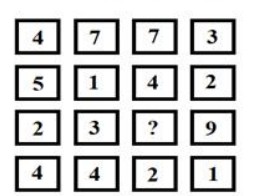
To solve this pattern-based question, examine the relationships between numbers in the grid. Look for arithmetic operations or patterns that connect the numbers in each row or column.
Correct Option: A) 2
This problem involves calculating the future population of a city given its present population and an annual growth rate. This is a classic compound interest type of problem, where the growth is applied to the new total each year. We can use the formula for compound growth or calculate year-by-year.
The formula for population after \(n\) years with an annual growth rate \(R\) is:
\[ \text{Future Population} = P \left(1 + \frac{R}{100}\right)^n \]A) 12,19,680 is the correct population after 2 years, calculated using the compound growth formula.
The question asks for the full form of the acronym FTTP. This is a common term in telecommunications and internet technology. Understanding common acronyms is crucial for competitive exams.
Correct Option: C) Fiber To The Premises
FTTP (Fiber To The Premises) is a broadband telecommunications system in which optical fiber is run directly to the customer's premises (home or business). This technology provides significantly higher internet speeds and bandwidth compared to traditional copper-based systems like DSL or cable.
To find the minimum number of rows, we first need to determine the maximum number of trees that can be planted in each row. Since each row must contain the same number of trees of only one variety, this number must be a common divisor of the total number of apple, mango, and orange trees. To maximize the number of trees per row, we need to find the Highest Common Factor (HCF) or Greatest Common Divisor (GCD) of the given numbers of trees. Once we have the HCF, we can calculate the number of rows required for each variety and sum them up to get the total minimum number of rows.
We can find the HCF by listing the factors of each number or by prime factorization.
The common factors are 1 and 3. The highest common factor is 3.
Alternatively, using prime factorization:
The common prime factor with the lowest power is \(3^1\). So, HCF = 3.
This means that each row will have 3 trees.
Total rows \( = 6 + 7 + 13 = 26 \)
A) 26 is the correct answer. By planting 3 trees in each row, we minimize the total number of rows while adhering to the conditions.
This problem involves properties of regular polygons, specifically the formulas for interior and exterior angles. We will use the relationship between interior and exterior angles and their sum, along with the given difference, to find the measure of each angle. Then, we can determine the number of sides of the polygon.
Let \(I\) be the measure of the interior angle and \(E\) be the measure of the exterior angle of a regular polygon.
We know that the sum of the interior and exterior angles at any vertex of a polygon is 180°:
\[ I + E = 180^\circ \quad \text{(Equation 1)} \]The problem states that the difference between the interior and exterior angles is 140°:
\[ I - E = 140^\circ \quad \text{(Equation 2)} \]Now, we have a system of two linear equations. Add Equation 1 and Equation 2:
\[ (I + E) + (I - E) = 180^\circ + 140^\circ \]\[ 2I = 320^\circ \]\[ I = \frac{320^\circ}{2} \]\[ I = 160^\circ \]Substitute the value of \(I\) back into Equation 1 to find \(E\):
\[ 160^\circ + E = 180^\circ \]\[ E = 180^\circ - 160^\circ \]\[ E = 20^\circ \]For a regular polygon with \(n\) sides, the measure of each exterior angle is given by the formula:
\[ E = \frac{360^\circ}{n} \]Substitute the calculated value of \(E\) into this formula:
\[ 20^\circ = \frac{360^\circ}{n} \]Solve for \(n\):
\[ n = \frac{360^\circ}{20^\circ} \]\[ n = 18 \]Thus, the number of sides of the polygon is 18.
Correct Option: B) 18
The question asks to identify the river on which the Kolkata Port is located. This is a factual question related to Indian geography and major ports.
Correct Option: D) The Kolkata Port is indeed located on the Hooghly River. The Hooghly River is a distributary of the Ganges River, flowing through West Bengal, India.
The question asks to identify the option where the organization's headquarters is NOT correctly matched. This requires knowledge of the headquarters locations of various international organizations.
Correct Option: B) OPEC-Zurich
The headquarters of the Organization of the Petroleum Exporting Countries (OPEC) is located in Vienna, Austria, not Zurich, Switzerland. Therefore, this match is incorrect.
The question asks to identify the individual responsible for assassinating Michael Francis O'Dwyer, who was associated with the Jallianwala Bagh massacre. This requires knowledge of key figures and events in India's freedom struggle.
Correct Option: B) Udham Singh was an Indian revolutionary who, on March 13, 1940, assassinated Michael O'Dwyer in London to avenge the Jallianwala Bagh massacre. He was subsequently tried and executed.