
This problem involves calculating ages and averages. We need to work backward from the past average age of the husband and wife to their present total age, and then use the present average age of the family (husband, wife, and son) to find the son's present age.
Given that 10 years ago, the average age of the husband and wife was 42 years.
\[ \text{Sum of ages 10 years ago} = \text{Average age} \times \text{Number of people} \]\[ = 42 \text{ years} \times 2 = 84 \text{ years} \]Since 10 years have passed, both the husband and the wife have aged by 10 years.
\[ \text{Present sum of ages of husband and wife} = 84 \text{ years} + (10 \text{ years} \times 2) \]\[ = 84 \text{ years} + 20 \text{ years} = 104 \text{ years} \]Given that the present average age of the family (husband, wife, and son) is 39 years.
\[ \text{Present sum of ages of family} = \text{Average age} \times \text{Number of people} \]\[ = 39 \text{ years} \times 3 = 117 \text{ years} \]The present sum of ages of the family includes the present ages of the husband, wife, and son. We can find the son's age by subtracting the present sum of ages of the husband and wife from the present sum of ages of the family.
\[ \text{Present age of son} = \text{Present sum of ages of family} - \text{Present sum of ages of husband and wife} \]\[ = 117 \text{ years} - 104 \text{ years} = 13 \text{ years} \]B) 13 Years — The calculations show that the present age of the son is 13 years.
To find the perimeter of the rectangle, we first need to determine its actual length and breadth. We are given the area and the ratio of the length to the breadth. We can use these two pieces of information to set up an equation and solve for the dimensions, and then calculate the perimeter.
Define length and breadth using the ratio:
Let the length of the rectangle be \(13x\) and the breadth be \(11x\), where \(x\) is a common multiplier.
Use the area formula to find \(x\):
The area of a rectangle is given by the formula: \(\text{Area} = \text{Length} \times \text{Breadth}\).
We are given the area as \(1287 \text{ cm}^2\).
So, we have:
Solve for \(x\):
Divide both sides by 143:
Take the square root of both sides:
\[ x = \sqrt{9} \]\[ x = 3 \]Calculate the actual length and breadth:
Length \( = 13x = 13 \times 3 = 39 \text{ cm}\)
Breadth \( = 11x = 11 \times 3 = 33 \text{ cm}\)
Calculate the perimeter:
The perimeter of a rectangle is given by the formula: \(\text{Perimeter} = 2 \times (\text{Length} + \text{Breadth})\).
Substitute the values of length and breadth:
Correct Option: B) 144 cm is the perimeter of the rectangle.
Find the remainder when 76 + 5 is divided by 6.
To find the remainder when an expression is divided by a number, we can use the properties of modular arithmetic. Specifically, we can find the remainder of each term separately and then combine them, or simplify the expression first.
We can find the remainder of 7 when divided by 6:
\[ 7 \div 6 = 1 \text{ with a remainder of } 1 \]This can be written in modular arithmetic as:
\[ 7 \equiv 1 \pmod{6} \]Using the property that if \(a \equiv b \pmod{m}\), then \(a^n \equiv b^n \pmod{m}\), we can write:
\[ 7^6 \equiv 1^6 \pmod{6} \]\[ 7^6 \equiv 1 \pmod{6} \]So, the remainder when \(7^6\) is divided by 6 is 1.
The remainder when 5 is divided by 6 is simply 5 itself, as 5 is less than 6.
\[ 5 \equiv 5 \pmod{6} \]Now, we need to find the remainder of the sum \(7^6 + 5\). We can add the individual remainders:
\[ (7^6 + 5) \equiv (1 + 5) \pmod{6} \]\[ (7^6 + 5) \equiv 6 \pmod{6} \]When 6 is divided by 6, the remainder is 0.
\[ 6 \equiv 0 \pmod{6} \]Therefore,
\[ (7^6 + 5) \equiv 0 \pmod{6} \]The remainder when \(7^6 + 5\) is divided by 6 is 0.
Correct Option: D) 0
The problem asks us to identify the pair of words that share the same relationship as the given pair: Writer : Pen. We need to analyze the relationship between 'Writer' and 'Pen' and then find an option where a similar relationship exists between the two words.
B) Chef : Pan — A Chef uses a Pan as a primary tool for cooking, just as a Writer uses a Pen as a primary tool for writing.
Study the given pattern carefully and select the number that can replace the question mark (?) in the third figure.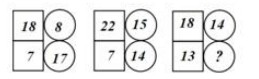
The problem involves identifying a pattern in a series of numbers arranged in a specific format. By analyzing the relationships between the numbers in the given figures, we can determine the missing number in the third figure.
Thus, the missing number that fits the pattern is 17.
Correct Option: C) 17
The question asks to identify the Government of India scheme that guarantees 100 days of wage-employment to enhance livelihood security in rural areas. We need to evaluate each option against this specific criterion.
C) MGNREGA (Mahatma Gandhi National Rural Employment Guarantee Act) is a flagship program of the Government of India that aims to enhance the livelihood security of people in rural areas by guaranteeing 100 days of wage employment in a financial year to every rural household whose adult members volunteer to do unskilled manual work. It is a demand-driven scheme.
This is a logical reasoning question based on statements and conclusions. We need to evaluate each conclusion based on the information provided in the statements and determine which ones logically follow.
Correct Option: A) Only conclusions (i) and (ii) follow.
This question tests knowledge of the scientific names (binomial nomenclature) of common fruits and vegetables. Binomial nomenclature is a formal system of naming living organisms, where each species is given a name consisting of two parts: the genus and the specific epithet. The first letter of the genus is always capitalized, and the specific epithet is always in lowercase. Both parts are typically italicized.
Correct Option: A) Mangifera indica is the correct scientific name for the fruit 'mango'. The term 'indica' often refers to its origin or association with India.
To find the sum of the greatest and smallest six-digit numbers, we first need to identify both numbers. The greatest six-digit number will consist of the largest possible digit in all six places, and the smallest six-digit number will be the smallest number that occupies six digits.
C) 1099999 is the correct sum of the greatest and smallest six-digit numbers.
This problem involves work and time, where the efficiency of individuals is given. We will use the concept that work done is proportional to efficiency and time. If Rinku is twice as efficient as Deepak, we can express their individual work rates and then combine them to find the total work rate. From the combined work rate and the total time taken, we can determine the total work. Finally, we can calculate the time Rinku would take alone.
B) 42 days — Rinku alone can finish the work in 42 days, as calculated.