
To find the HCF of any two even perfect squares, we need to understand the properties of even numbers and perfect squares. An even number can be expressed as \(2k\) for some integer \(k\). A perfect square is a number that can be expressed as \(n^2\) for some integer \(n\). An even perfect square must be the square of an even number.
Correct Option: D) 4
The question asks to identify the author of the famous collection of fables, the Panchatantra. This requires knowledge of ancient Indian literature and its prominent authors.
C) Vishnu Sharma is traditionally credited as the author of the Panchatantra. This collection of moral stories, often featuring animals, has been highly influential globally.
The question asks to identify the organization whose headquarters is NOT correctly matched from the given options. This requires knowledge of the headquarters locations of prominent international organizations.
Correct Option: B) Amnesty International – New York, USA. This is not correctly matched because Amnesty International's headquarters is in London, UK.
To a number, (\( \frac{1}{3} \) – \( \frac{1}{4} \)) is added. From the sum so obtained \( \frac{1}{3} \) of \( \frac{1}{4} \) is subtracted and the remainder is \( \frac{1}{3} \) + \( \frac{1}{4} \). Find the number.
\( \frac{1}{12} \)
\( \frac{2}{3} \)
\( \frac{7}{12} \)
\( \frac{4}{9} \)
This problem involves setting up an algebraic equation based on the given word problem. We need to translate the operations described into mathematical expressions and then solve for the unknown number.
Let the unknown number be \(x\).
First, "\[\frac{1}{3} - \frac{1}{4}\]" is added to the number. The value of this expression is:
\[ \frac{1}{3} - \frac{1}{4} = \frac{4 - 3}{12} = \frac{1}{12} \]So, the sum obtained is \(x + \frac{1}{12}\).
Next, "\( \frac{1}{3} \) of \( \frac{1}{4} \)" is subtracted from this sum. "Of" means multiplication, so this value is:
\[ \frac{1}{3} \times \frac{1}{4} = \frac{1}{12} \]Subtracting this from the sum, we get:
\[ \left( x + \frac{1}{12} \right) - \frac{1}{12} \]The problem states that the remainder is "\[\frac{1}{3} + \frac{1}{4}\]". The value of this expression is:
\[ \frac{1}{3} + \frac{1}{4} = \frac{4 + 3}{12} = \frac{7}{12} \]Now, we can set up the equation:
\[ \left( x + \frac{1}{12} \right) - \frac{1}{12} = \frac{7}{12} \]Simplify the left side of the equation:
\[ x + \frac{1}{12} - \frac{1}{12} = \frac{7}{12} \]\[ x = \frac{7}{12} \]Thus, the number is \( \frac{7}{12} \).
C) \( \frac{7}{12} \) is the correct answer, as derived from the step-by-step calculation.
The problem asks us to identify the odd one out from a given set of options. We need to find a common characteristic among three options and identify the one that does not share that characteristic.
From the analysis, options B, C, and D (socks, shoes, and gloves) are all items that are typically worn in pairs, with one item for each of the two corresponding body parts (feet or hands). A sweater, however, is a single garment worn on the torso and is not typically referred to or used as a "pair" in the same functional sense.
Therefore, "A pair of sweaters" is the odd one out.
A) A pair of sweaters — Sweaters are single garments worn on the upper body, not typically used or referred to as a "pair" in the same functional context as socks, shoes, or gloves, which are worn on two distinct body parts simultaneously.
The question asks to identify the river that does NOT originate from the Himalayas. To answer this, we need to recall the origin points of each given river.
A) Mahanadi — The Mahanadi River originates from the Sihawa mountains in Chhattisgarh, which is part of the Peninsular Plateau, not the Himalayas. Therefore, it is not a Himalayan river.
Which of the following statements is correct?
DDT is a bio-control agent.
Oxygen and ozone are the two main components of acid rain.
The main cause of ozone depletion and the ozone hole is chlorofluorocarbons (CFCs).
CO2 is not responsible for the green-house effect.
The question asks to identify the correct statement among the given options regarding environmental science concepts. We need to evaluate each statement individually based on established scientific facts.
Based on this evaluation, statement C is the only correct one.
Correct Option: C) The main cause of ozone depletion and the ozone hole is chlorofluorocarbons (CFCs).
To find the time after which A, B, and C will meet again at the starting point, we need to find the least common multiple (LCM) of the individual times they take to complete one round. The LCM will represent the smallest time interval after which all three will have completed an integer number of rounds and will simultaneously be back at the starting point.
The LCM is found by taking the highest power of all prime factors present in the numbers.
\[ \text{LCM}(252, 308, 198) = 2^{\text{max}(2,2,1)} \times 3^{\text{max}(2,0,2)} \times 7^{\text{max}(1,1,0)} \times 11^{\text{max}(0,1,1)} \]\[ = 2^2 \times 3^2 \times 7^1 \times 11^1 \]\[ = 4 \times 9 \times 7 \times 11 \]\[ = 36 \times 77 \]\[ = 2772 \text{ seconds} \]There are 60 seconds in 1 minute.
\[ \text{Minutes} = \frac{2772}{60} = 46 \text{ with a remainder of } 12 \]\[ \text{So, } 2772 \text{ seconds} = 46 \text{ minutes and } 12 \text{ seconds} \]B) 46 min 12 s is the correct answer because the LCM of 252, 308, and 198 seconds is 2772 seconds, which converts to 46 minutes and 12 seconds.
To find the missing term, we need to expand the product of the two binomials on the left side of the equation. We will use the distributive property (FOIL method) to multiply the terms and then compare the result with the right side of the given equation.
The given expression on the left side is \( (2a^{3}- 3)(5a^{3} - 2) \).
Using the FOIL method (First, Outer, Inner, Last):
Combine these results:
\[ (2a^{3}- 3)(5a^{3} - 2) = 10a^{6} - 4a^{3} - 15a^{3} + 6 \]The terms \( -4a^{3} \) and \( -15a^{3} \) are like terms. Combine them:
\[ -4a^{3} - 15a^{3} = (-4 - 15)a^{3} = -19a^{3} \]So, the expanded form of the left side is:
\[ 10a^{6} - 19a^{3} + 6 \]The given equation is \( (2a^{3}- 3)(5a^{3} - 2) = 10 a^{6}+ \) ? \( +6 \).
Substituting our expanded form:
\[ 10a^{6} - 19a^{3} + 6 = 10 a^{6}+ \text{?} +6 \]By comparing both sides, it is clear that the missing term (represented by '?') is \( -19a^{3} \).
D) \( -19a^{3} \) is the correct term that replaces the question mark, as derived from the expansion of the product.
Study the given pattern carefully and select the number that can replace the question mark (?) in it.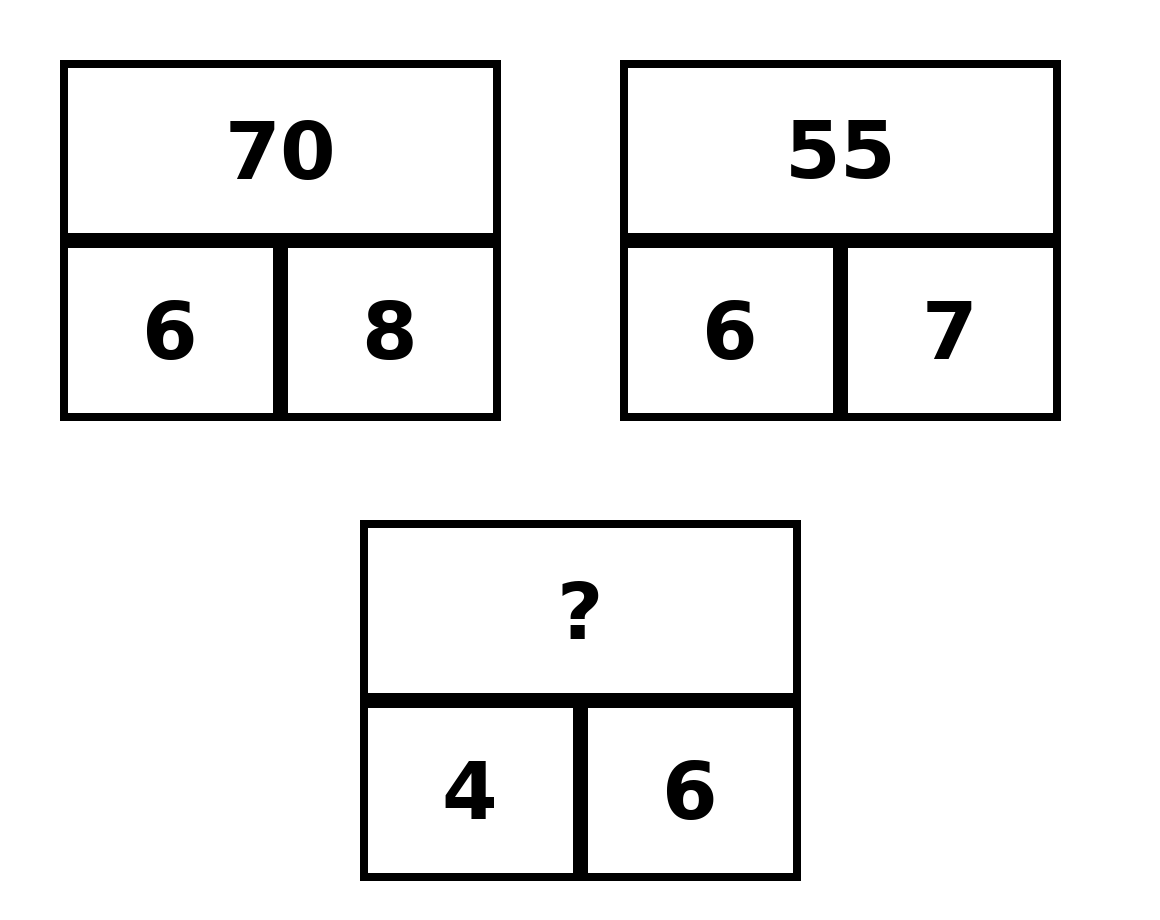
The pattern involves a relationship between the numbers in each box. By analyzing the given examples, we can determine the rule applied to find the missing number.
Correct Option: D) 40