
The question asks to identify the nanosatellite developed by IIT Kanpur for agriculture and disaster monitoring. This requires knowledge of specific Indian satellite projects and their origins.
The nanosatellite Jugnu was indeed designed and developed by students of the Indian Institute of Technology, Kanpur. It was launched by ISRO in 2011. Its primary objectives included providing data for agriculture, disaster monitoring, and other remote sensing applications.
B) Jugnu — Jugnu is the nanosatellite developed by IIT Kanpur for agriculture and disaster monitoring purposes.
Find the value of \( \frac{1}{4} \) + \(\frac{1}{4\times5}\) + \(\frac{1}{4\times5\times6}\) (rounded off to 2 decimal places)
To find the value of the given expression, we need to calculate each term separately and then sum them up. Finally, the result should be rounded off to two decimal places.
To convert \( \frac{1}{120} \) to a decimal, we perform the division:
\[ 1 \div 120 \approx 0.008333... \]Rounding this to four decimal places for intermediate calculation gives \( 0.0083 \).
To round \( 0.3083 \) to two decimal places, we look at the third decimal place. Since it is 8 (which is \(\ge 5\)), we round up the second decimal place.
\[ 0.3083 \approx 0.31 \]A) 0.31 — As calculated, the sum of the terms \( 0.25 + 0.05 + 0.0083 \) is \( 0.3083 \), which rounds to \( 0.31 \) when rounded to two decimal places.
How long will it take a sum of money invested at 6% p.a. on simple interest to increase its value by 50%?
3 \( \frac{1}{8} \) years
8 \( \frac{1}{3} \) years
8 years
3 years
To find the time it takes for a sum of money to increase its value by a certain percentage at a given simple interest rate, we can use the formula for simple interest. We'll assume an initial principal amount, calculate the required simple interest, and then solve for time.
Let the principal amount be \(P\).
The sum of money increases its value by 50%. This means the simple interest earned (\(SI\)) is 50% of the principal amount.
\[ SI = 50\% \text{ of } P = \frac{50}{100} \times P = \frac{P}{2} \]The rate of interest (\(R\)) is given as 6% p.a.
\[ R = 6\% = \frac{6}{100} \]The formula for simple interest is:
\[ SI = \frac{P \times R \times T}{100} \]Where \(T\) is the time in years.
Substitute the values of \(SI\) and \(R\) into the formula:
\[ \frac{P}{2} = \frac{P \times 6 \times T}{100} \]Now, solve for \(T\). We can cancel \(P\) from both sides (assuming \(P \neq 0\)):
\[ \frac{1}{2} = \frac{6 \times T}{100} \]Multiply both sides by 100:
\[ \frac{100}{2} = 6 \times T \] \[ 50 = 6 \times T \]Divide by 6 to find \(T\):
\[ T = \frac{50}{6} \]Simplify the fraction:
\[ T = \frac{25}{3} \text{ years} \]Convert the improper fraction to a mixed fraction:
\[ T = 8 \frac{1}{3} \text{ years} \]Correct Option: B) 8 \( \frac{1}{3} \) years
The question asks to identify the specific Article of the Indian Constitution under which an Inter-State Council is constituted to coordinate inter-state disputes. This requires knowledge of the constitutional provisions related to inter-state relations.
Correct Option: D) Article 263
Article 263 of the Constitution of India provides for the establishment of an Inter-State Council to inquire into and advise upon disputes between states, investigate and discuss subjects of common interest between states or the Union and states, and make recommendations for better coordination of policy and action. The President is empowered to establish such a Council.
The question asks about the architectural style of the Gateway of India, built to commemorate the visit of King George V and Queen Mary in 1911. This requires knowledge of Indian architectural history, specifically the styles adopted during the British colonial period.
Correct Option: A) Indo-Saracenic style. The Gateway of India is a prime example of Indo-Saracenic architecture, which was a hybrid style developed by British architects in India.
A bridge built across a river makes an angle of 45° with the river bank as shown in given figure. If the length of the bridge is 150 m, then what is the width of the river?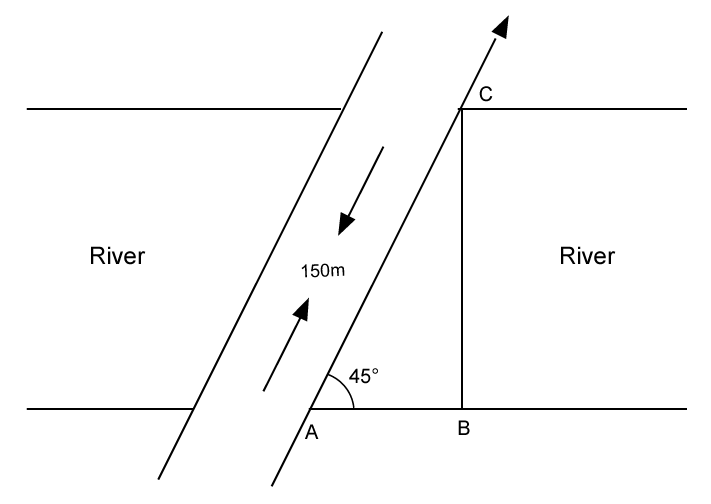
The problem involves calculating the width of the river using trigonometric relationships in a right triangle formed by the bridge and the river bank.
\[ \sin(45^\circ) = \frac{\text{Width of the river}}{\text{Length of the bridge}} \]
\[ \sin(45^\circ) = \frac{\text{Width of the river}}{150} \]
Since \( \sin(45^\circ) = \frac{1}{\sqrt{2}} \), we have:
\[ \frac{1}{\sqrt{2}} = \frac{\text{Width of the river}}{150} \]
\[ \text{Width of the river} = 150 \times \frac{1}{\sqrt{2}} \]
\[ \text{Width of the river} = \frac{150}{\sqrt{2}} \]
Rationalize the denominator:
\[ \text{Width of the river} = \frac{150 \times \sqrt{2}}{2} \]
\[ \text{Width of the river} = 75 \sqrt{2} \text{ m} \]
Thus, the width of the river is \(75\sqrt{2}\) meters.
Correct Option: B) 75\(\sqrt{2}\) m
The question asks about the chairman of the group constituted in 2018 by the Union Government to study India's Special Economic Zones (SEZ) Policy. This is a factual question related to government committees and policies, requiring knowledge of current affairs and economic policy developments.
D) Baba Kalyani — Baba Kalyani, Chairman and MD of Bharat Forge Ltd., was appointed to head the expert committee to review India's SEZ policy in 2018. The committee submitted its recommendations in November 2018.
The question asks for the year in which the Indian states of Chhattisgarh, Uttarakhand, and Jharkhand were created. This is a factual question related to the reorganization of states in India.
Correct Option: B) 2000
Calculate the compound interest on a sum of ₹12,000 at 16% p.a. for 3 months, compounded quarterly.
To calculate the compound interest when compounded quarterly, we need to adjust the annual interest rate and the time period to reflect the quarterly compounding frequency. The formula for compound interest will then be applied.
Since the interest is compounded quarterly, there are 4 compounding periods in a year. We divide the annual rate by 4.
\[ \text{Quarterly Rate} (r) = \frac{\text{Annual Rate}}{4} = \frac{16\%}{4} = 4\% \]The time period is 3 months. To express this in terms of quarters, we divide by 3 months per quarter.
\[ \text{Number of Compounding Periods} (n) = \frac{\text{Total Months}}{3 \text{ months/quarter}} = \frac{3}{3} = 1 \text{ quarter} \]The formula for the amount when compounded is:
\[ A = P \left(1 + \frac{r}{100}\right)^n \]\[ A = 12000 \left(1 + \frac{4}{100}\right)^1 \]\[ A = 12000 \left(1 + 0.04\right)^1 \]\[ A = 12000 \times 1.04 \]\[ A = 12480 \]Compound Interest is the difference between the Amount and the Principal.
\[ \text{CI} = A - P \]\[ \text{CI} = 12480 - 12000 \]\[ \text{CI} = 480 \]Correct Option: D) ₹480
When a metallic cuboid is melted and recast into a cube, the volume of the material remains constant. First, calculate the volume of the cuboid. Then, use this volume to find the side length of the new cube. Finally, calculate the surface area of the cube using its side length.
The dimensions of the cuboid are given as 50 cm × 40 cm × 32 cm.
\[ \text{Volume of cuboid} = \text{length} \times \text{width} \times \text{height} \]\[ \text{Volume of cuboid} = 50 \, \text{cm} \times 40 \, \text{cm} \times 32 \, \text{cm} \]\[ \text{Volume of cuboid} = 2000 \, \text{cm}^2 \times 32 \, \text{cm} \]\[ \text{Volume of cuboid} = 64000 \, \text{cm}^3 \]Since the cuboid is melted and recast into a cube, the volume remains the same.
\[ \text{Volume of cube} = \text{Volume of cuboid} \]\[ \text{side}^3 = 64000 \, \text{cm}^3 \]\[ \text{side} = \sqrt[3]{64000 \, \text{cm}^3} \]\[ \text{side} = \sqrt[3]{64 \times 1000 \, \text{cm}^3} \]\[ \text{side} = \sqrt[3]{64} \times \sqrt[3]{1000} \, \text{cm} \]\[ \text{side} = 4 \times 10 \, \text{cm} \]\[ \text{side} = 40 \, \text{cm} \]The formula for the total surface area of a cube is \(6 \times \text{side}^2\).
\[ \text{Surface Area of cube} = 6 \times (40 \, \text{cm})^2 \]\[ \text{Surface Area of cube} = 6 \times (1600 \, \text{cm}^2) \]\[ \text{Surface Area of cube} = 9600 \, \text{cm}^2 \]Correct Option: D) 9,600 cm²