
Ram is elder than Shyam and Shyam is younger than Abhijeet. Abhijeet celebrates his 18th birthday today. Abhijeet is younger than Sanjeev. Sanjeev, Ram and Shyam are brothers and Ram is the eldest among them. Which one of the brothers is NOT yet legally an adult?
To determine which brother is not yet legally an adult, we need to establish the relative ages of all the brothers and identify their current ages based on the given information. A person is legally an adult at 18 years of age or older.
Therefore, Shyam is the only brother who is not yet legally an adult.
Correct Option: D) Shyam
Two linear equations represent coincident lines if and only if the ratio of their corresponding coefficients (of \(x\), \(y\), and the constant term) are equal. We will use this condition to find the value of \(k\).
Identify the given linear equations:
\[ 2x + 3y + 11 = 0 \quad \text{(Equation 1)} \]\[ 6x + ky + 33 = 0 \quad \text{(Equation 2)} \]Recall the condition for two lines \(a_1x + b_1y + c_1 = 0\) and \(a_2x + b_2y + c_2 = 0\) to be coincident:
\[ \frac{a_1}{a_2} = \frac{b_1}{b_2} = \frac{c_1}{c_2} \]From Equation 1, we have \(a_1 = 2\), \(b_1 = 3\), \(c_1 = 11\).
From Equation 2, we have \(a_2 = 6\), \(b_2 = k\), \(c_2 = 33\).
Apply the condition for coincident lines:
\[ \frac{2}{6} = \frac{3}{k} = \frac{11}{33} \]Simplify the known ratios:
\[ \frac{2}{6} = \frac{1}{3} \]\[ \frac{11}{33} = \frac{1}{3} \]Now, equate the ratio involving \(k\) with the common ratio:
\[ \frac{3}{k} = \frac{1}{3} \]Solve for \(k\):
\[ k = 3 \times 3 \]\[ k = 9 \]C) 9 — The value \(k=9\) satisfies the condition for the two given linear equations to represent coincident lines, as the ratios of their corresponding coefficients become equal (\(1/3\)).
The problem can be solved by translating the given word problem into an algebraic equation. We will represent the unknown number with a variable, set up the equation based on the given conditions, and then solve for the variable.
Let the unknown number be \(x\).
According to the problem statement, "two-third of a number" can be written as \(\frac{2}{3}x\).
"70 is subtracted from two-third of a number" translates to \(\frac{2}{3}x - 70\).
"One-fourth of that number" can be written as \(\frac{1}{4}x\).
"The sum of 30 and one-fourth of that number" translates to \(30 + \frac{1}{4}x\).
The problem states that "the result is equal to" these two expressions. So, we can set up the equation:
\[ \frac{2}{3}x - 70 = 30 + \frac{1}{4}x \]Now, we need to solve for \(x\). First, gather all terms containing \(x\) on one side and constant terms on the other side:
\[ \frac{2}{3}x - \frac{1}{4}x = 30 + 70 \] \[ \frac{2}{3}x - \frac{1}{4}x = 100 \]To subtract the fractions with \(x\), find a common denominator for 3 and 4, which is 12:
\[ \frac{2 \times 4}{3 \times 4}x - \frac{1 \times 3}{4 \times 3}x = 100 \] \[ \frac{8}{12}x - \frac{3}{12}x = 100 \]Perform the subtraction:
\[ \frac{8 - 3}{12}x = 100 \] \[ \frac{5}{12}x = 100 \]Finally, isolate \(x\) by multiplying both sides by \(\frac{12}{5}\):
\[ x = 100 \times \frac{12}{5} \] \[ x = 20 \times 12 \] \[ x = 240 \]Thus, the number is 240.
A) 240 is the correct answer, as derived from the step-by-step calculation.
The question asks to identify the specific variety of mango for which the Girnar Hills region of Junagadh, Gujarat, is famous. This is a factual question related to agricultural geography and famous regional produce in India.
Correct Option: D) Kesar
The Girnar Hills of Junagadh, Gujarat, are renowned for the cultivation of Kesar mangoes. The Kesar mango is a highly prized variety known for its distinct sweet flavor, bright orange pulp, and aromatic qualities. It holds a Geographical Indication (GI) tag, recognizing its unique origin and characteristics tied to the specific region of Gir in Gujarat, which includes the Girnar Hills.
To find the amount Darshan would pay, we need to calculate the discount offered on the marked price and then subtract this discount from the marked price. The discount is 5% of the marked price.
The marked price of the bike is ₹75,200.
The company offers a 5% discount on cash purchases. So, the discount amount will be 5% of ₹75,200.
\[ \text{Discount Amount} = 5\% \times \text{Marked Price} \]\[ \text{Discount Amount} = \frac{5}{100} \times 75200 \]\[ \text{Discount Amount} = 5 \times 752 \]\[ \text{Discount Amount} = \text{₹}3760 \]The amount Darshan would pay is the marked price minus the discount amount.
\[ \text{Amount Paid} = \text{Marked Price} - \text{Discount Amount} \]\[ \text{Amount Paid} = 75200 - 3760 \]\[ \text{Amount Paid} = \text{₹}71440 \]Correct Option: A) ₹71,440
The Fiscal Responsibility and Budget Management Act (FRBMA) came into force in the year ________.
The question asks for the year in which the Fiscal Responsibility and Budget Management Act (FRBMA) came into force. This requires knowledge of the specific enactment date of this important Indian economic legislation.
Correct Option: D) 2004
The question asks to identify the traditional embroidery art for which Lucknow is famous. This requires knowledge of various Indian embroidery styles and their associated regions.
Correct Option: C) Chikankari work is a traditional embroidery style that originated in Lucknow, Uttar Pradesh, India. It is renowned for its delicate and intricate hand embroidery, often featuring white thread on white fabric, though colored threads and fabrics are also used now. It is a significant part of Lucknow's cultural heritage.
The problem presents a number series, and we need to find the pattern to determine the missing number. We will analyze the given numbers to identify a mathematical relationship, often involving squares, cubes, or arithmetic progressions.
Let's check if the numbers are related to cubes of integers plus or minus a constant.
So, the missing number will be \(8^3 + 1\).
\[ 8^3 = 8 \times 8 \times 8 = 64 \times 8 = 512 \]\[ 8^3 + 1 = 512 + 1 = 513 \]D) 513 is the correct answer because it follows the pattern \(n^3 + 1\) for \(n=8\), where the preceding terms are \(5^3+1\), \(6^3+1\), and \(7^3+1\).
In a given ΔABC, DE||BC and \( \frac{AD}{DB} \) = \( \frac{3}{5} \). If AC = 5.6 cm, then find AE.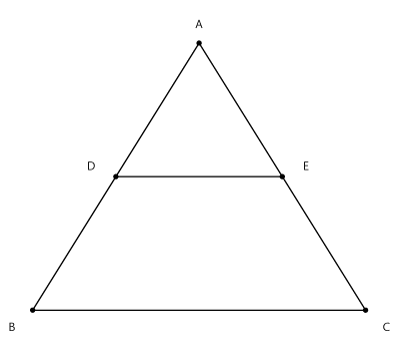
To find the length of segment \( AE \) in triangle \( \triangle ABC \) where \( DE \parallel BC \), we use the Basic Proportionality Theorem (or Thales' theorem), which states that if a line is drawn parallel to one side of a triangle, it divides the other two sides proportionally.
Correct Option: B) 2.1 cm
To find the next number in the series, we need to identify the pattern or relationship between the given numbers. We will analyze the differences between consecutive terms to determine if there's an arithmetic progression, a quadratic progression, or another type of sequence.
C) 401 is the correct answer because it follows the established pattern of increasing differences by 2, or by being one more than the square of consecutive integers.