
To answer this question, we need to recall the birth years of the Prime Ministers listed and compare them with India's independence date, which is August 15, 1947.
Correct Option: B) Narendra Modi
The question asks to identify which of the given options is NOT a type of social networking application. To answer this, we need to understand what constitutes a social networking application and then evaluate each option based on its primary function.
Correct Option: A) Haptik is an AI conversational platform for businesses, not a social networking application for individuals to connect socially.
Study the given pattern carefully and select the number that can replace the question mark (?) in it. 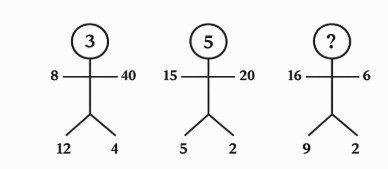
The pattern involves a stick figure with numbers at various positions. The number in the circle is derived from the numbers on the arms and legs of the figure.
Correct Option: A) 2
To find the percentage gain, we first need to calculate the actual gain (profit) by subtracting the cost price from the selling price. Then, we divide this gain by the cost price and multiply by 100 to express it as a percentage.
The man buys the book for ₹60, so the Cost Price \(CP = \text{₹}60\).
He sells it for ₹90, so the Selling Price \(SP = \text{₹}90\).
Gain is the difference between the Selling Price and the Cost Price.
\[ \text{Gain} = \text{SP} - \text{CP} \]
\[ \text{Gain} = \text{₹}90 - \text{₹}60 \]
\[ \text{Gain} = \text{₹}30 \]
Percentage Gain is calculated using the formula:
\[ \text{Percentage Gain} = \left( \frac{\text{Gain}}{\text{CP}} \right) \times 100 \%\]
Substitute the values:
\[ \text{Percentage Gain} = \left( \frac{30}{60} \right) \times 100 \% \]
\[ \text{Percentage Gain} = \left( \frac{1}{2} \right) \times 100 \% \]
\[ \text{Percentage Gain} = 50 \% \]
Correct Option: B) 50%
The question asks about the organization that launched the 'Young Scientist Programme (Yuvika-2019)'. This requires knowledge of major Indian scientific and financial institutions and their initiatives, particularly those related to space science and youth engagement.
A) ISRO (Indian Space Research Organisation) launched the 'Young Scientist Programme (Yuvika-2019)'. This program is specifically designed to encourage young students to pursue careers in science, technology, engineering, and mathematics (STEM), especially in space-related fields.
To find the code for 'Sharks', we need to compare the given statements and identify common words and their corresponding common codes. This is a common technique in coding-decoding problems where each word has a unique code.
A) The code for 'Sharks' is '@', as determined by comparing the common words and codes in the given statements.
The question asks to identify the type of satellite that APPLE was. This requires knowledge of India's early satellite programs and their specific applications.
Correct Option: C) Communication satellite. APPLE was India's first experimental geostationary communication satellite, launched to gain experience in satellite communication technology.
To find when A and B will be at the starting point again, we need to determine the time each person takes to complete one full round. Then, we find the least common multiple (LCM) of these individual times. The LCM represents the earliest time when both will simultaneously be at the starting point.
Calculate the time taken by A to complete one round:
The distance of the circular path is 10 km. A's speed is 3 km/h.
\[ \text{Time taken by A} = \frac{\text{Distance}}{\text{Speed of A}} = \frac{10 \text{ km}}{3 \text{ km/h}} = \frac{10}{3} \text{ hours} \]Calculate the time taken by B to complete one round:
The distance of the circular path is 10 km. B's speed is 2 km/h.
\[ \text{Time taken by B} = \frac{\text{Distance}}{\text{Speed of B}} = \frac{10 \text{ km}}{2 \text{ km/h}} = 5 \text{ hours} \]Find the LCM of the times taken by A and B:
A will be at the starting point after \(\frac{10}{3}\) hours, \(\frac{20}{3}\) hours, \(\frac{30}{3} = 10\) hours, etc.
B will be at the starting point after 5 hours, 10 hours, 15 hours, etc.
To find when they will be at the starting point again simultaneously, we need to find the LCM of \(\frac{10}{3}\) and 5.
The LCM of fractions \(\frac{a}{b}\) and \(\frac{c}{d}\) is given by \[\frac{\text{LCM of numerators}}{\text{HCF of denominators}}\].
So, for \(\frac{10}{3}\) and \(\frac{5}{1}\):
Therefore, the LCM is \(\frac{10}{1} = 10\) hours.
This means that after 10 hours, both A and B will be at the starting point simultaneously.
C) 10 h — After 10 hours, A will have completed \(10 / (10/3) = 3\) rounds and B will have completed \(10 / 5 = 2\) rounds. Both will be at the starting point.
If \(\sqrt{x}\)+ (\( \frac{2}{5} \)) × 70 = 20 × (\( \frac{1}{4} \)) × 7, then the value of x is:
The problem requires us to find the value of \(x\) from a given algebraic equation involving square roots and basic arithmetic operations. We will simplify both sides of the equation step-by-step to isolate the term containing \(x\) and then solve for \(x\).
Write down the given equation:
\[ \sqrt{x} + \left( \frac{2}{5} \right) \times 70 = 20 \times \left( \frac{1}{4} \right) \times 7 \]Simplify the left side of the equation:
\[ \left( \frac{2}{5} \right) \times 70 = 2 \times \frac{70}{5} = 2 \times 14 = 28 \]So, the left side becomes:\[ \sqrt{x} + 28 \]Simplify the right side of the equation:
\[ 20 \times \left( \frac{1}{4} \right) \times 7 = \frac{20}{4} \times 7 = 5 \times 7 = 35 \]Now, equate the simplified left and right sides:
\[ \sqrt{x} + 28 = 35 \]Isolate the \(\sqrt{x}\) term by subtracting 28 from both sides:
\[ \sqrt{x} = 35 - 28 \]\[ \sqrt{x} = 7 \]To find \(x\), square both sides of the equation:
\[ (\sqrt{x})^2 = 7^2 \]\[ x = 49 \]Correct Option: C) 49
The problem asks us to evaluate a statement and determine which courses of action logically follow from it. The statement describes a forecast of heavy snowfall in Kashmir for an entire week. We need to consider the practical and responsible actions that should be taken in response to such a forecast.
Correct Option: D) Only action (i) and (ii) follow.