
To find the maximum capacity of a container that can measure the oil from both cans an exact number of times, we need to find the Highest Common Factor (HCF) or Greatest Common Divisor (GCD) of the two quantities of oil.
B) 5 litres — The HCF of 50 and 35 is 5. A 5-litre container can measure 50 litres exactly 10 times (\(50 \div 5 = 10\)) and 35 litres exactly 7 times (\(35 \div 5 = 7\)). This is the largest such capacity.
The question asks for the specific year when German and Italian archaeologists commenced surface explorations at Mohenjo-daro. This requires knowledge of the history of archaeological research at this significant Indus Valley Civilization site.
C) 1980 — A team of German and Italian archaeologists began surface explorations at Mohenjo-daro in 1980. This project was led by Dr. Michael Jansen (Germany) and Dr. Maurizio Tosi (Italy) and focused on detailed architectural and topographical surveys.
The question asks to identify an enzyme responsible for converting proteins into peptides. This requires knowledge of digestive enzymes and their specific substrates.
Correct Option: A) Pepsin is a proteolytic enzyme secreted in the stomach that breaks down proteins into smaller polypeptides (peptides).
The question asks to identify the point where a nervous impulse passes from one structure to another. This is a fundamental concept in neurobiology, specifically related to the transmission of signals within the nervous system.
Therefore, a synapse is the point of communication between two neurons, or between a neuron and an effector cell.
Correct Option: D) one neuron to another
The problem asks us to find the value of an expression involving \(x\) and \(y\), where \(x\) and \(y\) are defined in terms of trigonometric functions of \(\theta\). We will first simplify the expressions for \(x^2+4\) and \((y^2-1)^2\) separately using trigonometric identities, and then multiply them to find the final value.
Given \(x = \tan \theta - \cot \theta\).
Square both sides:
\[ x^2 = (\tan \theta - \cot \theta)^2 = \tan^2 \theta + \cot^2 \theta - 2 \tan \theta \cot \theta \]Since \(\tan \theta \cot \theta = 1\), we have:
\[ x^2 = \tan^2 \theta + \cot^2 \theta - 2 \]Now, add 4 to both sides:
\[ x^2 + 4 = \tan^2 \theta + \cot^2 \theta - 2 + 4 \] \[ x^2 + 4 = \tan^2 \theta + \cot^2 \theta + 2 \]This expression is in the form of \((a+b)^2\), so:
\[ x^2 + 4 = (\tan \theta + \cot \theta)^2 \quad \text{(Equation 1)} \]Given \(y = \cos \theta - \sin \theta\).
Square both sides:
\[ y^2 = (\cos \theta - \sin \theta)^2 = \cos^2 \theta + \sin^2 \theta - 2 \sin \theta \cos \theta \]Using the identity \(\sin^2 \theta + \cos^2 \theta = 1\):
\[ y^2 = 1 - 2 \sin \theta \cos \theta \]Now, subtract 1 from \(y^2\):
\[ y^2 - 1 = (1 - 2 \sin \theta \cos \theta) - 1 \] \[ y^2 - 1 = -2 \sin \theta \cos \theta \]Square the expression \((y^2-1)\):
\[ (y^2 - 1)^2 = (-2 \sin \theta \cos \theta)^2 \] \[ (y^2 - 1)^2 = 4 \sin^2 \theta \cos^2 \theta \quad \text{(Equation 2)} \]We need to find the value of \((x^2 + 4)(y^2 - 1)^2\).
Substitute the simplified expressions from Equation 1 and Equation 2:
\[ (x^2 + 4)(y^2 - 1)^2 = (\tan \theta + \cot \theta)^2 (4 \sin^2 \theta \cos^2 \theta) \]Rewrite \(\tan \theta\) and \(\cot \theta\) in terms of \(\sin \theta\) and \(\cos \theta\):
\[ \tan \theta + \cot \theta = \frac{\sin \theta}{\cos \theta} + \frac{\cos \theta}{\sin \theta} \] \[ = \frac{\sin^2 \theta + \cos^2 \theta}{\sin \theta \cos \theta} \] \[ = \frac{1}{\sin \theta \cos \theta} \]Now substitute this back into the expression:
\[ (x^2 + 4)(y^2 - 1)^2 = \left(\frac{1}{\sin \theta \cos \theta}\right)^2 (4 \sin^2 \theta \cos^2 \theta) \] \[ = \frac{1}{\sin^2 \theta \cos^2 \theta} (4 \sin^2 \theta \cos^2 \theta) \]Cancel out the \(\sin^2 \theta \cos^2 \theta\) terms:
\[ = 4 \]C) The final calculated value is 4.
The following figure is a combination of 4 figures, P, Q, R and S. Figure P represents people who are swimmers while figure Q represents acrobats. Figure R and S represent painters and chefs, respectively. According to the figure below, whom does region 8 represent?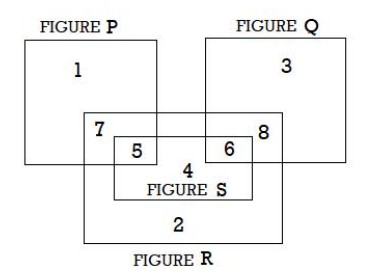
People who are painters and acrobats
People who are swimmers and acrobats
People who are chefs and swimmers
People who are chefs, painters and acrobats
The diagram consists of four overlapping figures labeled P, Q, R, and S, representing swimmers, acrobats, painters, and chefs, respectively. The regions where these figures overlap represent people who belong to multiple categories.
Correct Option: A) People who are painters and acrobats
This problem involves calculating the total time taken to type a certain number of words when two individuals type alternately. We need to determine the words typed in one cycle (2 minutes) and then find out how many full cycles are completed. Finally, we calculate the remaining words and the time taken by the individual who types them.
Calculate words typed in one cycle:
A types 50 words in 1 min.
B types 40 words in 1 min.
In one cycle (A types for 1 min, then B types for 1 min), the total time taken is \(1 + 1 = 2\) minutes.
Words typed in one cycle \( = 50 + 40 = 90\) words.
Determine the number of full cycles:
Total words to be typed = 980 words.
Number of words per cycle = 90 words.
Number of full cycles \[= \frac{\text{Total words}}{\text{Words per cycle}} = \frac{980}{90} = 10\] with a remainder of \(980 - (10 \times 90) = 980 - 900 = 80\) words.
Calculate time for full cycles:
Time for 10 full cycles \( = 10 \times 2 \text{ minutes} = 20 \text{ minutes}\).
Calculate time for remaining words:
After 10 cycles, 80 words remain. It's A's turn to type.
A types 50 words in 1 min.
A types the first 50 words of the remaining 80 words in 1 min.
Remaining words after A's turn \( = 80 - 50 = 30\) words.
Total time so far \( = 20 \text{ minutes} + 1 \text{ minute} = 21 \text{ minutes}\).
Calculate time for the last remaining words:
Now it's B's turn to type the remaining 30 words.
B types 40 words in 1 min (or 60 seconds).
Time taken by B to type 30 words \[= \frac{30}{40} \times 60 \text{ seconds} = \frac{3}{4} \times 60 \text{ seconds} = 45 \text{ seconds}\].
Calculate total time:
Total time \( = 21 \text{ minutes} + 45 \text{ seconds} = 21 \text{ min } 45 \text{ s}\).
Correct Option: B) 21 min 45 s
Which of the following is related to the 124th Constitutional Amendment Bill?
National Commission for Backward Class
GST Bill
Right to free and compulsory education till the age of fourteen
10% reservation to economically weaker sections in the general category
The question asks to identify the subject matter related to the 124th Constitutional Amendment Bill. This requires knowledge of significant constitutional amendments and bills in India.
Correct Option: D) 10% reservation to economically weaker sections in the general category
If \( \operatorname{cosec} ^{4}\theta = 49 + \cot ^{4}\theta \), what is the value of sin θ?
\( \frac{1}{8} \)
\( \frac{1}{5} \)
\( \frac{1}{6} \)
\( \frac{1}{7} \)
The problem provides an equation relating \(\operatorname{cosec}^{4}\theta\) and \(\cot^{4}\theta\). We need to find the value of \(\sin\theta\). We will use the fundamental trigonometric identity \(\operatorname{cosec}^{2}\theta - \cot^{2}\theta = 1\) to simplify the given equation and solve for \(\operatorname{cosec}\theta\) or \(\sin\theta\).
Recall the trigonometric identity:
\[ \operatorname{cosec}^{2}\theta - \cot^{2}\theta = 1 \]The given equation is:
\[ \operatorname{cosec}^{4}\theta = 49 + \cot^{4}\theta \]Rearrange the given equation to group the \(\operatorname{cosec}\) and \(\cot\) terms:
\[ \operatorname{cosec}^{4}\theta - \cot^{4}\theta = 49 \]Factor the left side using the difference of squares formula \((a^2 - b^2) = (a-b)(a+b)\). Here, \(a = \operatorname{cosec}^{2}\theta\) and \(b = \cot^{2}\theta\):
\[ (\operatorname{cosec}^{2}\theta - \cot^{2}\theta)(\operatorname{cosec}^{2}\theta + \cot^{2}\theta) = 49 \]Substitute the identity \(\operatorname{cosec}^{2}\theta - \cot^{2}\theta = 1\) into the factored equation:
\[ (1)(\operatorname{cosec}^{2}\theta + \cot^{2}\theta) = 49 \]\[ \operatorname{cosec}^{2}\theta + \cot^{2}\theta = 49 \]Now we have a system of two equations:
Equation (1): \(\operatorname{cosec}^{2}\theta - \cot^{2}\theta = 1\)
Equation (2): \(\operatorname{cosec}^{2}\theta + \cot^{2}\theta = 49\)
Add Equation (1) and Equation (2):
\[ (\operatorname{cosec}^{2}\theta - \cot^{2}\theta) + (\operatorname{cosec}^{2}\theta + \cot^{2}\theta) = 1 + 49 \]\[ 2\operatorname{cosec}^{2}\theta = 50 \]Solve for \(\operatorname{cosec}^{2}\theta\):
\[ \operatorname{cosec}^{2}\theta = \frac{50}{2} \]\[ \operatorname{cosec}^{2}\theta = 25 \]Take the square root of both sides. Since \(\operatorname{cosec}\theta = 1/\sin\theta\), and \(\sin\theta\) is typically positive in competitive exam problems unless a specific quadrant is mentioned, we consider the positive root:
\[ \operatorname{cosec}\theta = \sqrt{25} \]\[ \operatorname{cosec}\theta = 5 \]Since \(\operatorname{cosec}\theta = \frac{1}{\sin\theta}\), we can find \(\sin\theta\):
\[ \sin\theta = \frac{1}{\operatorname{cosec}\theta} \]\[ \sin\theta = \frac{1}{5} \]B) The value of \(\sin\theta\) is \(\frac{1}{5}\).