
The question asks about the percentage of stakes owned by the Government of India in SAIL (Steel Authority of India Limited) as of October 2020. This requires knowledge of government shareholding in Public Sector Undertakings (PSUs).
A) 75% — As of October 2020, the Government of India owned 75% of the stakes in Steel Authority of India Limited (SAIL). This makes SAIL a government-controlled entity.
The question asks for the headquarters location of the World Intellectual Property Organization (WIPO). This is a factual question requiring knowledge of international organizations and their administrative centers.
B) Geneva
The World Intellectual Property Organization (WIPO) is one of the 15 specialized agencies of the United Nations. Its main objective is to promote the protection of intellectual property throughout the world. WIPO is headquartered in Geneva, Switzerland. Geneva is a major hub for numerous international organizations, including many UN agencies.
The problem involves calculating the actual distance between two cities given their distance on a map and the map's scale. The scale represents the ratio of map distance to actual distance. We will use this ratio to find the actual distance and then convert the units to kilometers.
Correct Option: C) 6 km is the actual distance between the two cities.
The question asks about the initial purpose of Hindustan Steel Limited (HSL) concerning specific steel plants in India. To answer this, we need to recall the historical context of the establishment and management of major public sector steel plants in India.
Therefore, based on its initial design and establishment, HSL was intended to manage the Rourkela Steel Plant first.
Correct Option: B) Rourkela
In the following diagram, L represents educated people, M represents illiterate people, N represents working people. Which number represents people who are working and illiterate?"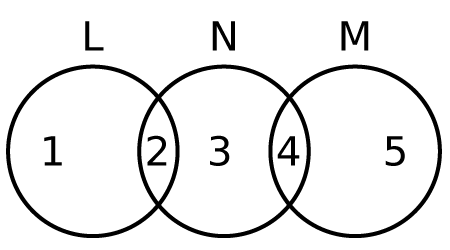
We need to identify the section of the Venn diagram that represents people who are both working and illiterate. This involves understanding the relationship between the circles labeled L, M, and N.
Therefore, the number that represents people who are working and illiterate is 4.
Correct Option: A) 4
If the cost price of 15 shirts is equal to the selling price of 10 shirts, then what will be the gain or loss percent?
50% gain
33 \( \frac{1}{3} \)% gain
50% loss
33 \( \frac{1}{3} \)% loss
To determine the gain or loss percentage, we need to establish a relationship between the cost price (CP) and the selling price (SP) of a single shirt based on the given information. We will then use the formula for gain/loss percentage.
Let the Cost Price (CP) of one shirt be \( \text{CP} \) and the Selling Price (SP) of one shirt be \( \text{SP} \).
According to the problem statement, the cost price of 15 shirts is equal to the selling price of 10 shirts. We can write this as an equation:
\[ 15 \times \text{CP} = 10 \times \text{SP} \]Now, we need to find the ratio of SP to CP:
\[ \frac{\text{SP}}{\text{CP}} = \frac{15}{10} = \frac{3}{2} \]This means that for every \( \text{CP} = 2 \) units, \( \text{SP} = 3 \) units. Since \( \text{SP} > \text{CP} \), there is a gain.
Calculate the gain:
\[ \text{Gain} = \text{SP} - \text{CP} = 3 - 2 = 1 \text{ unit} \]Calculate the gain percentage using the formula:
\[ \text{Gain Percent} = \left( \frac{\text{Gain}}{\text{CP}} \right) \times 100\% \]\[ \text{Gain Percent} = \left( \frac{1}{2} \right) \times 100\% \]\[ \text{Gain Percent} = 50\% \]A) 50% gain — As calculated, the gain percentage is 50%.
To solve this problem, we need to determine the combined rate of work of the two inlet pipes and the one outlet pipe. We will calculate the fraction of the tank filled or emptied by each pipe in one hour and then combine these rates to find the net filling rate. Finally, we will use the net rate to find the total time required to fill the tank.
Pipe A can fill the tank in 12 hours. So, in one hour, pipe A fills:
\[ \text{Rate}_A = \frac{1}{12} \text{ of the tank} \]Pipe B can fill the tank in 16 hours. So, in one hour, pipe B fills:
\[ \text{Rate}_B = \frac{1}{16} \text{ of the tank} \]Pipe C can empty the tank in 8 hours. So, in one hour, pipe C empties:
\[ \text{Rate}_C = \frac{1}{8} \text{ of the tank} \]When both inlets A and B are filling, and outlet C is emptying, the net change in the tank's volume per hour is the sum of the filling rates minus the emptying rate:
\[ \text{Net Rate} = \text{Rate}_A + \text{Rate}_B - \text{Rate}_C \]\[ \text{Net Rate} = \frac{1}{12} + \frac{1}{16} - \frac{1}{8} \]The least common multiple (LCM) of 12, 16, and 8 is 48.
\[ \text{Net Rate} = \frac{4}{48} + \frac{3}{48} - \frac{6}{48} \]If the net rate is \(\frac{1}{48}\) of the tank per hour, it means it takes 48 hours to fill the entire tank.
\[ \text{Time} = \frac{1}{\text{Net Rate}} = \frac{1}{\frac{1}{48}} = 48 \text{ hours} \]D) 48 hours is the correct answer. When all three pipes are operating simultaneously, the tank will fill at a net rate of \(\frac{1}{48}\) of its capacity per hour, leading to a total filling time of 48 hours.
The question asks about the shift of the capital of Magadha by Udayin. To answer this, we need to recall the historical facts related to the Magadhan Empire and its rulers, specifically Udayin (also known as Udayabhadra).
B) Rajagaha — Udayin shifted the capital of Magadha from Rajagaha (also known as Rajagriha or Girivraja) to Pataliputra. Rajagaha was strategically located amidst five hills, making it naturally defensible. However, Pataliputra, being at the confluence of major rivers, offered better control over trade routes and was considered more central for the expanding Magadhan empire.
(\(\sqrt{2}\) + \(\sqrt{3}\))(\(\sqrt{2}\) − \(\sqrt{3}\)) is equal to:
The problem requires us to simplify the given expression \((\sqrt{2} + \sqrt{3})(\sqrt{2} - \sqrt{3})\). This expression is in the form of a standard algebraic identity: \((a+b)(a-b) = a^2 - b^2\). We will apply this identity to find the value of the expression.
\[ (\sqrt{2} + \sqrt{3})(\sqrt{2} - \sqrt{3}) = (\sqrt{2})^2 - (\sqrt{3})^2 \]
\[ (\sqrt{2})^2 = 2 \]
\[ (\sqrt{3})^2 = 3 \]
\[ 2 - 3 = -1 \]
Thus, the value of the expression is \(-1\).
C) \(-1\) is the correct answer, as derived from applying the difference of squares identity.
When was the Indian Election Commission set up?
25th February, 1950
26th November, 1950
15th August, 1950
25th January, 1950
The question asks for the establishment date of the Indian Election Commission. This is a factual question requiring knowledge of key dates in Indian constitutional history.
Correct Option: D) 25 th January, 1950
The Election Commission of India (ECI) is a permanent and independent body established by the Constitution of India directly to ensure free and fair elections in the country. It was set up on 25th January 1950, a day before India became a Republic. This date is also celebrated as National Voters' Day.