
If the diagonal of a cube is 10\(\sqrt{3}\) cm long, then what is its volume?
To find the volume of a cube, we first need to determine the length of its side. We are given the length of the diagonal of the cube. We can use the formula relating the diagonal of a cube to its side length, and then use the side length to calculate the volume.
If \(a\) is the side length of a cube, then the length of its diagonal \(d\) is given by the formula:
\[ d = a\sqrt{3} \]We are given that the diagonal \(d = 10\sqrt{3}\) cm. Substitute this into the formula:
\[ 10\sqrt{3} = a\sqrt{3} \]Divide both sides by \(\sqrt{3}\):
\[ a = \frac{10\sqrt{3}}{\sqrt{3}} \]\[ a = 10 \text{ cm} \]The volume \(V\) of a cube with side length \(a\) is given by the formula:
\[ V = a^3 \]Using \(a = 10\) cm:
\[ V = (10 \text{ cm})^3 \]\[ V = 10 \times 10 \times 10 \text{ cm}^3 \]\[ V = 1000 \text{ cm}^3 \]Correct Option: B) 1000 cm³
How many planets are not sun?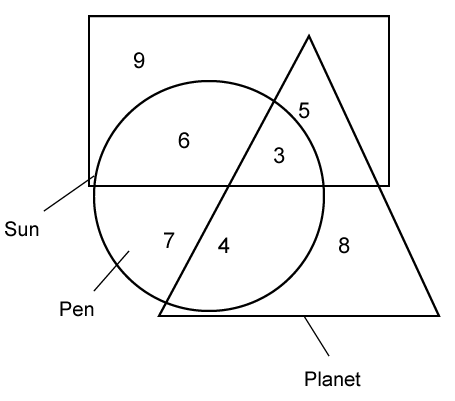
To determine how many planets are not the sun, we need to analyze the diagram, which includes a rectangle labeled "Sun," a circle labeled "Pen," and a triangle labeled "Planet." The numbers within these shapes represent elements belonging to each category or their intersections.
Correct Option: C) 12
The question asks for the year in which the Government of India approved ISRO's proposal for the first Indian Moon Mission, Chandrayaan-1. This requires knowledge of the historical timeline of India's space program, specifically related to its lunar missions.
Therefore, the year of approval was 2003.
Correct Option: A) 2003
The question asks for the number of rational numbers between two given integers, 5 and 7. To answer this, we need to understand the definition of rational numbers and their density property on the number line.
We can always find a new rational number by taking the average of any two rational numbers, for example, between 5 and 6, we have \(\frac{5+6}{2} = 5.5\). Between 5 and 5.5, we have \(\frac{5+5.5}{2} = 5.25\), and so on. This process can be continued indefinitely, generating an infinite number of rational numbers.
B) infinite — Due to the density property of rational numbers, there are infinitely many rational numbers between any two distinct rational numbers, including 5 and 7.
The question asks to identify the correct matching of a Part of the Indian Constitution with its subject matter. This requires knowledge of the structure and contents of the Indian Constitution.
B) Part III – Fundamental Rights
Part III of the Indian Constitution (Articles 12 to 35) deals with Fundamental Rights. These rights are essential for the intellectual, moral, and spiritual development of individuals and are enforceable by courts.
If x = \(\sqrt{3}\) + \(\sqrt{2}\), then the value of x² + \( \frac{1}{x^2} \) is:
To find the value of \(x^2 + \frac{1}{x^2}\) given \(x = \sqrt{3} + \sqrt{2}\), we first need to calculate \(x^2\). Then, we will find \(\frac{1}{x}\) by rationalizing the denominator, and subsequently calculate \(\frac{1}{x^2}\). Finally, we sum \(x^2\) and \(\frac{1}{x^2}\).
Correct Option: D) 10
The product of 4\(\sqrt{6}\) and 3\(\sqrt{24}\) is:
a negative number
a prime number
a rational number
an irrational number
To find the product of the given numbers, we will multiply them. We will simplify the square roots by factoring out perfect squares and then combine the terms. Finally, we will determine the nature of the resulting number (rational, irrational, prime, or negative).
The two numbers are \(4\sqrt{6}\) and \(3\sqrt{24}\).
Product \(P = (4\sqrt{6}) \times (3\sqrt{24})\)
Multiply the coefficients and the terms under the square root separately:
\[ P = (4 \times 3) \times (\sqrt{6} \times \sqrt{24}) \]\[ P = 12 \times \sqrt{6 \times 24} \]\[ P = 12 \times \sqrt{144} \]We know that \(144\) is a perfect square, as \(12 \times 12 = 144\).
\[ \sqrt{144} = 12 \]The product is \(144\).
Therefore, \(144\) is a rational number.
Correct Option: C) a rational number
The question asks to identify the Indian personality who received the 'Champions of the Earth' award, the UN's highest environmental honour, in 2018. This requires knowledge of significant environmental awards and their recipients, particularly those related to India.
Correct Option: D) Narendra Modi
The question asks to identify the leader whose opposition in 1928 led to the failure of compromise efforts between the Indian National Congress and the Muslim League. This refers to the discussions around the Nehru Report and the subsequent All Parties Conference.
D) MR Jayakar — His strong opposition, representing the Hindu Mahasabha, to Jinnah's proposed amendments to the Nehru Report, particularly concerning Muslim representation and reservations, was a primary reason for the breakdown of compromise between the Congress and the Muslim League in 1928.
The problem involves decoding a word based on a given coding pattern. We need to identify the rule applied to transform "TRUNK" into "YVXPL" and then apply the same rule to "GLOBE".
TRUNK is coded as YVXPL.
The pattern is a decreasing increment: +5, +4, +3, +2, +1 for successive letters.
L P R D F
A) LPRDF is the correct code for GLOBE, following the identified pattern of adding +5, +4, +3, +2, +1 to successive letters.