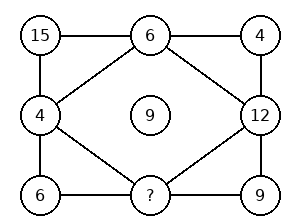
Select the number from among the given options that can replace the question mark (?) in the above figure.
The diagram consists of a series of numbers arranged in a geometric pattern. The objective is to determine the logic or pattern that relates these numbers and find the missing number represented by a question mark.
Thus, the missing number is 10.
Correct Option: D) 10
To find the image of a point reflected along the x-axis, we need to understand how the coordinates change during such a reflection. Reflection across the x-axis means the x-coordinate remains the same, while the y-coordinate changes its sign.
D) (7, -8) is the correct image of the point \((7, 8)\) when reflected along the x-axis, as the x-coordinate remains unchanged and the y-coordinate becomes its negative.
This is a blood relation question. To solve such problems, it's best to break down the statement into smaller, manageable parts, starting from the end of the statement and working backward to establish the relationship with the main person (Paulo in this case).
Therefore, the teacher is Paulo's paternal aunt.
B) Paternal aunt — As derived step-by-step, the teacher is the sister of Paulo's father, which makes her Paulo's paternal aunt.
To find the length of the bridge, we need to use the relationship between speed, distance, and time. The man's speed is given in km/h, and the time taken is in minutes. We need to convert these units to be consistent (e.g., meters per second or kilometers per hour and hours) to calculate the distance in meters.
Given speed \( = 5 \text{ km/h}\).
To convert km/h to m/s, we multiply by \(\frac{5}{18}\).
\[ \text{Speed} = 5 \times \frac{5}{18} \text{ m/s} = \frac{25}{18} \text{ m/s} \]Given time \( = 15 \text{ minutes}\).
To convert minutes to seconds, we multiply by 60.
\[ \text{Time} = 15 \times 60 \text{ seconds} = 900 \text{ seconds} \]The formula for distance is:
\[ \text{Distance} = \text{Speed} \times \text{Time} \]\[ \text{Distance} = \frac{25}{18} \text{ m/s} \times 900 \text{ s} \]\[ \text{Distance} = 25 \times \frac{900}{18} \text{ m} \]\[ \text{Distance} = 25 \times 50 \text{ m} \]\[ \text{Distance} = 1250 \text{ m} \]The length of the bridge is 1250 meters.
Correct Option: D) 1250
What will be the simple interest earned on an amount of ₹16,800 in 9 months at the rate of 6\( \frac{1}{4} \)% per annum?
To calculate the simple interest, we use the formula \(SI = \frac{P \times R \times T}{100}\). We need to ensure that the time (T) is expressed in years and the rate (R) is an annual rate. The given time is in months, so it must be converted to years.
The rate is \(6\frac{1}{4}\)%. Convert this mixed fraction to an improper fraction:
\[ R = 6\frac{1}{4}\% = \frac{(6 \times 4) + 1}{4}\% = \frac{24 + 1}{4}\% = \frac{25}{4}\% \]Since there are 12 months in a year, 9 months can be expressed as:
\[ T = \frac{9}{12} \text{ years} = \frac{3}{4} \text{ years} \]The formula for Simple Interest (SI) is:
\[ SI = \frac{P \times R \times T}{100} \]Simplify the expression:
\[ SI = \frac{16800 \times 25 \times 3}{100 \times 4 \times 4} \]\[ SI = \frac{16800 \times 75}{1600} \]\[ SI = \frac{168 \times 75}{16} \]\[ SI = \frac{42 \times 75}{4} \]\[ SI = \frac{21 \times 75}{2} \]\[ SI = \frac{1575}{2} \]\[ SI = 787.50 \]A) ₹787.50 is the simple interest earned.
Dandi March, the non-violent protest organised by Mahatma Gandhi against the British salt monopoly, culminated on:
6th April 1930
4th April 1930
7th April 1930
5th April 1930
The question asks for the culmination date of the Dandi March. This is a factual question about a significant event in Indian history. To answer correctly, one needs to recall the specific date when Mahatma Gandhi broke the salt law at Dandi.
Correct Option: A) 6th April 1930 is the correct date when Mahatma Gandhi reached Dandi and broke the salt law, marking the culmination of the Dandi March.
Which of the following is the smallest fraction?
\( \frac{7}{6} \),\( \frac{7}{9} \), \( \frac{4}{5} \), \( \frac{5}{7} \)
\( \frac{7}{6} \)
\( \frac{4}{5} \)
\( \frac{7}{9} \)
\( \frac{5}{7} \)
To find the smallest fraction among a given set, we can convert each fraction into its decimal equivalent. Comparing decimal values is straightforward: the fraction with the smallest decimal value is the smallest fraction.
Convert each fraction to a decimal:
Compare the decimal values:
The decimal values are approximately:
Identify the smallest decimal:
Comparing these values, \( 0.714 \) is the smallest decimal.
Relate back to the original fraction:
The decimal \( 0.714 \) corresponds to the fraction \( \frac{5}{7} \).
D) \( \frac{5}{7} \) is the smallest fraction because its decimal equivalent \( \approx 0.714 \) is the smallest among all the given options.
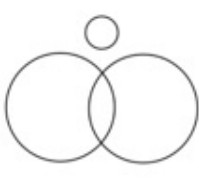
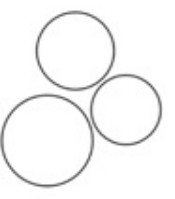
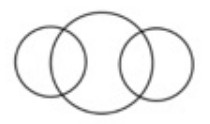
Which of the Venn diagrams shown below correctly represents the relationship: Juice, Soft Drinks, Drinks
To solve this question, we need to understand the relationship between the categories: Juice, Soft Drinks, and Drinks. Drinks is a broader category that includes both Juice and Soft Drinks. Therefore, Juice and Soft Drinks should be subsets of Drinks, but they do not overlap with each other.
Correct Option: D) The diagram shows two smaller circles inside a larger circle, representing Juice and Soft Drinks as separate subsets within Drinks.
To determine the percentage gain or loss, we will assume a cost price for the goods. Then, we will calculate the marked price based on the given markup percentage. Finally, we will calculate the selling price after applying the discount and compare it with the assumed cost price to find the percentage gain or loss.
Assume the Cost Price (CP):
Let the Cost Price (CP) of the goods be \(₹100\).
Calculate the Marked Price (MP):
The dealer marks his goods 10% above the cost price. So, the Marked Price will be:
Calculate the Selling Price (SP):
The dealer allows a 10% discount on the Marked Price. So, the Selling Price will be:
Calculate the Gain or Loss:
Now, we compare the Selling Price (SP) with the Cost Price (CP):
Since \(\text{SP} < \text{CP}\), there is a loss.
\[ \text{Loss} = \text{CP} - \text{SP} \]\[ \text{Loss} = 100 - 99 = ₹1 \]Calculate the Percentage Loss:
The percentage loss is calculated with respect to the Cost Price:
A) 1% loss
This problem involves comparing the cost price (CP) and selling price (SP) of items to determine if there's a profit or loss percentage. The key is to establish a relationship between the CP and SP of a single item based on the given condition.
Set up the initial equation:
The problem states that the cost price of six items is equal to the selling price of seven items. Let CP be the cost price of one item and SP be the selling price of one item.
Express CP in terms of SP (or vice versa):
From the equation above, we can find the ratio of CP to SP.
Determine if there is a profit or loss:
Since the cost price of one item (\(\text{CP}\)) is greater than its selling price (\(\text{SP}\)), there will be a loss. Specifically, \(\text{CP} = \frac{7}{6} \text{SP}\) means that for every 6 units of SP, the CP is 7 units. This indicates a loss.
Calculate the loss amount:
Loss is calculated as \(\text{CP} - \text{SP}\).
Calculate the percentage loss:
Percentage loss is calculated as \[\left(\frac{\text{Loss}}{\text{CP}}\right) \times 100\%\]. We need to express Loss in terms of CP or convert CP to SP for the calculation.
Using \(\text{CP} = \frac{7}{6} \text{SP}\) and \(\text{Loss} = \frac{1}{6} \text{SP}\):
\[ \text{Percentage Loss} = \frac{\frac{1}{6} \text{SP}}{\frac{7}{6} \text{SP}} \times 100\% \]\[ \text{Percentage Loss} = \frac{1}{7} \times 100\% \]\[ \text{Percentage Loss} = 14.2857...\% \]Round to two decimal places:
\[ \text{Percentage Loss} \approx 14.28\% \]D) 14.28% loss. The calculation shows a loss of approximately 14.28%.