
If y = 5, then what will be the value of 10y\(\sqrt{y^3-y^2}\)?
To find the value of the given expression, we need to substitute the value of \(y\) into the expression and then simplify it using basic algebraic operations and properties of square roots.
Given \(y = 5\), we substitute this into the expression \(10y\sqrt{y^3-y^2}\).
\[ 10(5)\sqrt{(5)^3 - (5)^2} \]First, calculate \(5^3\) and \(5^2\).
\[ 5^3 = 5 \times 5 \times 5 = 125 \]\[ 5^2 = 5 \times 5 = 25 \]Thus, the value of the expression is 500.
Correct Option: B) 500
The question asks about the authority empowered to grant pardons under Article 161 of the Indian Constitution. This requires knowledge of the constitutional provisions regarding pardoning powers.
D) Governor: Article 161 of the Indian Constitution explicitly grants the Governor of a State the power to grant pardons, reprieves, respites, or remissions of punishment, or to suspend, remit, or commute the sentence of any person convicted of any offence against any law relating to a matter to which the executive power of the State extends.
The question asks to identify the specific lubricating fluid found in movable joints between bones. This requires knowledge of human anatomy and physiology, specifically the components of a synovial joint.
A) Synovial fluid: This is the correct answer. Synovial fluid is a viscous, non-Newtonian fluid found in the cavities of synovial joints. Its primary role is to reduce friction between the articular cartilages of synovial joints during movement, acting as a lubricant. It also provides nutrients to the articular cartilage and absorbs shock.
Who wrote 'Ain-i-Akbari'? It is a 16th-century detailed document recording the administration of the Mughal Empire under Emperor Akbar.
The question asks to identify the author of 'Ain-i-Akbari', a significant historical document detailing the administration of the Mughal Empire under Emperor Akbar. This requires knowledge of prominent historians and writers of the Mughal period.
Correct Option: C) Abul Fazl wrote 'Ain-i-Akbari'. It is the third volume of the 'Akbarnama' and provides extensive details about the administration, revenue system, geography, and culture of the Mughal Empire during Akbar's rule.
The question asks about the founder of the Satyagraha Sabha in February 1919. This requires knowledge of key historical figures and events during India's freedom struggle, specifically related to Mahatma Gandhi's early movements.
D) Mohandas Karamchand Gandhi
Mohandas Karamchand Gandhi founded the Satyagraha Sabha in February 1919 in Bombay (now Mumbai). This organization was specifically established to launch a nationwide Satyagraha (non-violent civil disobedience) movement against the draconian Rowlatt Act, which allowed for the arrest and detention of individuals without trial.
How many squares are there in the given illustration? 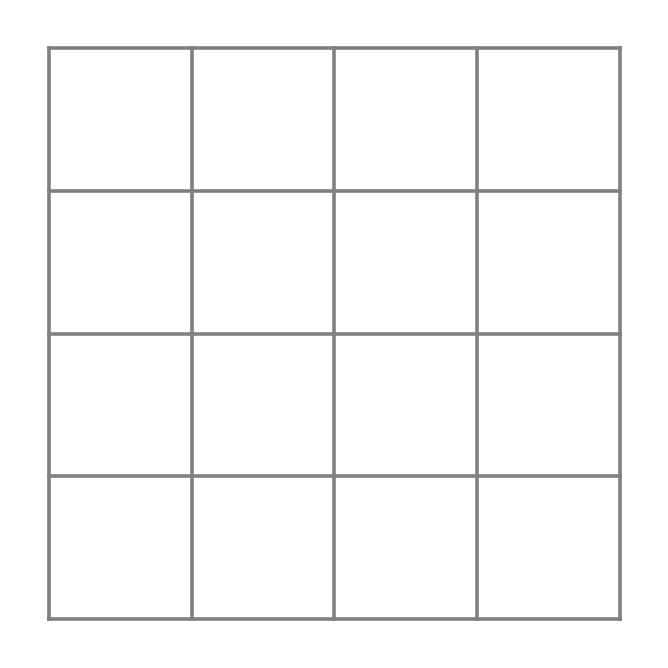
To determine the total number of squares in the given grid, we need to count all possible squares of different sizes within the grid.
Adding these together, the total number of squares is \(16 + 9 + 4 + 1 = 30\).
Correct Option: B) 30
The problem presents a pattern where two numbers are combined using a placeholder symbol (□) to produce three results. We need to identify the mathematical operations represented by the placeholder and then apply those same operations to the third pair of numbers to find the missing results.
Analyze the first equation:
\(25 \text{ □ } 36 = 5; 6; 11\)
Verify with the second equation:
\(100 \text{ □ } 64 = 10; 8; 18\)
Determine the pattern:
If \(A \text{ □ } B = X; Y; Z\), then the pattern is:
Apply the pattern to the third equation:
\(36 \text{ □ } 81 = ?; ?; ?\)
So, \(36 \text{ □ } 81 = 6; 9; 15\).
D) 6; 9; 15. This matches our calculated results.
The question asks for the location of the Great Victoria Desert. This is a factual geography question that requires knowledge of major deserts and their continental locations.
Correct Option: D) Australia — The Great Victoria Desert is indeed located in Australia, spanning Western Australia and South Australia. It is the largest desert in Australia.
The question asks about the composition of "Power Alcohol." This term refers to a specific blend of fuels used as an alternative to conventional gasoline. Understanding the components of this blend is key to answering the question.
Correct Option: B) petrol
What number must be subtracted from both the numerator and denominator of the fraction \( \frac{15}{19} \) so as to make it \( \frac{3}{4} \)?
To solve this problem, we need to set up an algebraic equation. Let the unknown number that must be subtracted from both the numerator and the denominator be \(x\). We then form a new fraction and equate it to the target fraction \( \frac{3}{4} \). Finally, we solve for \(x\).
Let the number to be subtracted from both the numerator and the denominator be \(x\).
The original fraction is \( \frac{15}{19} \).
After subtracting \(x\) from both the numerator and the denominator, the new fraction becomes \( \frac{15 - x}{19 - x} \).
According to the problem, this new fraction should be equal to \( \frac{3}{4} \). So, we set up the equation:
\[ \frac{15 - x}{19 - x} = \frac{3}{4} \]Now, we cross-multiply to solve for \(x\):
\[ 4(15 - x) = 3(19 - x) \]Distribute the numbers on both sides:
\[ 60 - 4x = 57 - 3x \]Rearrange the terms to isolate \(x\). Add \(4x\) to both sides:
\[ 60 = 57 - 3x + 4x \]\[ 60 = 57 + x \]Subtract \(57\) from both sides to find \(x\):
\[ x = 60 - 57 \]\[ x = 3 \]Thus, the number that must be subtracted is 3.
To verify, substitute \(x=3\) back into the modified fraction: \[\frac{15 - 3}{19 - 3} = \frac{12}{16}\]. Simplifying \( \frac{12}{16} \) by dividing both numerator and denominator by 4 gives \( \frac{3}{4} \), which matches the desired fraction.
Correct Option: D) 3