
The question asks to identify the type of chemical reaction represented by the given equation: \(2\text{Cu} + \text{O}_2 ightarrow 2\text{CuO}\). We need to analyze the reactants and products to classify the reaction.
Correct Option: D) combination
Read the given question and decide which of the following statements is/are sufficient to answer the
question
What is the value of z?
1. z2 + (-1) = 0
2. z is an integer
Neither 1 nor 2 is sufficient
Only 2 is sufficient
Both 1 and 2 are sufficient
Only 1 is sufficient
The problem asks us to determine if the given statements are sufficient to find the unique value of \(z\). We need to analyze each statement individually and then combine them if necessary.
The statement is \(z^2 + (-1) = 0\).
This can be rewritten as \(z^2 - 1 = 0\).
Factoring the equation, we get \((z - 1)(z + 1) = 0\).
This implies \(z - 1 = 0\) or \(z + 1 = 0\).
So, \(z = 1\) or \(z = -1\).
Since statement 1 gives two possible values for \(z\), it is not sufficient to find a unique value for \(z\).
The statement is "\(z\) is an integer".
This statement alone does not provide any specific value for \(z\). An integer can be any number from the set \(\{..., -3, -2, -1, 0, 1, 2, 3, ...\}\). Therefore, statement 2 is not sufficient to find a unique value for \(z\).
From statement 1, we know that \(z = 1\) or \(z = -1\).
From statement 2, we know that \(z\) is an integer.
Both \(1\) and \(-1\) are integers. Therefore, even when both statements are combined, we still have two possible values for \(z\), namely \(1\) and \(-1\).
Since we cannot determine a unique value for \(z\) even after combining both statements, neither statement 1 nor statement 2 (alone or combined) is sufficient to answer the question.
Correct Option: A) Neither 1 nor 2 is sufficient
Select the option that can replace the question mark (?) in the following series.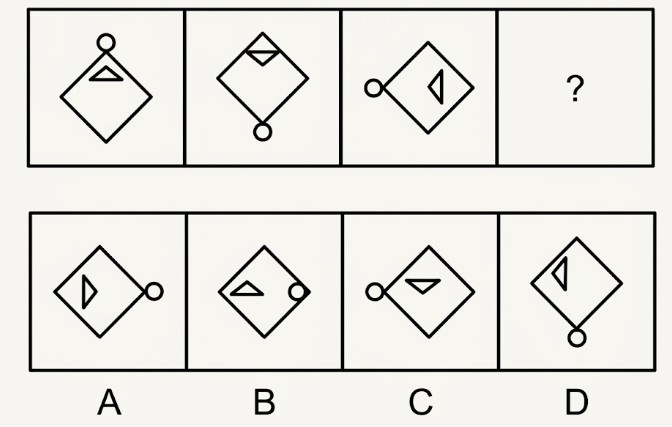
To determine the correct option for the series, we need to analyze the pattern in the given sequence of shapes and identify the consistent changes in orientation and position.
Therefore, the correct option is the image where the triangle points downwards and the circle is at the bottom, which matches option B.
Correct Option: B) Triangle pointing downwards, circle at the bottom.
We are given the percentage of students absent and the number of students present. We need to find the total strength of the class. We can determine the percentage of students present and then use this percentage along with the number of present students to calculate the total strength.
Correct Option: C) 40
The question asks to identify the word that does not belong to the group. This is a classification question where we need to find a common characteristic among most options and identify the outlier.
C) Hip-hop is the word that does not belong to the group because it is a modern, Western dance style, whereas the other options are traditional Indian classical dance forms.
A can do a piece of work in 8 hours while B alone can do it in 12 hours. Both A and B working together can finish the work in how much time?
10 hours
4 hours
\( \frac{24}{5} \) hours
\( \frac{21}{4} \) hours
This problem involves calculating the combined work rate of two individuals to find the total time taken to complete a task. We will determine the individual work rates (fraction of work done per hour) and then sum them to find the combined work rate. Finally, we will take the reciprocal of the combined work rate to find the total time.
If A can do a piece of work in 8 hours, then in 1 hour, A completes \(\frac{1}{8}\) of the work.
If B can do the same piece of work in 12 hours, then in 1 hour, B completes \(\frac{1}{12}\) of the work.
When A and B work together, their work rates add up. So, the fraction of work they complete together in 1 hour is:
\[ \text{Combined work rate} = \frac{1}{8} + \frac{1}{12} \]To add these fractions, find a common denominator, which is 24.
\[ \text{Combined work rate} = \frac{3}{24} + \frac{2}{24} = \frac{3+2}{24} = \frac{5}{24} \]So, A and B together complete \(\frac{5}{24}\) of the work in 1 hour.
If they complete \(\frac{5}{24}\) of the work in 1 hour, then the total time taken to complete the entire work (which is 1 unit of work) is the reciprocal of their combined work rate.
\[ \text{Total time} = \frac{1}{\text{Combined work rate}} = \frac{1}{\frac{5}{24}} = \frac{24}{5} \text{ hours} \]Correct Option: C) \( \frac{24}{5} \) hours
The question asks about the thick waxy coating found on the epidermis of desert plants. This coating is a crucial adaptation for survival in arid environments, primarily to prevent water loss. We need to identify the specific substance that forms this waxy layer.
A) cutin — Cutin is a waxy, lipid-like polymer that forms the main component of the plant cuticle. This cuticle is particularly thick in desert plants to reduce transpiration and prevent water loss, which is essential for their survival in arid conditions.
The question asks to identify the first Asian and first individual from Assam to be nominated for the Heritage Heroes Award – 2016 by the International Union for Conservation of Nature (IUCN). This is a factual recall question related to environmental awards and notable personalities.
D) Bibhuti Lahkar — Bibhuti Lahkar is a well-known conservation activist from Assam, India. He was nominated for the IUCN Heritage Heroes Award in 2016 for his significant contributions to wildlife conservation, particularly in the Manas National Park. This nomination made him the first Asian and the first individual from Assam to receive such recognition from the IUCN.
\(\frac{0.12 \div 0.15}{2}\) =?
To solve this problem, we need to perform the division operation inside the numerator first, and then divide the result by 2. It involves basic decimal arithmetic.
The numerator is \(0.12 \div 0.15\). We can rewrite this division as a fraction:
\[ \frac{0.12}{0.15} \]To remove the decimals, multiply both the numerator and the denominator by 100 (since there are two decimal places in both numbers):
\[ \frac{0.12 \times 100}{0.15 \times 100} = \frac{12}{15} \]Both 12 and 15 are divisible by 3:
\[ \frac{12 \div 3}{15 \div 3} = \frac{4}{5} \]Divide 4 by 5:
\[ 4 \div 5 = 0.8 \]Now, substitute this result back into the original expression:
\[ \frac{0.8}{2} \]Divide 0.8 by 2:
\[ 0.8 \div 2 = 0.4 \]Correct Option: C) 0.4
What is the area (in m2) of a triangular field whose sides measure 25 m, 39 m and 56 m?
To find the area of a triangular field when all three side lengths are given, we can use Heron's formula. Heron's formula requires calculating the semi-perimeter first, and then applying the formula to find the area.
Identify the side lengths: Let the sides of the triangle be \(a = 25 \text{ m}\), \(b = 39 \text{ m}\), and \(c = 56 \text{ m}\).
Calculate the semi-perimeter (s): The semi-perimeter is half the sum of the lengths of the sides of the triangle.
\[ s = \frac{a + b + c}{2} \] \[ s = \frac{25 + 39 + 56}{2} \] \[ s = \frac{120}{2} \] \[ s = 60 \text{ m} \]Apply Heron's Formula: Heron's formula for the area (\(A\)) of a triangle is:
\[ A = \sqrt{s(s-a)(s-b)(s-c)} \]Substitute the values of \(s\), \(a\), \(b\), and \(c\):
\[ A = \sqrt{60(60-25)(60-39)(60-56)} \] \[ A = \sqrt{60(35)(21)(4)} \]Calculate the product inside the square root:
\[ A = \sqrt{60 \times 35 \times 21 \times 4} \] \[ A = \sqrt{176400} \]Find the square root:
\[ A = 420 \text{ m}^2 \]Correct Option: A) The area of the triangular field is \(420 \text{ m}^2\).