
P 3 R I M J 3 Q % W @ / N $ E 5 X Y 1 # 8
Which is the 6th term to the right of 15th from the right end in the above series?
The problem asks us to find a specific term in a given series based on its position relative to the right end. We need to first identify the 15th term from the right end and then count 6 terms to its right.
P 3 R I M J 3 Q % W @ / N \( E 5 X Y 1 # 8
The right end is '8'.
Counting from the right end (starting with 8 as 1st):
1st: 8
2nd: #
3rd: 1
4th: Y
5th: X
6th: 5
7th: E
8th: \)
9th: N
10th: /
11th: @
12th: W
13th: %
14th: Q
15th: 3
So, the 15th term from the right end is '3' (the second '3' in the series).
The 15th term from the right end is '3'. We need to find the 6th term to its right. Moving right from '3':
1st to the right: Q
2nd to the right: %
3rd to the right: W
4th to the right: @
5th to the right: /
6th to the right: N
Therefore, the 6th term to the right of the 15th term from the right end is 'N'.
D) N is the correct answer because, following the step-by-step counting, 'N' is found to be the 6th term to the right of the 15th term from the right end of the series.
This is a statement and conclusion question. We need to determine which conclusions logically follow from the given statement. The statement describes an action (producer team presenting film highlights to media for promotion). We must infer the most direct and logical reasons or intentions behind this action.
Correct Option: D) Both conclusions follow.
Identify the odd one from the given figures.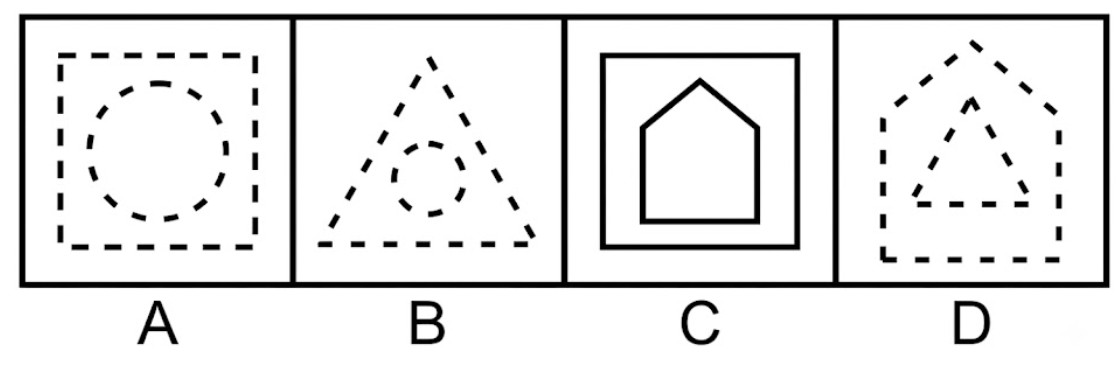
To identify the odd one out, examine the relationship between the shapes in each option. The odd one will have a different pattern or structure compared to the others.
Option C is the odd one out because it mixes different types of shapes (a pentagon and a square), unlike the other options that maintain a consistent pattern of similar shapes.
Correct Option: C) Option C is the odd one out due to the mix of different shapes.
To find the ratio of sand and cement, we need to establish a common link between the given ratios. Both ratios involve 'scree'. We will make the 'scree' part of the ratio equal in both given ratios to find the combined ratio of sand, scree, and cement.
Write down the given ratios:
Identify the common term: The common term in both ratios is 'scree'.
Make the common term equal in both ratios:
The scree part in the first ratio is \(30\), and in the second ratio, it is \(6\). To make them equal, find the least common multiple (LCM) of \(30\) and \(6\), which is \(30\).
Combine the ratios:
Now we have:
Since the scree part is now the same (\(30\)) in both ratios, we can combine them to get the ratio of Sand : Scree : Cement:
\[ \text{Sand} : \text{Scree} : \text{Cement} = 41 : 30 : 35 \]Find the ratio of sand and cement:
From the combined ratio, the ratio of sand to cement is \(41 : 35\).
D) 41 : 35 — As derived in the step-by-step explanation, by making the scree component common, the ratio of sand to cement is found to be \(41 : 35\).
This question tests logical reasoning based on a single statement. We need to determine which conclusions can be definitively drawn from the given information, avoiding assumptions or generalizations.
Correct Option: B) Neither I nor II is correct.
To determine the number of digits in the square root of a number, we can analyze the range of numbers with a specific number of digits and their corresponding square roots. We will consider the smallest and largest numbers with 3 and 4 digits respectively, and then find the number of digits in their square roots.
Consider numbers with 3 digits:
So, if a perfect square has 3 digits, its square root will have 2 digits.
Consider numbers with 4 digits:
So, if a perfect square has 4 digits, its square root will have 2 digits.
Conclusion:
In both cases (3-digit or 4-digit perfect square numbers), the number of digits in their square roots is 2.
C) 2
To calculate the concentration of a solution as a mass by mass percentage, we need to find the ratio of the mass of the solute to the total mass of the solution, and then multiply by 100. The total mass of the solution is the sum of the mass of the solute and the mass of the solvent.
The total mass of the solution is the sum of the mass of the solute and the mass of the solvent.
\[ \text{Mass of solution} = \text{Mass of solute} + \text{Mass of solvent} \] \[ \text{Mass of solution} = 41 \text{ g} + 320 \text{ g} = 361 \text{ g} \]The formula for mass by mass percentage is:
\[ \text{Mass by mass percentage} = \left( \frac{\text{Mass of solute}}{\text{Mass of solution}} \right) \times 100 \]Substitute the values:
\[ \text{Mass by mass percentage} = \left( \frac{41 \text{ g}}{361 \text{ g}} \right) \times 100 \] \[ \text{Mass by mass percentage} = 0.11357 \times 100 \] \[ \text{Mass by mass percentage} \approx 11.36\% \]Correct Option: D) 11.36%
The question asks to identify the Indian Army regiment that completed 250 years of its inception in 2018. This requires knowledge of the founding dates of various Indian Army regiments.
C) Maratha Light Infantry — The Maratha Light Infantry is one of the oldest and most decorated regiments of the Indian Army. It traces its lineage back to the 2nd Battalion, Bombay Sepoys, raised in 1768. Therefore, in 2018, it completed 250 years of its inception.
This question asks to identify the specific type of force applied when an object is pulled from both ends. We need to understand the definitions of the given options in the context of physics.
Correct Option: D) Tension is the pulling force transmitted through a string, cable, or similar object when it is pulled from opposite ends. It is an internal force that resists stretching.
The question asks to identify the Indian movement led by the Ali brothers, Shaukat and Muhammad Ali. This requires knowledge of key figures and their associated movements in India's freedom struggle.
Correct Option: D) Khilafat Movement