
The sides of a hexagon are extended three times. Find the ratio of the areas of the new and the old (original) hexagon so formed.
When the sides of a polygon are extended by a certain factor, the new polygon formed is similar to the original polygon. For similar polygons, the ratio of their areas is equal to the square of the ratio of their corresponding sides.
Correct Option: D) 9 : 1
Identify the odd one from the following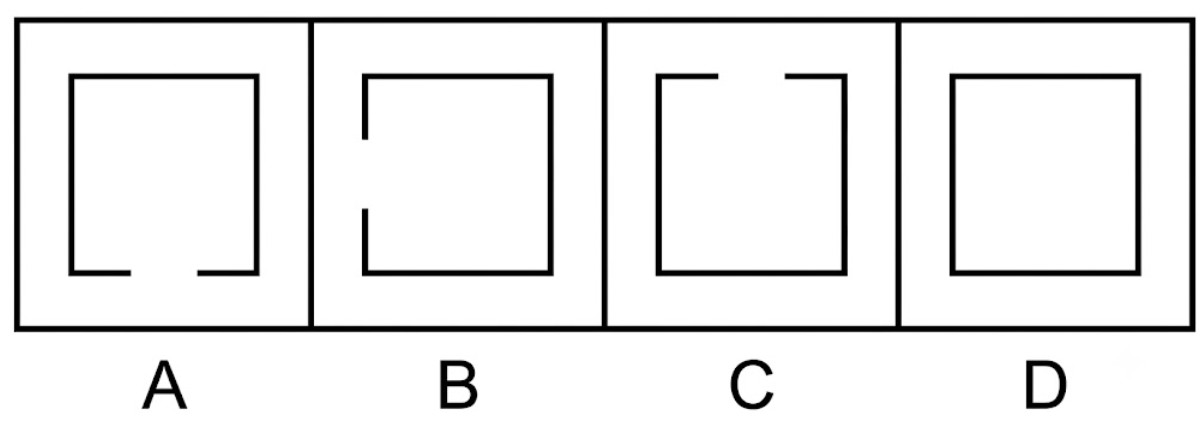
The task is to identify the odd one out from the given diagrams. Each diagram consists of a square with varying line segments missing.
Thus, Option B is different from the others due to the number of missing segments.
Correct Option: B) Option B is the odd one out because it has two missing segments, unlike the others.
To find the percentage of profit margin, we first need to calculate the profit by subtracting the cost price from the selling price. Then, we divide the profit by the cost price and multiply by 100 to express it as a percentage. The formula for profit percentage is: \[\frac{\text{Profit}}{\text{Cost Price}} \times 100\].
Profit is the difference between the Selling Price and the Cost Price.
\[ \text{Profit} = \text{SP} - \text{CP} \]\[ \text{Profit} = 700 - 350 \]\[ \text{Profit} = \text{Rs } 350 \]The percentage profit margin is calculated with respect to the Cost Price.
\[ \text{Profit Percentage} = \left( \frac{\text{Profit}}{\text{CP}} \right) \times 100\% \]\[ \text{Profit Percentage} = \left( \frac{350}{350} \right) \times 100\% \]\[ \text{Profit Percentage} = 1 \times 100\% \]\[ \text{Profit Percentage} = 100\% \]C) 100% is the correct answer. Geeta made a profit of Rs 350 on a cost price of Rs 350, which is a 100% profit margin.
This problem involves understanding directions and rotations. We need to track Suresh's initial direction, apply the given rotations (anticlockwise and clockwise), and determine his final facing direction. We can represent directions on a compass and calculate the net rotation.
C) Northwest is the correct direction Suresh is facing after the rotations.
This problem involves finding the ages of two persons given the difference in their ages and the ratio of their ages. We can represent their ages using a common multiple and then set up an equation based on the given difference.
Let the ages of the two persons be \(A\) and \(B\). We are given that the difference between their ages is 7 years.
\[ |A - B| = 7 \]We are also given that the ratio of their ages is 7 : 9. Let the common multiple be \(x\). Then, the ages can be represented as \(7x\) and \(9x\).
Since the ratio is 7:9, the person with age \(9x\) is older, and the person with age \(7x\) is younger. The difference between their ages is \(9x - 7x\).
Equate the difference in ages to the given value:
\[ 9x - 7x = 7 \]\[ 2x = 7 \]Solve for \(x\):
\[ x = \frac{7}{2} \]\[ x = 3.5 \]The age of the younger person is \(7x\). Substitute the value of \(x\):
\[ \text{Younger person's age} = 7 \times 3.5 \]\[ \text{Younger person's age} = 24.5 \text{ years} \]The age of the older person is \(9x\):
\[ \text{Older person's age} = 9 \times 3.5 \]\[ \text{Older person's age} = 31.5 \text{ years} \]Verify the difference: \(31.5 - 24.5 = 7\), which matches the given information.
B) The age of the younger person is 24.5 years, as calculated above.
The question asks to identify the common passageway formed when the duct leading from the spermatic cord joins with the duct leading through the bladder. This requires knowledge of the male reproductive and urinary systems' anatomy.
Correct Option: B) Urethra is the common passageway for both urine and semen in males, formed by the joining of the ejaculatory ducts (carrying sperm) and the bladder's outlet (carrying urine).
This problem involves calculating the original population given a percentage increase and the current population. We can use the formula for population growth, similar to compound interest, but in reverse to find the population a year ago.
Let the population a year ago be \(P_{\text{ago}}\). The present population is obtained by increasing \(P_{\text{ago}}\) by 5%.
\[ P_0 = P_{\text{ago}} \times \left(1 + \frac{r}{100}\right)^n \]In this case, \(n=1\), so:
\[ P_0 = P_{\text{ago}} \times \left(1 + \frac{5}{100}\right) \] \[ P_0 = P_{\text{ago}} \times (1 + 0.05) \] \[ P_0 = P_{\text{ago}} \times 1.05 \]Substitute the given present population:
\[ 1,85,220 = P_{\text{ago}} \times 1.05 \]Divide both sides by 1.05 to find \(P_{\text{ago}}\):
\[ P_{\text{ago}} = \frac{1,85,220}{1.05} \] \[ P_{\text{ago}} = 1,76,400 \]Correct Option: C) 1,76,400
The question asks to identify the state-level political party led by E. Madhusudanan. This requires knowledge of prominent political figures and their affiliations with specific parties, particularly in the context of Indian state politics.
Correct Option: D) All India Anna Dravida Munnetra Kazhagam
E. Madhusudanan was a senior leader and former Presidium Chairman of the All India Anna Dravida Munnetra Kazhagam (AIADMK). He was a significant figure in Tamil Nadu politics and a loyalist of former Chief Ministers M.G. Ramachandran and J. Jayalalithaa. He served as a Member of the Legislative Assembly (MLA) and as a minister in the Tamil Nadu government.
If a + b + c = 16 and ab + bc + ca = 78, find the value of a3 + b3 + c3 – 3abc?
This problem can be solved by using a standard algebraic identity for the sum of cubes. The identity relates \((a+b+c)\), \((ab+bc+ca)\), and \((a^3+b^3+c^3-3abc)\).
Recall the algebraic identity:
\[ a^3 + b^3 + c^3 - 3abc = (a+b+c)(a^2+b^2+c^2 - ab - bc - ca) \]
We are given the values of \((a+b+c)\) and \((ab+bc+ca)\):
We need to find the value of \((a^2+b^2+c^2)\). We can use another identity:
\[ (a+b+c)^2 = a^2+b^2+c^2 + 2(ab+bc+ca) \]
Substitute the given values into this identity:
\[ (16)^2 = a^2+b^2+c^2 + 2(78) \] \[ 256 = a^2+b^2+c^2 + 156 \] \[ a^2+b^2+c^2 = 256 - 156 \] \[ a^2+b^2+c^2 = 100 \]
Now substitute the values of \((a+b+c)\), \((a^2+b^2+c^2)\), and \((ab+bc+ca)\) into the main identity:
\[ a^3 + b^3 + c^3 - 3abc = (a+b+c)(a^2+b^2+c^2 - (ab+bc+ca)) \] \[ a^3 + b^3 + c^3 - 3abc = (16)(100 - 78) \] \[ a^3 + b^3 + c^3 - 3abc = (16)(22) \] \[ a^3 + b^3 + c^3 - 3abc = 352 \]
Correct Option: B) 352
Identify the odd one from the given figures.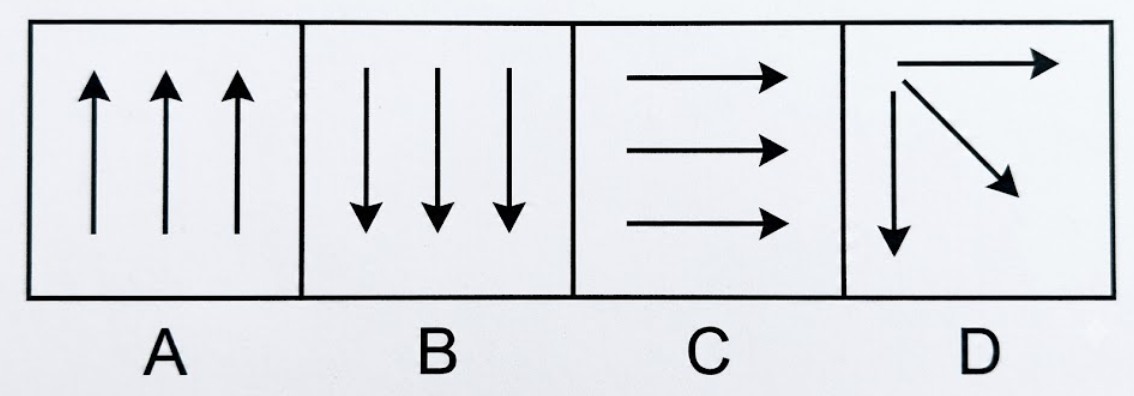
The task is to identify the odd figure among the given options based on the direction of the arrows depicted in each figure.
Correct Option: B) Figure B is the odd one as it has arrows pointing in a direction opposite to the uniform direction pattern seen in figures A and C.