
The question asks to identify which of the given options propagates through the stem. This refers to a method of asexual reproduction known as vegetative propagation, specifically using the stem part of the plant.
C) Rose — Roses are commonly propagated by stem cuttings. A piece of the stem is cut and planted, which then develops roots and grows into a new plant. This is a very common method of vegetative propagation for roses.
If sin θ = cos θ, then what will be the value of sec θ?
The problem asks for the value of \(\text{sec } \theta\) given that \(\text{sin } \theta = \text{cos } \theta\). We will first find the value of \(\theta\) that satisfies the given condition and then use this value to calculate \(\text{sec } \theta\).
Use the given condition:
We are given that \(\text{sin } \theta = \text{cos } \theta\).
Solve for \(\theta\):
Divide both sides by \(\text{cos } \theta\) (assuming \(\text{cos } \theta \neq 0\)):
\[ \frac{\text{sin } \theta}{\text{cos } \theta} = 1 \]Identify the trigonometric ratio:
We know that \[\frac{\text{sin } \theta}{\text{cos } \theta} = \text{tan } \theta\]. So, the equation becomes:
\[ \text{tan } \theta = 1 \]Find the angle \(\theta\):
The angle \(\theta\) for which \(\text{tan } \theta = 1\) is \(45^\circ\) or \(\frac{\pi}{4}\) radians (in the first quadrant). For competitive exams, it's usually assumed to be in the first quadrant unless specified otherwise.
\[ \theta = 45^\circ \]Calculate \(\text{sec } \theta\):
Now we need to find the value of \(\text{sec } \theta\) for \(\theta = 45^\circ\). We know that \(\text{sec } \theta = \frac{1}{\text{cos } \theta}\).
The value of \(\text{cos } 45^\circ\) is \(\frac{1}{\sqrt{2}}\).
Therefore,
\[ \text{sec } 45^\circ = \frac{1}{\text{cos } 45^\circ} = \frac{1}{\frac{1}{\sqrt{2}}} = \sqrt{2} \]Correct Option: A) \(\sqrt{2}\)
The value of \(\text{sec } \theta\) is \(\sqrt{2}\) when \(\text{sin } \theta = \text{cos } \theta\).
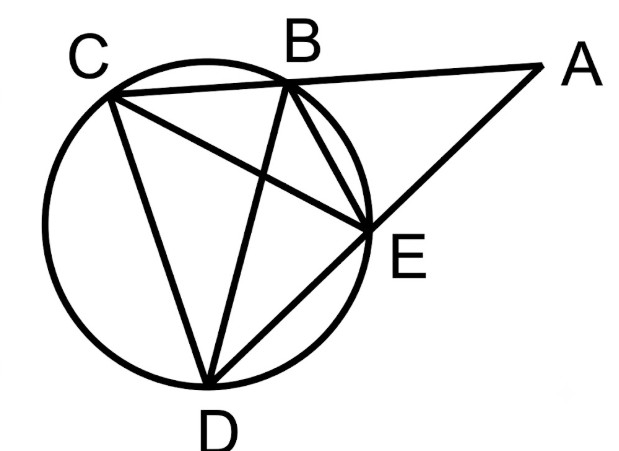
In the above figure, ∠BAE = 30°, ∠ABE = 80° and ∠DBE = 50°. What is the value of ∠BCE?
To find the value of \( \angle BCE \), we will use the properties of angles in a circle and the given angles in the diagram. The key is to use the fact that angles subtended by the same arc are equal.
Correct Option: D) 20°
This is a logical reasoning question where we need to determine which conclusions can be logically derived from the given statement. We must stick strictly to the information provided in the statement and not introduce outside knowledge or assumptions.
A) Only conclusion (1) follows. Conclusion (1) logically follows from the statement because if freedom and discipline are crucial for a good society, their absence would naturally lead to problems.
A number is divisible by 6 if it is divisible by both 2 and 3. We will check each option against these two divisibility rules.
'g' (acceleration due to gravity) =?
\(\frac{GR^2}{M}\)
\(\frac{GM}{R^2}\)
\(\frac{G}{MR^2}\)
\(\frac{R^2M}{G}\)
To find the acceleration due to gravity ('g') on the surface of a planet, we equate Newton's Law of Universal Gravitation with Newton's Second Law of Motion. This allows us to derive an expression for 'g' in terms of the gravitational constant (G), the mass of the planet (M), and its radius (R).
Correct Option: B) \(\frac{GM}{R^2}\)
To multiply decimal numbers, we first multiply them as whole numbers, ignoring the decimal points. Then, we count the total number of decimal places in the original numbers and place the decimal point in the product accordingly.
D) \(0.0081\) is the correct product of \(5.4 \times 0.0015\).
The problem states that the highest common factor (HCF) of 117 and another number is 13. This means that both numbers must be multiples of 13. Additionally, when each number is divided by 13, the resulting quotients must be coprime (their HCF must be 1). We will check each option to see which one violates this condition.
The question asks for the number that cannot be the second number. Based on our analysis, 156 is that number.
C) 156 — If the second number is 156, then \(b = 156/13 = 12\). The HCF of 9 and 12 is 3, not 1. This violates the condition that the quotients (9 and \(b\)) must be coprime for the HCF of the original numbers to be 13. Therefore, 156 cannot be the second number.
The chemical formula of sodium carbonate is ______.
To determine the correct chemical formula for sodium carbonate, we need to recall the valencies of the constituent ions: sodium (\(\text{Na}^+\)) and carbonate (\(\text{CO}_3^{2-}\)). The chemical formula is formed by balancing the charges of these ions.
A) \(\text{Na}_2\text{CO}_3\) — This formula correctly represents two sodium ions (\(\text{Na}^+\)) balancing the charge of one carbonate ion (\(\text{CO}_3^{2-}\)).
To find the average monthly sales for personal hygiene products, we first need to calculate the total quarterly sales, then determine the sales for personal hygiene products within that quarter, and finally divide by the number of months in a quarter.
The problem states that the store's sales average Rs. 15,00,000 every quarter.
\[ \text{Total Quarterly Sales} = \text{Rs. } 15,00,000 \]It is given that 40% of sales are from personal hygiene products.
\[ \text{Quarterly Sales (Personal Hygiene)} = 40\% \text{ of Total Quarterly Sales} \]\[ \text{Quarterly Sales (Personal Hygiene)} = 0.40 \times 15,00,000 \]\[ \text{Quarterly Sales (Personal Hygiene)} = \text{Rs. } 6,00,000 \]A quarter has 3 months. To find the average monthly sales, divide the quarterly sales for personal hygiene products by 3.
\[ \text{Average Monthly Sales (Personal Hygiene)} = \frac{\text{Quarterly Sales (Personal Hygiene)}}{3} \]\[ \text{Average Monthly Sales (Personal Hygiene)} = \frac{6,00,000}{3} \]\[ \text{Average Monthly Sales (Personal Hygiene)} = \text{Rs. } 2,00,000 \]Correct Option: D) Rs. 2,00,000