
The question asks to identify the object that does not possess kinetic energy. Kinetic energy is the energy an object possesses due to its motion. We need to analyze each option based on this definition.
Correct Option: B) Raised hammer
______ reacts vigorously with water to form slaked lime
The question asks to identify the substance that reacts vigorously with water to form slaked lime. This is a common chemical reaction in inorganic chemistry, specifically involving calcium compounds. We need to recall the chemical names and properties of the given options.
B) \(\text{CaO}\) (Calcium oxide), also known as quicklime, reacts vigorously with water to produce slaked lime (calcium hydroxide). This is a highly exothermic reaction.
The question asks for the physical quantity whose unit is Ohm-meter (\(\Omega \cdot \text{m}\)). To answer this, we need to recall the definitions and units of various electrical quantities, particularly resistivity and resistance.
where \(R\) is the resistance, \(\rho\) (rho) is the resistivity of the material, \(L\) is the length of the conductor, and \(A\) is the cross-sectional area of the conductor.
Substituting the respective units:
\[ \text{Unit of } \rho = \Omega \times \frac{\text{m}^2}{\text{m}} \]Simplifying the units:
\[ \text{Unit of } \rho = \Omega \cdot \text{m} \]Thus, Ohm-meter (\(\Omega \cdot \text{m}\)) is the unit of resistivity.
A) Resistivity — As derived above, the unit of resistivity is Ohm-meter (\(\Omega \cdot \text{m}\)).
The question asks for the year in which the Battle of Ghaghra was fought. This is a direct factual recall question from Indian history, specifically related to the early Mughal period.
B) 1529 is the correct year for the Battle of Ghaghra.
18 ÷ \( \frac{1}{8} \) of {11 + 16 − (10 + 7 −\(\overline{6+8}\))} =?
To solve this problem, we need to follow the order of operations, often remembered by the acronym BODMAS/PEMDAS. This means we perform operations in the following order: Brackets (or Parentheses), Orders (powers and square roots), Division and Multiplication (from left to right), Addition and Subtraction (from left to right). Within brackets, we prioritize the vinculum (bar over numbers) first.
A) 6 is the correct answer, as derived from the step-by-step calculation following the BODMAS rule.
Study the following pie chart and select the answers that follow the questions. The given pie chart shows the sales details of a mobile company in different states.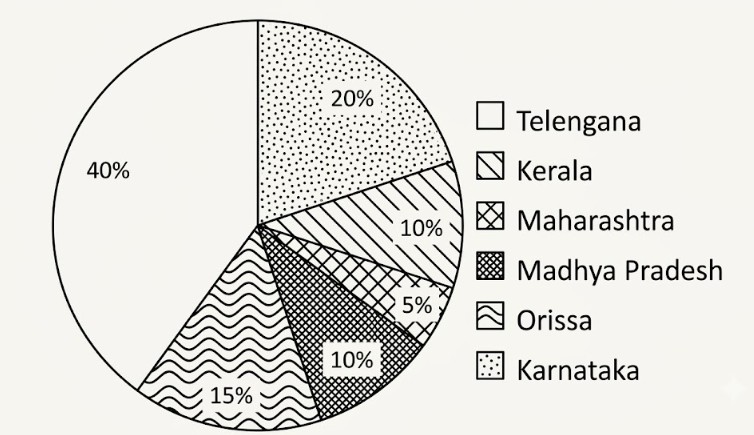
If a total of 120 million units of mobile phones were sold, then how many units were sold (in millions) in Karnataka region?
The pie chart illustrates the percentage distribution of mobile phone sales across different states. To find the number of units sold in Karnataka, we need to calculate the percentage of total sales represented by Karnataka and apply it to the total sales figure.
Units sold in Karnataka:
\[ \text{Units in Karnataka} = \frac{40}{100} \times 120 = 48 \text{ million units} \]Therefore, 48 million units were sold in Karnataka.
Correct Option: A) 48
Find the number of circles in the figure?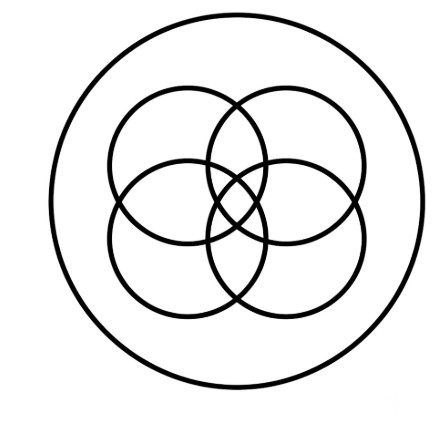
The question requires counting the total number of distinct circles present in the given diagram.
Correct Option: A) 5
The question asks to identify the Indian anti-hunger activist who received the Queen's Young Leaders Award in England in 2017. This is a factual recall question related to current affairs and notable awards.
B) Ankit Kawatra: Ankit Kawatra is the founder of 'Feeding India', an organization that aims to solve hunger and food waste. He was awarded the prestigious Queen's Young Leaders Award in 2017 for his efforts in this field. This award recognizes exceptional young people from across the Commonwealth who are taking the lead in their communities and using their skills to transform lives.
To arrange the given ratios in descending order, we need to convert them into a comparable format, such as decimal values or fractions with a common denominator. Comparing decimal values is often the most straightforward method.
Comparing the decimal values:
So, the ratios in descending order are:
\[ 17:21 > 11:14 > 5:7 > 2:3 \]The last number in this arrangement is \(2:3\).
C) 2 : 3 — As determined in the step-by-step analysis, \(2:3\) has the smallest decimal value (\(\approx 0.6667\)) among the given ratios, making it the last number when arranged in descending order.
The problem requires us to find the number of ways to select a student council of 5 members from a group of 7 boys and 6 girls, with the condition that at least 3 of the selected members must be boys. This is a combination problem, and we need to consider different cases that satisfy the condition.
Identify the total number of boys and girls:
Total boys = 7
Total girls = 6
Identify the total number of students to be selected:
Total students to be selected = 5
Determine the conditions for selection:
At least 3 boys must be selected. This means we can have 3 boys, 4 boys, or 5 boys.
Calculate combinations for each case:
Case 1: 3 boys and 2 girls
Number of ways to select 3 boys from 7: \[C(7, 3) = \frac{7!}{3!(7-3)!} = \frac{7!}{3!4!} = \frac{7 \times 6 \times 5}{3 \times 2 \times 1} = 35\]
Number of ways to select 2 girls from 6: \[C(6, 2) = \frac{6!}{2!(6-2)!} = \frac{6!}{2!4!} = \frac{6 \times 5}{2 \times 1} = 15\]
Total ways for Case 1 = \(C(7, 3) \times C(6, 2) = 35 \times 15 = 525\)
Case 2: 4 boys and 1 girl
Number of ways to select 4 boys from 7: \[C(7, 4) = \frac{7!}{4!(7-4)!} = \frac{7!}{4!3!} = \frac{7 \times 6 \times 5}{3 \times 2 \times 1} = 35\]
Number of ways to select 1 girl from 6: \[C(6, 1) = \frac{6!}{1!(6-1)!} = \frac{6}{1} = 6\]
Total ways for Case 2 = \(C(7, 4) \times C(6, 1) = 35 \times 6 = 210\)
Case 3: 5 boys and 0 girls
Number of ways to select 5 boys from 7: \[C(7, 5) = \frac{7!}{5!(7-5)!} = \frac{7!}{5!2!} = \frac{7 \times 6}{2 \times 1} = 21\]
Number of ways to select 0 girls from 6: \(C(6, 0) = 1\)
Total ways for Case 3 = \(C(7, 5) \times C(6, 0) = 21 \times 1 = 21\)
Sum the ways from all valid cases:
Total ways = Ways (Case 1) + Ways (Case 2) + Ways (Case 3)
Total ways = \(525 + 210 + 21 = 756\)
D) 756
A) 765 — This value is obtained if there's an error in calculation, for example, if one of the cases is miscalculated or if an incorrect sum is made. For instance, if \(C(7,3) \times C(6,2)\) was calculated as \(35 \times 16\) instead of \(35 \times 15\), it would lead to \(560\), and the sum would be \(560 + 210 + 21 = 791\), which is not 765. This option is likely a result of calculation error.
B) 760 — This value is also likely a result of a calculation error in one of the cases or in the final summation. For example, if Case 3 was calculated as 25 instead of 21, the total would be \(525 + 210 + 25 = 760\). This indicates a mistake in calculating \(C(7,5)\).
C) 768 — This value would occur if there was a significant calculation error. For instance, if Case 1 was \(35 \times 16 = 560\), Case 2 was \(35 \times 6 = 210\), and Case 3 was \(C(7,5)\) was \(21\), then \(560 + 210 + 21 = 791\). If any of the combinations were incorrectly calculated, it could lead to this value. For example, if \(C(7,3) \times C(6,2)\) was \(36 \times 15 = 540\), then \(540 + 210 + 21 = 771\). This option is not derivable from correct calculations.