
This problem involves setting up and solving a system of linear equations based on the given age relationships at different points in time. We will define variables for the present ages of Raman and his mother and then translate the given conditions into algebraic equations.
Let Raman's present age be \(R\) years.
Let his mother's present age be \(M\) years.
First condition: Twelve years ago
Second condition: Six years from now
Solve the system of equations
Raman's present age is 54 years.
B) 54 years is the correct answer, as calculated from the system of equations.
The question asks for the term describing the phase transition of a substance from a liquid state to a gaseous state. We need to recall the definitions of common phase changes.
Correct Option: A) Vapourisation is the process by which a substance changes from a liquid to a gas. This can occur through evaporation (at the surface of the liquid below its boiling point) or boiling (throughout the liquid at its boiling point).
If x² + kx + 3k = 0 has no real solution, then the value of k will satisfy:
To determine the conditions for which a quadratic equation has no real solution, we need to analyze its discriminant. For a quadratic equation of the form \(ax^2 + bx + c = 0\), the discriminant is given by \(\Delta = b^2 - 4ac\). If the discriminant is less than zero (\(\Delta < 0\)), the equation has no real solutions.
Identify the coefficients: The given quadratic equation is \(x^2 + kx + 3k = 0\). Comparing this with the standard form \(ax^2 + bx + c = 0\), we have:
Calculate the discriminant: The discriminant \(\Delta\) is given by \(b^2 - 4ac\). Substitute the values of \(a\), \(b\), and \(c\):
\[ \Delta = (k)^2 - 4(1)(3k) \]\[ \Delta = k^2 - 12k \]Apply the condition for no real solution: For the equation to have no real solution, the discriminant must be less than zero:
\[ \Delta < 0 \]\[ k^2 - 12k < 0 \]Solve the inequality: To solve \(k^2 - 12k < 0\), factor out \(k\):
\[ k(k - 12) < 0 \]Determine the range for k: For the product of two terms to be negative, one term must be positive and the other negative. We consider two cases:
This implies \(k > 0\) and \(k < 12\). Combining these, we get \(0 < k < 12\).
This implies \(k < 0\) and \(k > 12\). This case is impossible, as \(k\) cannot be both less than 0 and greater than 12 simultaneously.
Therefore, the only valid range for \(k\) is \(0 < k < 12\).
Correct Option: D) 0 < k < 12
To solve this problem, we need to follow the order of operations, commonly known as BODMAS/PEMDAS. This acronym stands for Brackets/Parentheses, Orders/Exponents, Division, Multiplication, Addition, and Subtraction. We will evaluate the expression step-by-step according to this rule.
The expression inside the brackets is \(96 - 18 \div 6 - 58\).
Within the brackets, perform division first:
\[ 18 \div 6 = 3 \]Now, substitute this back into the bracketed expression:
\[ 96 - 3 - 58 \]Perform subtraction from left to right:
\[ 96 - 3 = 93 \] \[ 93 - 58 = 35 \]So, the expression becomes:
\[ 75 - (35) \div 5 + 4 \times 17 \]Next, perform the division operation:
\[ 35 \div 5 = 7 \]The expression now is:
\[ 75 - 7 + 4 \times 17 \]Next, perform the multiplication operation:
\[ 4 \times 17 = 68 \]The expression now is:
\[ 75 - 7 + 68 \]Finally, perform subtraction and addition from left to right:
\[ 75 - 7 = 68 \] \[ 68 + 68 = 136 \]Thus, the final answer is 136.
Correct Option: B) 136
From the top of a platform 17 m high, the angle of elevation of the top of a tower was 30°. If the platform was positioned 50\(\sqrt{3}\) m away from the tower, how tall was the tower?
This problem involves trigonometry, specifically the concept of angles of elevation. We need to use the tangent function to find the unknown height of a part of the tower and then add it to the height of the platform to get the total height of the tower.
Correct Option: A) 67 m
The given series consists of a letter followed by a number. We need to identify the pattern for both the letters and the numbers separately to find the next term.
The letters are C, L, ...
Let's assign numerical positions to the letters in the English alphabet (A=1, B=2, C=3, and so on).
The difference between the positions is \(12 - 3 = 9\). If this is an arithmetic progression, the next letter should be \(12 + 9 = 21\). The 21st letter of the alphabet is U.
The numbers are 14, 28, ...
Let's find the relationship between these numbers.
This indicates an arithmetic progression where 14 is added to the previous term. So, the next number would be \(28 + 14 = 42\).
The next letter is U and the next number is 42.
Therefore, the next term in the series is U42.
A) U42 is the correct option because it follows both the letter and number patterns identified.
The question asks to identify the Indian state or Union Territory with the largest wetland area. This requires knowledge of the geographical distribution of wetlands in India.
C) West Bengal — West Bengal is home to the Sundarbans, a UNESCO World Heritage Site and a vast estuarine wetland ecosystem, making it the state with the largest wetland area in India.
This question tests general knowledge about famous sports personalities and their autobiographies. The key is to correctly identify the cricketer associated with the autobiography 'Playing It My Way'.
Correct Option: D) Sachin Tendulkar
Sachin Tendulkar's autobiography, co-written with Boria Majumdar, is titled 'Playing It My Way'. It was released on 5 November 2014 and covers his journey from childhood to his retirement from cricket.
The question asks to identify the biological process during which heat energy is produced. We need to evaluate each option based on its primary function and energy transformations involved.
Correct Option: D) respiration. Respiration is the metabolic process that breaks down food molecules to release energy, a significant portion of which is dissipated as heat, contributing to the body's temperature regulation.
Select the option that can replace the question mark (?) in the given figure series.
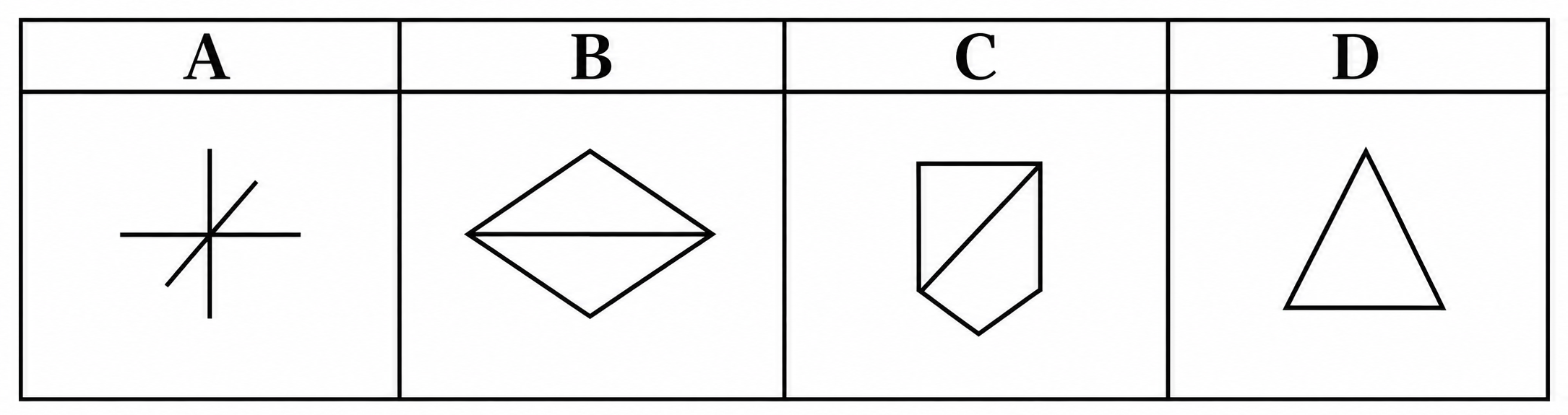
The problem involves identifying the pattern in a series of shapes and selecting the shape that logically follows the sequence. Observing the changes in the given figures will help determine the correct option.
Correct Option: D) Triangle