
The problem provides information about the passing percentage, the marks obtained by a candidate, and the marks by which the candidate failed. We need to determine the total marks of the examination. We can first find the passing marks and then use the passing percentage to calculate the total marks.
Calculate the passing marks: We are given that the candidate scored 210 marks and failed by 50 marks. This means if the candidate had scored 50 more marks, they would have passed.
\[ \text{Passing Marks} = \text{Marks Obtained} + \text{Marks to Pass} \] \[ \text{Passing Marks} = 210 + 50 = 260 \]So, the passing marks for the examination are 260.
Relate passing marks to percentage: We are given that a candidate must get 65% marks to pass. This means the 260 marks calculated above represent 65% of the total marks.
Let the total marks of the examination be \(T\).
\[ 65\% \text{ of } T = 260 \] \[ \frac{65}{100} \times T = 260 \]Calculate the total marks: Now, we solve for \(T\):
\[ T = \frac{260 \times 100}{65} \]We can simplify the fraction:
\[ T = \frac{26000}{65} \]Divide 260 by 65:
\[ 260 \div 65 = 4 \]So,
\[ T = 4 \times 100 \] \[ T = 400 \]Thus, the examination was out of 400 marks.
Correct Option: C) 400
This problem involves calculating the total number of items in a group based on given mean values for different subsets of the group. We will use the formula for the mean, which is \[\text{Mean} = \frac{\text{Sum of numbers}}{\text{Count of numbers}}\], to set up equations and solve for the unknown total count.
Let \( N \) be the total number of numbers in the group.
The mean of the 5 smallest numbers is 21.
Sum of the 5 smallest numbers \( = 5 \times 21 = 105 \).
The mean of all the numbers in the group is 25.
Sum of all \( N \) numbers \( = N \times 25 = 25N \).
The numbers, leaving the smallest five out, means there are \( N - 5 \) numbers remaining.
The mean of these \( N - 5 \) numbers is 27.5.
Sum of these \( N - 5 \) numbers \( = (N - 5) \times 27.5 \).
The sum of all numbers in the group can also be expressed as the sum of the 5 smallest numbers plus the sum of the remaining \( N - 5 \) numbers.
So, we can set up the equation:
\[ 25N = 105 + (N - 5) \times 27.5 \]Now, solve the equation for \( N \):
\[ 25N = 105 + 27.5N - 5 \times 27.5 \]\[ 25N = 105 + 27.5N - 137.5 \]\[ 25N = 27.5N - 32.5 \]\[ 32.5 = 27.5N - 25N \]\[ 32.5 = 2.5N \]\[ N = \frac{32.5}{2.5} \]\[ N = \frac{325}{25} \]\[ N = 13 \]B) There were 13 numbers in the group in all.
The problem involves finding out how much water needs to be added to a milk and water mixture to change its ratio to an equal proportion. We will first calculate the initial quantities of milk and water, then determine the amount of water required to achieve the desired 1:1 ratio.
Correct Option: C) 10 liters
Simplify the following expression∶
\(\left(\frac{2}{3}\times\frac{1}{6}\right)+\left(\frac{2}{3}\times\frac{7}{2}\right)-\left(\frac{13}{4}\times\frac{4}{3}\right)\)=?
\(\frac{14}{3}\)
\(\frac{-17}{9}\)
\(\frac{29}{3}\)
\(\frac{23}{9}\)
To simplify the given expression, we will perform the multiplication operations within each parenthesis first, and then combine the resulting fractions by finding a common denominator.
Correct Option: B) \(\frac{-17}{9}\)
This problem involves calculating the work done by pipes (filling and draining) over time. We will determine the individual filling/draining rates of each pipe and then use these rates to set up an equation based on the total time taken and the total work (filling the cistern).
Pipe B fills the cistern in 7.2 hours. Its filling rate is:
\[ \text{Rate of B} = \frac{1}{7.2} \text{ cistern/hour} = \frac{10}{72} = \frac{5}{36} \text{ cistern/hour} \]Pipe C drains the cistern in 9.6 hours. Its draining rate is:
\[ \text{Rate of C} = -\frac{1}{9.6} \text{ cistern/hour} = -\frac{10}{96} = -\frac{5}{48} \text{ cistern/hour} \](The negative sign indicates draining.)
Work done in the first phase: \( \frac{5}{48} \times t_1 \)
In the second phase, Pipe B and Pipe C are on. Their combined rate is:
To subtract these fractions, find a common denominator, which is 144:
\[ \text{Rate}_{B+C} = \frac{5 \times 4}{144} - \frac{5 \times 3}{144} = \frac{20 - 15}{144} = \frac{5}{144} \text{ cistern/hour} \]Work done in the second phase: \( \frac{5}{144} \times t_2 \)
The total work done is 1 (representing one full cistern):
Multiply the entire equation by 144 to eliminate denominators:
\[ 3 \times 5 (16.8 - t_2) + 5 t_2 = 144 \]\[ 15 (16.8 - t_2) + 5 t_2 = 144 \]\[ 252 - 15 t_2 + 5 t_2 = 144 \]\[ 252 - 10 t_2 = 144 \]\[ 10 t_2 = 252 - 144 \]\[ 10 t_2 = 108 \]\[ t_2 = \frac{108}{10} \]\[ t_2 = 10.8 \text{ hours} \]Pipe B was turned on for \(t_2\) hours, which is 10.8 hours.
Correct Option: D) 10.8
This problem involves calculating distance based on varying speeds and corresponding time differences. We can use the formula \(\text{Distance} = \text{Speed} \times \text{Time}\) and set up equations based on the given information. Let the distance be \(D\) and the actual time taken be \(T\). We will express the time taken in each scenario in terms of \(D\) and the given speeds, and then use the time difference to solve for \(D\).
D) 3 km is the correct distance between Seeta's home and school.
This problem involves finding the Least Common Multiple (LCM) of two numbers, given their Highest Common Factor (HCF). We can use the fundamental relationship between the HCF and LCM of two positive integers, which states that the product of the two numbers is equal to the product of their HCF and LCM.
The two numbers are \(a = 6\) and \(b = 100\).
The HCF of \((6, 100)\) is given as \(2\).
For any two positive integers \(a\) and \(b\), the following relationship holds true:
\[ a \times b = \text{HCF}(a, b) \times \text{LCM}(a, b) \]We have \(a = 6\), \(b = 100\), and \(\text{HCF}(6, 100) = 2\). Let \(\text{LCM}(6, 100)\) be denoted by \(L\).
\[ 6 \times 100 = 2 \times L \]First, calculate the product of the numbers:
\[ 600 = 2 \times L \]Now, divide both sides by \(2\) to find \(L\):
\[ L = \frac{600}{2} \]\[ L = 300 \]Therefore, the LCM of \((6, 100)\) is \(300\).
D) 300 is the correct LCM calculated using the HCF-LCM relationship.
To solve this problem, we first need to find the difference between the two given numbers. Then, we need to determine what value, when added to this difference, will result in 10. This can be set up as a simple algebraic equation.
The difference is found by subtracting the smaller number from the larger number.
\[ \text{Difference} = 5.42 - 3.56 \]\[ \text{Difference} = 1.86 \]Let \(x\) be the amount that needs to be added to the difference (1.86) to get 10. The equation will be:
\[ 1.86 + x = 10 \]To find \(x\), subtract 1.86 from both sides of the equation.
\[ x = 10 - 1.86 \]\[ x = 8.14 \]Thus, 8.14 needs to be added to the difference of 5.42 and 3.56 to get 10.
A) 8.14 is the correct answer, as calculated in the step-by-step solution.
In the diagram above, TU∥PS and points Q and R lie on PS. Also, ∠PQT = x°, ∠RQT = (x – 60)°, and ∠TUR = (x + 50)°. What is the measure of ∠URS?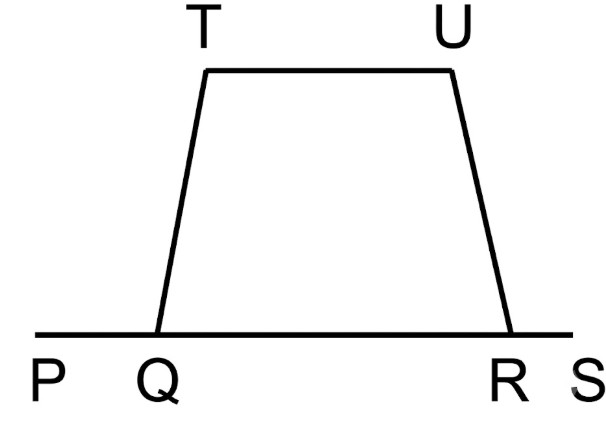
To find the measure of \( \angle URS \), we use the properties of parallel lines and angles. Given that \( TU \parallel PS \), we can apply the concept of alternate interior angles and the angle sum property of triangles.
However, this calculation seems incorrect. Re-evaluate the given angles and properties:
Correct Option: A) 170°
If x + y = 3, xy = 2, find the value of x3 – y3.
The problem asks us to find the value of \(x^3 - y^3\) given the sum \(x+y\) and the product \(xy\). We can use algebraic identities to solve this. Specifically, the identity for \(x^3 - y^3\) and the identity for \((x-y)^2\) will be useful.
\[ x^3 - y^3 = (x - y)(x^2 + xy + y^2) \]
We know that \((x+y)^2 = x^2 + y^2 + 2xy\). Therefore,
\[ x^2 + y^2 = (x+y)^2 - 2xy \]
\[ x^3 - y^3 = (x - y)((x+y)^2 - 2xy + xy) \]
\[ x^3 - y^3 = (x - y)((x+y)^2 - xy) \]
We know that \((x-y)^2 = (x+y)^2 - 4xy\). Given \(x+y=3\) and \(xy=2\):
\[ (x-y)^2 = (3)^2 - 4(2) \]
\[ (x-y)^2 = 9 - 8 \]
\[ (x-y)^2 = 1 \]
So, \(x-y = \pm 1\). Since the problem does not specify which of \(x\) or \(y\) is larger, we can choose either \(x-y=1\) or \(x-y=-1\). Let's proceed with \(x-y=1\). If we get a valid option, that's the answer. If not, we'd check \(x-y=-1\).
Using \(x-y=1\), \(x+y=3\), and \(xy=2\):
\[ x^3 - y^3 = (1)((3)^2 - 2) \]
\[ x^3 - y^3 = 1(9 - 2) \]
\[ x^3 - y^3 = 1(7) \]
\[ x^3 - y^3 = 7 \]
If we had chosen \(x-y = -1\), then \(x^3 - y^3 = (-1)((3)^2 - 2) = -1(9-2) = -7\). Since \(7\) is an option and \(-7\) is not, we proceed with \(7\).
D) 7