
The question asks about the factors affecting the value of 'g', the acceleration due to gravity. We need to recall the formula for 'g' and analyze its dependence on height and other parameters.
From step 2, it is clear that 'g' increases as the height decreases.
Correct Option: D) decrease in height
The problem requires us to analyze a statement and determine which of the given conclusions logically follow from it. We need to evaluate each conclusion based solely on the information provided in the statement, without introducing external assumptions.
C) Both conclusions follow
Both conclusions are directly inferable from the teacher's statement. Conclusion I identifies the reason for the grace marks (typing error implies management error). Conclusion II identifies the condition for receiving the grace marks (only those who attempted the question).
The question asks to identify the winner of a specific Formula 1 race, the German Grand Prix 2018. This requires knowledge of historical Formula 1 race results.
Correct Option: B) Lewis Hamilton
When the mirror is placed on the line MN, then choose the mirror image for the following figure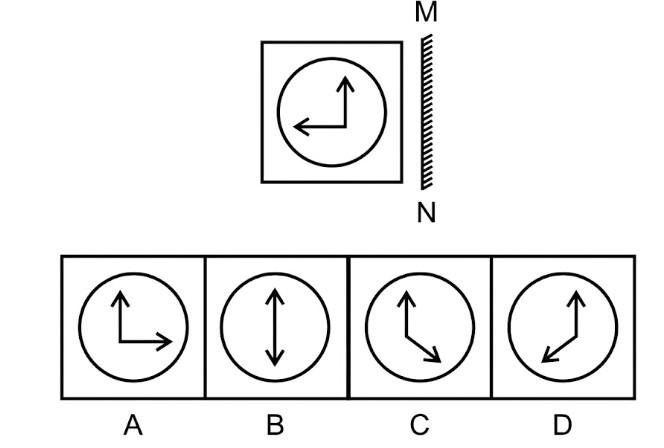
To find the mirror image of a figure, we need to reflect the figure across the given line, which in this case is MN. The mirror image will have the same shape and size but will be reversed along the line of reflection.
Correct Option: B) The arrow points directly downwards, matching the mirror image.
Which of the following will be the next figure from the alternatives in the question figure?
Question figure: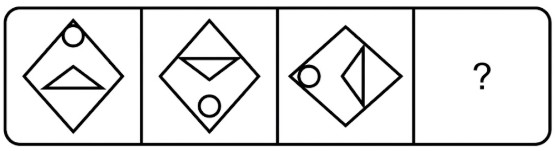
Option figure: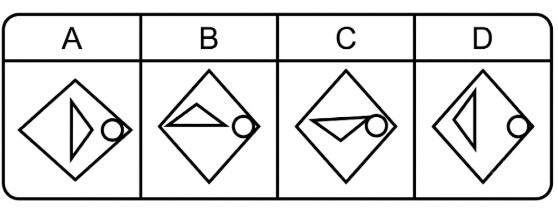
The problem involves identifying the pattern in a sequence of figures and predicting the next figure in the series. Each figure consists of a diamond shape containing a triangle and a circle, with variations in their positions and orientations.
The correct option is the one where the triangle is rotated correctly and the circle is positioned at the next vertex, which matches option C.
Correct Option: C) …
This is a blood relations question. We need to trace the relationships described to identify how the girl is related to Ankita's father.
Therefore, the girl is the niece of Ankita's father.
A) Niece — As determined in the step-by-step analysis, the girl is the daughter of Ankita's father's sister, which makes her his niece.
The following data shows the information on tire manufacturing by various companies in India during 2017. If the total number of tires manufactured in India during 2017 was 1,80,000, then how many tires were manufactured by company A?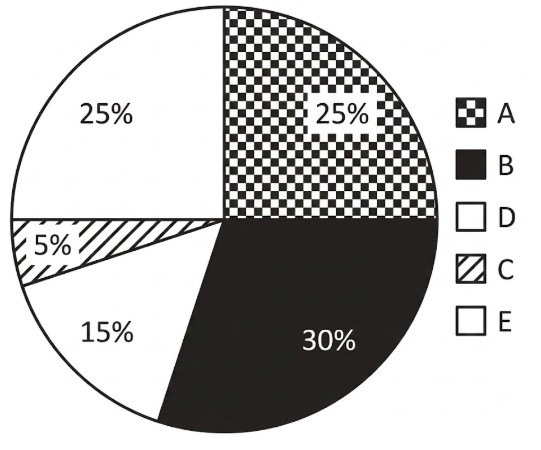
The question provides a pie chart showing the percentage of tires manufactured by different companies in India during 2017. We need to calculate the number of tires manufactured by company A based on the total production.
\[ \text{Number of tires by Company A} = \frac{25}{100} \times 1,80,000 \]
\[ = 0.25 \times 1,80,000 \]
\[ = 45,000 \]
Thus, company A manufactured 45,000 tires.
Correct Option: C) 45,000
The question asks to identify the word that does not belong to the given group: "calendar, day, year, month". We need to analyze the relationship between these words to find the odd one out.
D) Calendar — Calendar is the odd one out because it is a system or a tool used to organize and display time units (days, months, years), whereas day, month, and year are actual units of time.
This problem involves substituting new meanings for mathematical operators and then evaluating the expression according to the standard order of operations (BODMAS/PEMDAS).
+ means -- means ×÷ means +× means ÷The original expression is: \(9 - 4 + 14 \times 7 \div 6\)
Applying the substitutions:
- becomes ×+ becomes -× becomes ÷÷ becomes +So, the new expression is: \(9 \times 4 - 14 \div 7 + 6\)
BODMAS stands for Brackets, Orders (powers/roots), Division, Multiplication, Addition, Subtraction. Operations are performed from left to right for Division/Multiplication and for Addition/Subtraction.
First, perform Multiplication and Division from left to right:
The expression becomes: \(36 - 2 + 6\)
Next, perform Addition and Subtraction from left to right:
B) 40 is the correct value obtained after substituting the operators and following the order of operations.
To find the length of the second diagonal of a rhombus, we use the properties of a rhombus: its diagonals bisect each other at right angles. This creates four congruent right-angled triangles. We can then apply the Pythagorean theorem to one of these triangles, where the side of the rhombus is the hypotenuse, and half of each diagonal forms the legs.
Understand the properties of a rhombus: A rhombus is a quadrilateral whose four sides are equal in length. Its diagonals bisect each other at right angles.
Identify given values:
Determine half the length of the given diagonal: Since the diagonals bisect each other, half of the first diagonal will be:
\[ \frac{d_1}{2} = \frac{48 \text{ cm}}{2} = 24 \text{ cm} \]Apply the Pythagorean theorem: Consider one of the right-angled triangles formed by the intersection of the diagonals. The hypotenuse of this triangle is the side of the rhombus (\(s\)), and the legs are half the lengths of the diagonals (\(\frac{d_1}{2}\) and \(\frac{d_2}{2}\)).
According to the Pythagorean theorem:
\[ s^2 = \left(\frac{d_1}{2}\right)^2 + \left(\frac{d_2}{2}\right)^2 \]Substitute the known values into the equation:
\[ (26)^2 = (24)^2 + \left(\frac{d_2}{2}\right)^2 \]Calculate the squares:
\[ 676 = 576 + \left(\frac{d_2}{2}\right)^2 \]Solve for \(\left(\frac{d_2}{2}\right)^2\):
\[ \left(\frac{d_2}{2}\right)^2 = 676 - 576 \]\[ \left(\frac{d_2}{2}\right)^2 = 100 \]Find \(\frac{d_2}{2}\):
\[ \frac{d_2}{2} = \sqrt{100} \]\[ \frac{d_2}{2} = 10 \text{ cm} \]Calculate the length of the second diagonal (\(d_2\)):
\[ d_2 = 2 \times 10 \text{ cm} \]\[ d_2 = 20 \text{ cm} \]B) 20 cm is the calculated length of the second diagonal.