
The question asks for the fundamental basis of the Digital India campaign. We need to identify which of the given options provides the core infrastructure necessary for the campaign's objectives.
Correct Option: C) Bharat Net Project is the basis of the Digital India campaign because it is the flagship project to provide the necessary digital infrastructure (broadband connectivity) to rural and remote areas, enabling the delivery of digital services and achieving the goals of a digitally empowered society.
Identify the odd one out: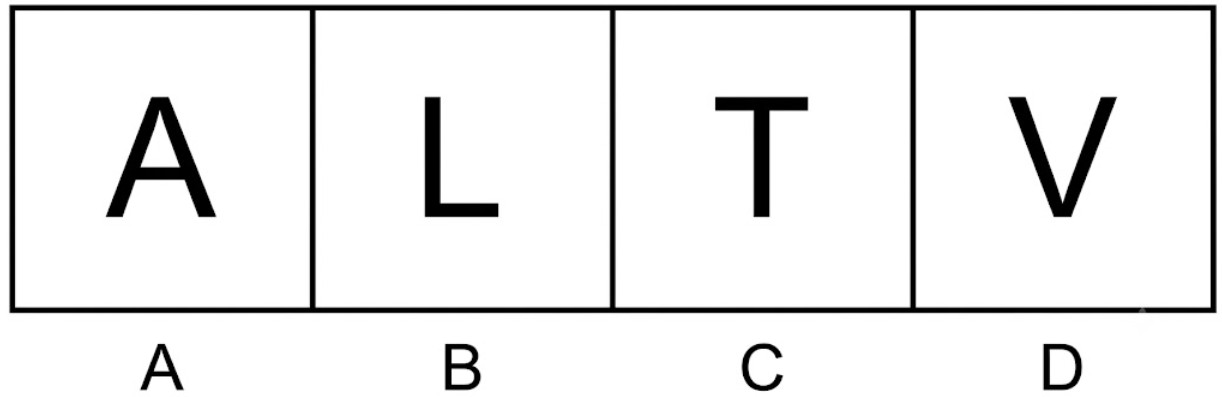
The task is to identify the odd one out among the given options based on the characteristics of the letters shown in the diagram.
Thus, the letter T (Option C) is the odd one out because it does not share the vertical symmetry characteristic with the others.
Correct Option: C) T
The bar graph below shows the personal computers sold by the company "XYZ" in the last 10 years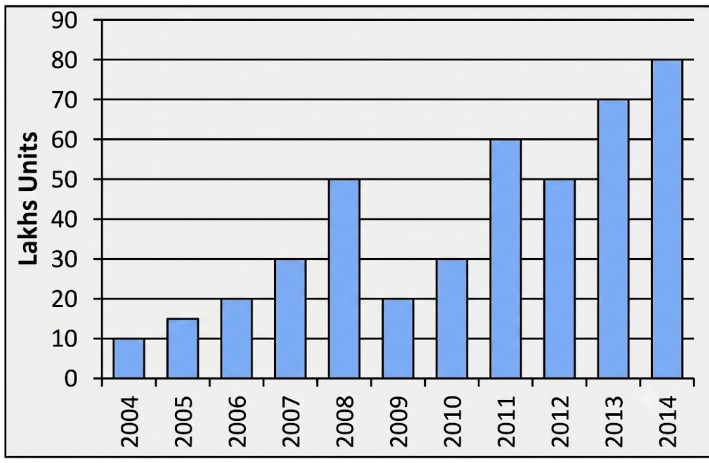
How many personal computers (in lakhs) were sold by Company XYZ in the year 2008?
To determine the number of personal computers sold by Company XYZ in the year 2008, we need to examine the bar graph provided and identify the height of the bar corresponding to the year 2008.
Thus, the number of personal computers sold in 2008 is 50 lakh units.
Correct Option: C) 50
The question asks about a specific diplomatic appointment made in 2018. To answer this, one needs to recall or research the appointments of Indian ambassadors during that period. Diplomatic appointments are common current affairs topics for competitive exams.
Correct Option: B) Ashok Das was appointed as the next Ambassador of India to the Federal Republic of Brazil in 2018. He presented his credentials on July 25, 2018.
This question tests the understanding of different forms of energy, specifically what type of energy is stored when an elastic object like a rubber band is stretched. We need to identify the energy associated with the deformation of an object.
A) Potential energy. When a rubber band is stretched, work is done against its internal elastic forces. This work is stored in the rubber band as elastic potential energy. This stored energy allows the rubber band to snap back to its original shape or propel an object, demonstrating its potential to do work.
This question tests the fundamental definition of pressure and its relationship with force and area. Pressure is defined as force per unit area. Understanding this inverse relationship is key to solving the problem.
Correct Option: C) More
To determine which of the given numbers is not a prime number, we need to test each number for divisibility by prime numbers up to its square root. A prime number is a natural number greater than 1 that has no positive divisors other than 1 and itself. If a number is not prime, it is composite, meaning it can be factored into smaller prime numbers.
Correct Option: C) 553 is not a prime number because it is divisible by 7 ( \(553 = 7 \times 79\) ).
The atmosphere of the early Earth was mainly composed of:
NH3, CH4 and H2S
NH3, H2S and O2
NH3, CH4 and O2
CH4, H2S and O2
The question asks about the composition of the early Earth's atmosphere. This refers to the atmosphere before the Great Oxidation Event, when life forms like cyanobacteria began producing significant amounts of oxygen. This early atmosphere was reducing, meaning it lacked free oxygen.
A) NH\(_3\), CH\(_4\) and H\(_2\)S. These are all reducing gases that are consistent with an anoxic early Earth atmosphere. Ammonia (\(\text{NH}_3\)), methane (\(\text{CH}_4\)), and hydrogen sulfide (\(\text{H}_2\text{S}\)) were prominent components, along with water vapor, carbon dioxide, and nitrogen.
In the new budget, the price of petrol has been increased by 10%. By what percent can a passenger of a motor vehicle reduce the consumption of petrol, so that his total expenditure on petrol does not increase?
To solve this problem, we need to determine the percentage reduction in petrol consumption required to maintain the total expenditure on petrol at the original level, given a price increase. We can use a formula for percentage decrease or work with assumed values to find the required reduction.
B) \(9 \frac{1}{11}\)%. This is the correct percentage by which consumption must be reduced to keep the total expenditure constant after a 10% price increase.
\( \frac{1}{5} \) + \( \frac{999+494}{495} \) × 99 − 6 =?
The problem requires simplifying a mathematical expression involving fractions, addition, multiplication, and subtraction. We will follow the order of operations (BODMAS/PEMDAS) to solve it. A key step involves simplifying the fraction within the parentheses before proceeding with multiplication and other operations.
The expression is \[\frac{1}{5} + \left( \frac{999+494}{495} \right) \times 99 - 6\].
First, calculate the numerator inside the parenthesis:
\[ 999 + 494 = 1493 \]So the term becomes:
\[ \frac{1493}{495} \]Substitute the simplified fraction back into the original expression:
\[ \frac{1}{5} + \frac{1493}{495} \times 99 - 6 \]Multiply \( \frac{1493}{495} \) by 99. Notice that \( 495 = 5 \times 99 \).
\[ \frac{1493}{495} \times 99 = \frac{1493}{5 \times 99} \times 99 \]Cancel out 99 from the numerator and denominator:
\[ \frac{1493}{5} \]Now the expression is:
\[ \frac{1}{5} + \frac{1493}{5} - 6 \]Combine the fractions:
\[ \frac{1 + 1493}{5} - 6 = \frac{1494}{5} - 6 \]Divide 1494 by 5:
\[ \frac{1494}{5} = 298.8 \]Now subtract 6:
\[ 298.8 - 6 = 292.8 \]Correct Option: A) 292.8 is the correct result of the calculation.