
Count the number of squares in the following figure: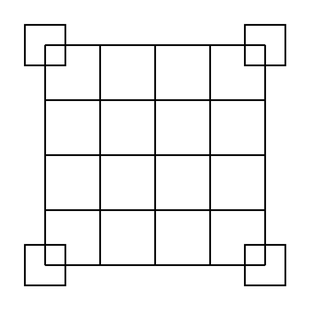
To count the number of squares in the given figure, we need to consider squares of different sizes formed within the grid and the overlapping squares at the corners.
Adding all these, we have:
Total number of squares: \(16 + 9 + 4 + 1 + 12 = 42\).
Correct Option: B) 38
The question asks to identify the national political party that uses the 'clock' as its election symbol as of 2018. This requires knowledge of the symbols of major national parties in India.
Correct Option: C) Nationalist Congress Party
The Nationalist Congress Party (NCP) has the 'clock' as its election symbol. This symbol features an analog clock, typically showing the time 10:10, and is recognized by the Election Commission of India.
The question asks about the accuracy of statements regarding the speed of sound in Aluminium and Nickel at a specific temperature (25°C). This requires knowledge of typical sound speeds in these materials.
Correct Option: A) Only B is true
The question asks which phenomenon is NOT explained by Newton's universal law of gravitation. We need to evaluate each option based on the principles of this law.
where \(F\) is the gravitational force, \(G\) is the gravitational constant, \(m_1\) and \(m_2\) are the masses of the two objects, and \(r\) is the distance between their centers.
D) The motion of sun around the planets. This statement is factually incorrect. The planets revolve around the Sun, not the other way around. The universal law of gravitation explains why planets orbit the Sun, not the reverse.
The question asks to identify which of the given metals forms an amphoteric oxide. An amphoteric oxide is an oxide that reacts with both acids and bases to form salt and water. This property is typically exhibited by metals that are neither strongly electropositive nor strongly electronegative.
A) Al — Aluminum oxide (\(\text{Al}_2\text{O}_3\)) is a classic example of an amphoteric oxide. It reacts with acids like hydrochloric acid:
\[ \text{Al}_2\text{O}_3 (\text{s}) + 6\text{HCl} (\text{aq}) \rightarrow 2\text{AlCl}_3 (\text{aq}) + 3\text{H}_2\text{O} (\text{l}) \]And it reacts with bases like sodium hydroxide:
\[ \text{Al}_2\text{O}_3 (\text{s}) + 2\text{NaOH} (\text{aq}) + 3\text{H}_2\text{O} (\text{l}) \rightarrow 2\text{Na}[\text{Al}(\text{OH})_4] (\text{aq}) \]The question asks about the number of major physiographical regions into which India is divided. This is a fundamental concept in Indian geography. We need to recall the standard classification of India's physical divisions.
A) 6 is the correct answer as India is traditionally divided into six major physiographical regions.
The problem asks us to calculate the energy possessed by an object at a certain height above the ground. This type of energy is known as potential energy, specifically gravitational potential energy. We can calculate it using the formula for gravitational potential energy, which relates the object's mass, the acceleration due to gravity, and its height.
The gravitational potential energy (\(PE\)) is given by the formula:
\[ PE = mgh \]Energy is measured in Joules (\(J\)).
Correct Option: D) 686 J is the calculated gravitational potential energy of the object.
Which of the options bears the closest resemblance to the following figure?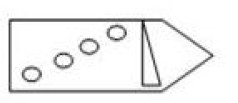
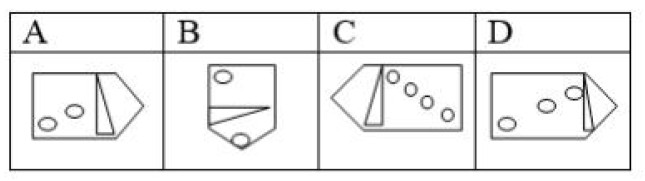
The task is to identify which option most closely resembles the given figure. This involves comparing shapes, orientations, and arrangements of elements within the figures.
Correct Option: C) The elements are arranged and oriented exactly like the original figure.
A tank has two inlets and one outlet. The inlets fill up the tank in 6 hours and 3 hours individually and outlet empties it in 10 hours. If the inlets are opened for an hour and closed and then all the three taps are opened together, how much time will it take to fill up the remaining tank?
\( \frac{5}{4} \) hours
\( \frac{72}{23} \) hours
\( \frac{85}{23} \) hours
\( \frac{82}{23} \) hours
This problem involves calculating the work done by pipes (inlets and outlets) to fill or empty a tank. We will determine the individual rates of filling and emptying, then calculate the amount of tank filled in the initial phase. Finally, we will find the combined rate of all pipes and use it to calculate the time required to fill the remaining portion of the tank.
Calculate the filling rate of Inlet 1:
Inlet 1 fills the tank in 6 hours. So, its 1-hour filling rate is:
\[ \text{Rate of Inlet 1} = \frac{1}{6} \text{ tank/hour} \]Calculate the filling rate of Inlet 2:
Inlet 2 fills the tank in 3 hours. So, its 1-hour filling rate is:
\[ \text{Rate of Inlet 2} = \frac{1}{3} \text{ tank/hour} \]Calculate the emptying rate of the Outlet:
The outlet empties the tank in 10 hours. So, its 1-hour emptying rate is:
\[ \text{Rate of Outlet} = \frac{1}{10} \text{ tank/hour} \]Calculate the amount of tank filled in the first hour:
Both inlets are opened for 1 hour. Their combined filling rate is:
\[ \text{Combined rate of Inlets} = \text{Rate of Inlet 1} + \text{Rate of Inlet 2} = \frac{1}{6} + \frac{1}{3} \] \[ = \frac{1}{6} + \frac{2}{6} = \frac{3}{6} = \frac{1}{2} \text{ tank/hour} \]In 1 hour, the amount of tank filled is:
\[ \text{Amount filled in 1 hour} = \frac{1}{2} \times 1 = \frac{1}{2} \text{ of the tank} \]Calculate the remaining portion of the tank to be filled:
\[ \text{Remaining portion} = 1 - \frac{1}{2} = \frac{1}{2} \text{ of the tank} \]Calculate the net filling rate when all three taps are opened:
When both inlets and the outlet are open, the net rate is:
\[ \text{Net rate} = \text{Rate of Inlet 1} + \text{Rate of Inlet 2} - \text{Rate of Outlet} \] \[ = \frac{1}{6} + \frac{1}{3} - \frac{1}{10} \] \[ = \frac{5}{30} + \frac{10}{30} - \frac{3}{30} = \frac{5 + 10 - 3}{30} = \frac{12}{30} = \frac{2}{5} \text{ tank/hour} \]Calculate the time to fill the remaining portion:
Time = \[\frac{\text{Remaining portion}}{\text{Net rate}}\]
\[ \text{Time} = \frac{\frac{1}{2}}{\frac{2}{5}} = \frac{1}{2} \times \frac{5}{2} = \frac{5}{4} \text{ hours} \]A) \( \frac{5}{4} \) hours is the correct time required to fill the remaining tank.
The problem involves calculating the number of coins of a specific denomination given the total amount of money and the percentage distribution of coins for other denominations. We will first determine the percentage of Rs 1 coins, then set up an equation based on the total value of the coins to find the total number of coins, and finally calculate the number of Rs 1 coins.
A) The number of Rs 1 coins is 20, which matches our calculation.