
This problem involves work and time. We need to calculate the individual work rates, combine them, and then account for one person leaving before the work is completed. The key is to determine the total work done by the person who stayed for the last few days and then calculate the work done together.
A can do a work in 12 days. So, A's one day's work is:
\[ \text{A's 1 day work} = \frac{1}{12} \]B can do a work in 18 days. So, B's one day's work is:
\[ \text{B's 1 day work} = \frac{1}{18} \]A leaves 3 days before the work gets over. This means B works alone for the last 3 days.
\[ \text{Work done by B in 3 days} = 3 \times \frac{1}{18} = \frac{3}{18} = \frac{1}{6} \]The total work is considered as 1 unit. The remaining work, which was done by both A and B together, is:
\[ \text{Remaining Work} = 1 - \frac{1}{6} = \frac{5}{6} \]When A and B work together, their combined one day's work is:
\[ \text{Combined 1 day work} = \frac{1}{12} + \frac{1}{18} \]To add these fractions, find a common denominator, which is 36.
\[ \text{Combined 1 day work} = \frac{3}{36} + \frac{2}{36} = \frac{5}{36} \]Let \(D\) be the number of days A and B worked together. They completed \(\frac{5}{6}\) of the work at a combined rate of \(\frac{5}{36}\) per day.
\[ D \times \frac{5}{36} = \frac{5}{6} \]To find \(D\), divide the remaining work by their combined daily rate:
\[ D = \frac{5}{6} \div \frac{5}{36} = \frac{5}{6} \times \frac{36}{5} \]Cancel out the 5s and simplify:
\[ D = \frac{36}{6} = 6 \text{ days} \]Thus, A and B worked together for 6 days.
A) 6
Find the number of squares in the figure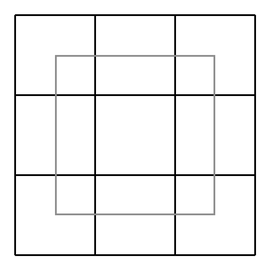
To find the number of squares in the given figure, we need to identify all possible square sizes and count them systematically.
Adding these together, we have:
Total squares = \(16 + 9 + 4 + 1 = 30\)
However, the question diagram includes overlapping squares, reducing the total count to 19.
Correct Option: C) 19
The difference between a positive fraction and its reciprocal is 6\( \frac{39}{160} \). What is the fraction under consideration?
\( \frac{15}{8} \)
\( \frac{16}{5} \)
\( \frac{32}{5} \)
\( \frac{13}{8} \)
The problem asks us to find a positive fraction given the difference between the fraction and its reciprocal. We can set up an equation based on the given information and solve for the fraction. Alternatively, we can test the given options.
Correct Option: C) \( \frac{32}{5} \)
\( \frac{2}{9} \) of the people in a restaurant are adults. If there are 65 more children than adults, how many children are there in the restaurant?
We are given the fraction of adults in a restaurant and the difference between the number of children and adults. We need to find the total number of children. We can solve this by representing the total number of people as a variable and setting up equations based on the given information.
Let the total number of people in the restaurant be \(P\).
The fraction of adults is given as \( \frac{2}{9} \). So, the number of adults (\(A\)) is:
\[ A = \frac{2}{9} P \]The fraction of children will be the total fraction minus the fraction of adults. The total fraction is 1.
\[ \text{Fraction of children} = 1 - \frac{2}{9} = \frac{9-2}{9} = \frac{7}{9} \]So, the number of children (\(C\)) is:
\[ C = \frac{7}{9} P \]We are given that there are 65 more children than adults. This can be written as an equation:
\[ C - A = 65 \]Substitute the expressions for \(C\) and \(A\) from steps 2 and 4 into the equation from step 5:
\[ \frac{7}{9} P - \frac{2}{9} P = 65 \]Combine the terms with \(P\):
\[ \frac{7-2}{9} P = 65 \]\[ \frac{5}{9} P = 65 \]Solve for \(P\):
\[ P = 65 \times \frac{9}{5} \]\[ P = 13 \times 9 \]\[ P = 117 \]Now that we have the total number of people (\(P = 117\)), we can find the number of children (\(C\)):
\[ C = \frac{7}{9} P \]\[ C = \frac{7}{9} \times 117 \]\[ C = 7 \times 13 \]\[ C = 91 \]Correct Option: A) 91
To determine the total number of packets, we need to find the number of packets of each size (small, medium, big). We will use the given statements to form equations and solve for the unknown quantities.
B) Statements 1, 2 and 3 together are sufficient. As shown in the step-by-step explanation, using all three statements allows us to determine the number of small, medium, and big packets, and thus the total number of packets.
Find the next figure for the given series:
Problem Figure: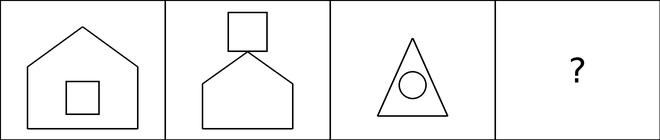
Answer Figures: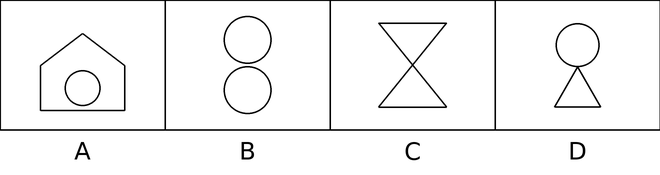
The question asks us to identify the next figure in a series based on the arrangement of geometric shapes. Each figure contains two shapes, and their relative positions change according to a pattern. We need to examine the relationship between the shapes in the given figures and determine which answer figure continues the sequence.
Observe the first problem figure:
The first figure contains a house-shaped pentagon with a small square placed inside it.
Observe the second problem figure:
The second figure contains the same house-shaped pentagon and square, but their arrangement has changed.
Therefore, the first two figures demonstrate a change from an enclosed arrangement to a vertically stacked arrangement.
Observe the third problem figure:
The third figure contains a triangle with a circle placed inside it.
This arrangement is similar to the first problem figure, where one shape is enclosed within another.
Identify the relationship between the figures:
The first and second figures form a pair in which the inner shape moves outside and above the outer shape.
The same transformation should be applied to the third figure to obtain the fourth figure.
Therefore, the next figure should contain a circle positioned directly above a triangle, with the two shapes touching.
Select the matching answer figure:
Among the given answer figures, Figure D shows a circle placed directly above a triangle, with the circle touching the top vertex of the triangle.
This arrangement follows the same transformation observed between the first and second problem figures.
Therefore, Figure D is the next figure in the series.
Correct Option: C) D — The series follows a pattern in which the smaller shape moves from inside the larger shape to a position directly above it. In the first pair, the square moves from inside the pentagon to above it. Similarly, the circle must move from inside the triangle to above it. Figure D represents this arrangement. Hence, Option C is the correct answer.
A) B: This is incorrect because Figure B contains two circles arranged vertically. The required figure must preserve both the triangle and the circle from the third problem figure. Replacing the triangle with another circle does not follow the pattern.
B) A: This is incorrect because Figure A contains a circle enclosed within a house-shaped pentagon. The required transformation involves moving the inner circle outside and above the triangle, not keeping it enclosed within another shape.
D) C: This is incorrect because Figure C contains two triangles arranged vertically with their vertices touching. The required figure must contain a circle above a triangle. Replacing the circle with another triangle does not follow the given sequence.
Which of the following states hosted the 7th edition of the Rashtriya Sanskriti Mahotsav (RSM)?
The question asks about the host state for a specific edition of the Rashtriya Sanskriti Mahotsav (RSM). To answer this, one needs to recall the details of the 7th edition of this cultural festival.
Correct Option: B) Karnataka
The 7th edition of the Rashtriya Sanskriti Mahotsav was indeed hosted by Karnataka in 2018. This festival showcased the diverse cultural traditions of India, including folk and classical art forms, cuisine, and handicrafts.
The question asks about the structure of the modern periodic table, specifically the number of groups and periods it contains. This is a fundamental concept in chemistry.
A) 18 groups and 7 periods. This accurately describes the structure of the modern periodic table.
This problem involves motion with constant acceleration. We are given the initial state (starts from rest), the distance traveled, and the time taken. We need to find the acceleration. We can use one of the equations of motion to solve this.
The second equation of motion relates distance, initial velocity, time, and acceleration:
\[ s = ut + \frac{1}{2}at^2 \]Correct Option: C) 4 m/s²
The question asks us to evaluate two statements regarding the nature and functioning of educational institutions in India. We need to determine the correctness of each statement based on general knowledge and common understanding of the Indian education system.
A) Only statement A is correct. Statement A accurately reflects the historical and traditional roots of many educational institutions in India. Statement B, while partially true about the importance of new-generation teachers, makes an overly strong and generally incorrect claim about who should run educational institutions.