The question asks to identify the court poet of the famous Indian emperor Harshavardhana. This requires knowledge of prominent historical figures and their associated court poets from ancient Indian history.
Correct Option: D) Banabhatta was the court poet of Harshavardhana. His works like 'Harshacharita' provide valuable historical information about Harshavardhana's reign.
The question asks to identify the father of King Ashoka, who was a prominent ruler of the Maurya dynasty. This requires knowledge of the lineage of the Maurya emperors.
Correct Option: D) Bindusara — Bindusara was the son of Chandragupta Maurya and the father of Ashoka. He ruled the Mauryan Empire from c. 297 BCE to c. 273 BCE.
To find the Least Common Multiple (LCM) of a set of numbers, we can use the prime factorization method. This involves finding the prime factors of each number and then taking the highest power of all common and uncommon prime factors.
Thus, the LCM of 94, 188, and 235 is 940.
Correct Option: C) 940
Choose the mirror image for the following figure: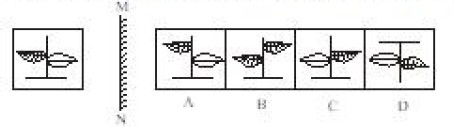
To find the mirror image of a figure, we need to visualize how the figure would look if reflected across a vertical line. This involves flipping the figure horizontally.
Correct Option: C) The flag is correctly positioned on the right side, and the pole with the base is on the left, matching the mirror image of the original.
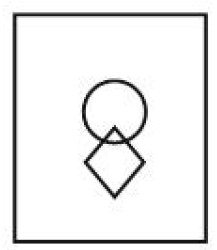
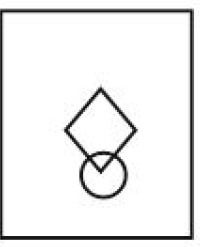
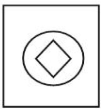
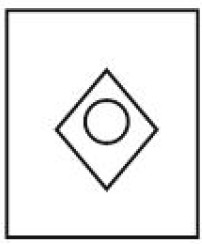
Find the next figure in the given series: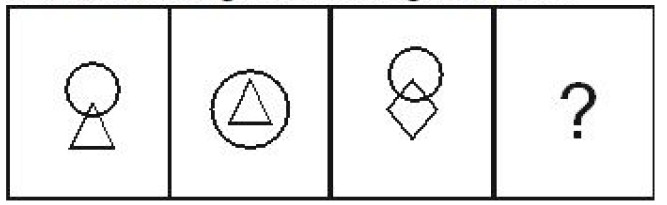
To find the next figure in the series, observe the pattern of shapes and their positions in the sequence. The series involves a circle and a triangle or diamond shape, which change positions in each step.
Therefore, the correct option is the one where the diamond is inside the circle.
Correct Option: C) The diamond is inside the circle.
To find the median of a data set, we first need to arrange the data in ascending order. Then, we determine if the number of data points is odd or even. If odd, the median is the middle value. If even, the median is the average of the two middle values.
Correct Option: A) 49.5
The problem involves finding the current ages of a father and son using their age ratio and the product of their ages. Once their current ages are determined, we need to calculate their ages after 5 years and then find the new ratio.
Represent current ages:
Let the current age of the father be \(4x\) years and the current age of the son be \(1x\) (or just \(x\)) years, since their ratio is 4:1.
Use the product of their ages:
Given that the product of their ages is 196.
\[ (4x) \times (x) = 196 \]\[ 4x^2 = 196 \]Solve for \(x\):
Divide both sides by 4:
\[ x^2 = \frac{196}{4} \]\[ x^2 = 49 \]\[ x = \sqrt{49} \]\[ x = 7 \]Calculate current ages:
Father's current age \( = 4x = 4 \times 7 = 28 \) years.
Son's current age \( = x = 7 \) years.
Calculate ages after 5 years:
Father's age after 5 years \( = 28 + 5 = 33 \) years.
Son's age after 5 years \( = 7 + 5 = 12 \) years.
Find the ratio of their ages after 5 years:
Ratio \[= \frac{\text{Father's age after 5 years}}{\text{Son's age after 5 years}} = \frac{33}{12}\]
Simplify the ratio by dividing both numbers by their greatest common divisor, which is 3:
\[ \frac{33 \div 3}{12 \div 3} = \frac{11}{4} \]Thus, the ratio is 11 : 4.A) 11 : 4 is the correct ratio of their ages after 5 years, as calculated.
Travelling at 66 km/h, Piyali reaches a place 5 minutes early. If she travelled at 54 km/h, she would have been 3 minutes late. What is the distance Piyali had to travel?
This problem involves calculating distance based on varying speeds and the corresponding time differences. We can use the fundamental relationship between distance, speed, and time, and set up equations based on the given conditions. Let the distance be \(D\) and the usual time taken be \(T\). We will express the time taken in each scenario and equate the difference to the given time variations.
Let the distance Piyali had to travel be \(D\) km.
Let the usual time taken to travel this distance be \(T\) hours.
Case 1: Travelling at 66 km/h
Piyali reaches 5 minutes early. So, the time taken is \(T - 5 \text{ minutes}\).
Convert minutes to hours: \[5 \text{ minutes} = \frac{5}{60} = \frac{1}{12} \text{ hours}\].
Time taken \((t_1) = T - \frac{1}{12}\) hours.
Using the formula \(\text{Distance} = \text{Speed} \times \text{Time}\):
\[ D = 66 \times \left(T - \frac{1}{12}\right) \quad \ldots(1) \]Case 2: Travelling at 54 km/h
Piyali would have been 3 minutes late. So, the time taken is \(T + 3 \text{ minutes}\).
Convert minutes to hours: \[3 \text{ minutes} = \frac{3}{60} = \frac{1}{20} \text{ hours}\].
Time taken \((t_2) = T + \frac{1}{20}\) hours.
Using the formula \(\text{Distance} = \text{Speed} \times \text{Time}\):
\[ D = 54 \times \left(T + \frac{1}{20}\right) \quad \ldots(2) \]Since the distance \(D\) is the same in both cases, we can equate equations (1) and (2):
\[ 66 \times \left(T - \frac{1}{12}\right) = 54 \times \left(T + \frac{1}{20}\right) \]Divide both sides by 6 (the greatest common divisor of 66 and 54):
\[ 11 \times \left(T - \frac{1}{12}\right) = 9 \times \left(T + \frac{1}{20}\right) \]Expand the equation:
\[ 11T - \frac{11}{12} = 9T + \frac{9}{20} \]Rearrange the terms to solve for \(T\):
\[ 11T - 9T = \frac{9}{20} + \frac{11}{12} \]\[ 2T = \frac{9 \times 3 + 11 \times 5}{60} \quad (\text{LCM of } 20, 12 \text{ is } 60) \]\[ 2T = \frac{27 + 55}{60} \]\[ 2T = \frac{82}{60} \]\[ 2T = \frac{41}{30} \]\[ T = \frac{41}{60} \text{ hours} \]Now substitute the value of \(T\) into either equation (1) or (2) to find \(D\).
Using equation (1):
\[ D = 66 \times \left(T - \frac{1}{12}\right) \]\[ D = 66 \times \left(\frac{41}{60} - \frac{1}{12}\right) \]\[ D = 66 \times \left(\frac{41}{60} - \frac{5}{60}\right) \]\[ D = 66 \times \left(\frac{41 - 5}{60}\right) \]\[ D = 66 \times \frac{36}{60} \]\[ D = 66 \times \frac{3}{5} \]\[ D = \frac{198}{5} \]\[ D = 39.6 \text{ km} \]This is a letter series problem. We need to identify the pattern in the given sequence of letters and then apply that pattern to find the next letter. Often, such patterns involve the alphabetical position of the letters or a combination of operations.
The pattern observed is a repeating sequence of operations: +4, -1, +4, -1, +4.
Thus, the next letter in the series is O.
C) O is the correct option because following the established pattern of adding 4 to the alphabetical position and then subtracting 1, the letter after P (16th position) would be the 15th letter, which is O.
The question asks to identify the scientist who proposed the theory of evolution of species by natural selection in the nineteenth century. This requires knowledge of key figures in biology and their contributions.
Correct Option: D) Charles Darwin is credited with developing the theory of evolution by natural selection. His work, published in 1859, revolutionized the understanding of how species change over time.