
The question asks for the location and year of the first FIFA World Cup. This is a factual recall question related to sports history.
The first FIFA World Cup was held in 1930. Uruguay was chosen as the host nation, and the matches were primarily played in its capital city, Montevideo.
Correct Option: C) Montevideo, 1930
To determine the day of the week for a given date, we use the concept of "odd days". Odd days are the number of days remaining after dividing the total number of days by 7. We calculate the total odd days from a known reference point (e.g., January 1, 1 AD) up to the day before the target date, and then use a mapping for the day of the week.
Reference for Odd Days:
Calculate Odd Days for Centuries:
This pattern repeats every 400 years (e.g., 800 years = 0 odd days, 1200 years = 0 odd days, 1600 years = 0 odd days, 2000 years = 0 odd days).
Calculate Odd Days for the year 2008: We need to find the day for April 2, 2008. We calculate odd days up to April 1, 2008.
Odd days up to 2000 years:
\[ 2000 \text{ years} = 5 \times 400 \text{ years} = 0 \text{ odd days} \]Odd days for the remaining 7 years (2001-2007):
Number of leap years between 2001 and 2007: 2004 (1 leap year).
Number of ordinary years: \(7 - 1 = 6\) ordinary years.
Odd days from 2001 to 2007:
\[ (1 \text{ leap year} \times 2 \text{ odd days/leap year}) + (6 \text{ ordinary years} \times 1 \text{ odd day/ordinary year}) \] \[ = 2 + 6 = 8 \text{ odd days} \] \[ = 8 \pmod{7} = 1 \text{ odd day} \]Total odd days up to the end of 2007: \(0 + 1 = 1\) odd day.
Calculate Odd Days for 2008 (up to April 1):
2008 is a leap year (divisible by 4).
Total odd days in 2008 up to April 1:
\[ 3 + 1 + 3 + 1 = 8 \text{ odd days} \] \[ = 8 \pmod{7} = 1 \text{ odd day} \]Total Odd Days:
Total odd days = (Odd days up to 2007) + (Odd days in 2008 up to April 1)
\[ = 1 + 1 = 2 \text{ odd days} \]According to our reference, 2 odd days correspond to Wednesday.
A) Wednesday — Based on the calculation, April 2, 2008, had a total of 2 odd days, which corresponds to Wednesday.
The question asks to identify the largest group of animals among the given options. This requires knowledge of animal classification and the relative diversity of different phyla.
D) Arthropod — The phylum Arthropoda is by far the largest phylum in the animal kingdom, comprising over 80% of all known animal species. This group includes insects, spiders, crabs, and centipedes, among others, and they are characterized by an exoskeleton, segmented bodies, and jointed appendages.
The question asks to identify the color that experiences the least deviation angle when light passes through a dispersive medium, such as a prism. This phenomenon is known as dispersion of light, where white light splits into its constituent colors due to different refractive indices for different wavelengths.
D) Red — Red light has the longest wavelength among the visible spectrum. Due to this, it experiences the lowest refractive index when passing through a dispersive medium like a prism. A lower refractive index means the light bends less, resulting in the least deviation angle.
Which of the following Venn diagram correctly represents the relations of the given series? (A) Metal (B) Sand (C) Water
To determine the correct Venn diagram representation for the relationship between Metal, Sand, and Water, we need to consider their distinct characteristics and whether they overlap or are entirely separate.
Correct Option: A) The diagram correctly represents the distinct and non-overlapping nature of Metal, Sand, and Water.
Count the number of triangles in the given figure: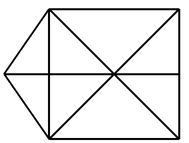
To count the number of triangles in the given figure, we need to identify all possible triangles formed by the intersecting lines.
Observe the figure. It consists of several intersecting lines forming a complex shape.
Start by counting the smallest triangles. There are 8 small triangles formed within the larger square and the adjoining triangle.
Next, count the medium-sized triangles that are formed by combining two small triangles. There are 6 such triangles.
Then, count the larger triangles formed by combining three or more small triangles. There are 3 such triangles.
Finally, count the largest triangle that encompasses the entire figure. There is 1 such triangle.
Add all the triangles: \(8 + 6 + 3 + 1 = 18\).
Correct Option: C) 17
The question asks to identify the term for a series of organic compounds that share the same functional group but differ by a -CH2 group. This is a fundamental concept in organic chemistry related to the classification of organic compounds.
Correct Option: D) Homologous series is the correct term for a series of organic compounds having the same functional group but differing by a -CH2 group. They exhibit similar chemical properties and a gradual change in physical properties.
To find the angle between the hour hand and the minute hand of a clock, we need to calculate the angular position of each hand from the 12 o'clock mark. The minute hand completes a full circle (360°) in 60 minutes, and the hour hand completes a full circle in 12 hours. We will calculate the angle for each hand at the given time and then find the difference.
The minute hand moves 360° in 60 minutes. So, in 1 minute, it moves \( \frac{360^\circ}{60} = 6^\circ \).
At 10:45 a.m., the minute hand is at 45 minutes past the hour. Its angle from the 12 o'clock mark is:
\[ \text{Minute hand angle} = 45 \times 6^\circ = 270^\circ \]The hour hand moves 360° in 12 hours. So, in 1 hour, it moves \( \frac{360^\circ}{12} = 30^\circ \).
In 1 minute, it moves \( \frac{30^\circ}{60} = 0.5^\circ \).
At 10:45 a.m., the time can be expressed as 10 hours and 45 minutes. The hour hand's position is determined by the hours past 12 (or 0) and the additional movement due to the minutes.
Angle due to hours: \( 10 \times 30^\circ = 300^\circ \)
Angle due to minutes: \( 45 \times 0.5^\circ = 22.5^\circ \)
Total hour hand angle from the 12 o'clock mark is:
\[ \text{Hour hand angle} = 300^\circ + 22.5^\circ = 322.5^\circ \]The difference between the two angles is:
\[ \text{Angle difference} = | \text{Hour hand angle} - \text{Minute hand angle} | \]\[ \text{Angle difference} = | 322.5^\circ - 270^\circ | = 52.5^\circ \]The angle calculated is 52.5°. Since a clock has two angles between the hands (the smaller one and the larger one, which is \(360^\circ - \text{smaller angle}\)), and 52.5° is less than 180°, this is the smaller angle.
C) 52.5° is the calculated smaller angle between the hour and minute hands at 10:45 a.m.
This is a syllogism problem. We need to analyze the given statements and determine which of the conclusions logically follow. We can use Venn diagrams or logical deduction to solve this.
A) Both conclusions I and II follow.
Find the cost price when the selling price is Rs. 6,300 and the profit is 5%
To find the cost price (CP) when the selling price (SP) and profit percentage are given, we can use the formula relating these three quantities. The selling price is the cost price plus the profit. Profit is calculated as a percentage of the cost price.
The selling price is the cost price plus the profit. The profit is a percentage of the cost price.
\[ \text{SP} = \text{CP} + \text{Profit} \]\[ \text{Profit} = \left( \frac{\text{Profit Percentage}}{100} \right) \times \text{CP} \]We have \(\text{SP} = 6300\) and \(\text{Profit Percentage} = 5\).
\[ 6300 = \text{CP} \left( 1 + \frac{5}{100} \right) \]\[ 6300 = \text{CP} \left( 1 + 0.05 \right) \]\[ 6300 = \text{CP} (1.05) \]To find CP, divide the SP by 1.05.
\[ \text{CP} = \frac{6300}{1.05} \]\[ \text{CP} = \frac{6300}{\frac{105}{100}} \]\[ \text{CP} = \frac{6300 \times 100}{105} \]\[ \text{CP} = \frac{630000}{105} \]\[ \text{CP} = 6000 \]Thus, the cost price is Rs. 6,000.
C) Rs. 6,000 is the correct cost price calculated using the given selling price and profit percentage.


