
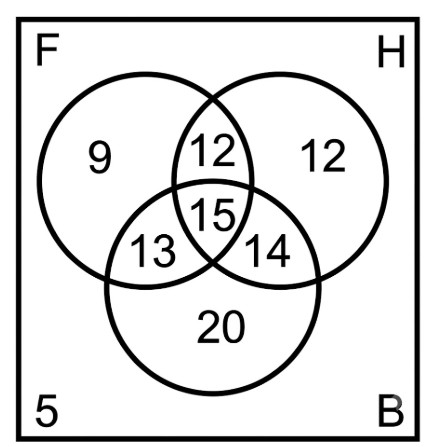
The given diagram shows the number of students playing Football (F), Hockey (H) and Basketball (B) in a class. The total number of students who like at most two sports is:
To find the total number of students who like at most two sports, we need to consider students who like either one or two sports, excluding those who like all three sports.
Sum of students who like only one sport:
Sum of students who like exactly two sports:
Adding these gives:
\[9 + 12 + 20 + 12 + 14 + 13 = 80\]
Thus, the total number of students who like at most two sports is \(80\).
Correct Option: D) 80
The first ionization potential (or ionization energy) is the energy required to remove the most loosely bound electron from an isolated gaseous atom in its ground state. Generally, ionization potential increases across a period due to increasing nuclear charge and decreasing atomic size, and decreases down a group due to increasing atomic size and shielding effect. However, there are exceptions to this trend, particularly when moving from Group 2 to Group 13 elements, and from Group 14 to Group 15 elements.
Let's recheck the options with the derived order: Na < Al < Mg < Si.
Option B states: Na < Al < Mg < Si. This matches our derived order.
B) Na < Al < Mg < Si. This order correctly reflects the general trend of increasing ionization potential across a period, with the specific exception that Group 13 elements (Al) have a lower ionization potential than Group 2 elements (Mg) due to the easier removal of a p-electron compared to a stable s-electron.
The question asks to identify the Indian film that won the Best Short Film award at the Los Angeles Film Festival in 2018. This requires specific knowledge of film awards and their recipients.
In 2018, the Indian short film Shunyta, directed by Chintan Sarda, won the Best Short Film award at the Los Angeles Film Festival.
Correct Option: D) Shunyta
The question asks for the basic source of biological diversity. This requires understanding the fundamental mechanisms that introduce variation into populations, which is the raw material for evolution.
Correct Option: A) mutation — Mutations are random changes in the DNA sequence. These changes introduce new genetic material and new alleles into a population, serving as the ultimate raw material for evolution and thus, the basic source of biological diversity.
The question asks about the physiological process that allows air to enter the lungs during inhalation. This involves understanding the mechanics of breathing, specifically how changes in lung volume facilitate air movement.
Correct Option: C) lung inflation. During inhalation, the increase in thoracic cavity volume causes a pressure drop inside the lungs, leading to air rushing in and causing the lungs to inflate or expand.
The problem involves ratios. We are given a ratio of two linear expressions in terms of \(x\) and \(y\). Our goal is to find the ratio of two other linear expressions in terms of \(x\) and \(y\). The strategy is to first use the given ratio to find a relationship between \(x\) and \(y\) (specifically, the ratio \(x:y\)). Once we have \(x:y\), we can substitute this relationship into the second expression to find its ratio.
Set up the equation from the given ratio:
We are given \((10x + 3y) : (5x + 2y) = 9 : 5\). This can be written as a fraction:
\[ \frac{10x + 3y}{5x + 2y} = \frac{9}{5} \]Cross-multiply to eliminate the denominators:
\[ 5(10x + 3y) = 9(5x + 2y) \]Distribute the numbers on both sides:
\[ 50x + 15y = 45x + 18y \]Rearrange the terms to group \(x\) terms on one side and \(y\) terms on the other:
Subtract \(45x\) from both sides:
\[ 50x - 45x + 15y = 18y \] \[ 5x + 15y = 18y \]Subtract \(15y\) from both sides:
\[ 5x = 18y - 15y \] \[ 5x = 3y \]Find the ratio \(x:y\):
From \(5x = 3y\), we can write:
\[ \frac{x}{y} = \frac{3}{5} \]This means \(x = 3k\) and \(y = 5k\) for some constant \(k\).
Substitute the relationship into the expression we need to evaluate:
We need to find \((2x + y) : (x + 2y)\). Substitute \(x = 3k\) and \(y = 5k\):
\[ 2x + y = 2(3k) + 5k = 6k + 5k = 11k \] \[ x + 2y = 3k + 2(5k) = 3k + 10k = 13k \]Form the final ratio:
\[ (2x + y) : (x + 2y) = 11k : 13k = 11 : 13 \]Correct Option: D) 11 : 13
The problem asks us to find an unknown number given the product of two numbers and one of the numbers. We can set up an algebraic equation to represent the given information and then solve for the unknown number.
B) 0.27 is the other number. This matches our calculated value.
This is a syllogism problem. We need to analyze the given statements and determine which conclusions logically follow. We can use Venn diagrams or logical deduction to represent the relationships between the categories (Cake, Pie, Cream, Sour) and then check the validity of the conclusions.
B) Neither conclusion I nor II follows
This problem involves work and time. We will use the concept that if a person or a group can complete a work in \(D\) days, then their one day's work is \(1/D\). We will set up equations based on the given information to find the individual efficiencies and then calculate the time required for A and C to complete twice the work.
Calculate one day's work for each group:
Find C's one day's work:
We know (A + B + C)'s one day's work and (A + B)'s one day's work. Subtracting the latter from the former gives C's one day's work.
\[ \text{C's one day's work} = (\text{A} + \text{B} + \text{C})'s \text{ one day's work} - (\text{A} + \text{B})'s \text{ one day's work} \]\[ \text{C's one day's work} = \frac{1}{6} - \frac{1}{8} = \frac{4 - 3}{24} = \frac{1}{24} \]Find A's one day's work:
Similarly, we know (A + B + C)'s one day's work and (B + C)'s one day's work. Subtracting the latter from the former gives A's one day's work.
\[ \text{A's one day's work} = (\text{A} + \text{B} + \text{C})'s \text{ one day's work} - (\text{B} + \text{C})'s \text{ one day's work} \]\[ \text{A's one day's work} = \frac{1}{6} - \frac{1}{12} = \frac{2 - 1}{12} = \frac{1}{12} \]Calculate (A + C)'s one day's work:
Add A's and C's one day's work.
\[ (\text{A} + \text{C})'s \text{ one day's work} = \text{A's one day's work} + \text{C's one day's work} \]\[ (\text{A} + \text{C})'s \text{ one day's work} = \frac{1}{12} + \frac{1}{24} = \frac{2 + 1}{24} = \frac{3}{24} = \frac{1}{8} \]Calculate the time for A and C to complete the original work:
If (A + C)'s one day's work is \( \frac{1}{8} \), then A and C together can complete the original work in 8 days.
Calculate the time for A and C to complete twice the work:
To complete twice the work, they will take twice the time.
\[ \text{Time for twice the work} = 2 \times (\text{Time for original work}) = 2 \times 8 \text{ days} = 16 \text{ days} \]Correct Option: B) 16
A and C together take 8 days to complete the original work. Therefore, to complete twice the work, they will take \(2 \times 8 = 16\) days.
The question asks for the location of the Indira Gandhi Indoor Stadium. This is a factual question about a prominent landmark in India. Knowledge of major sports and event venues in Indian cities is important for general awareness sections of competitive exams.
Correct Option: A) The Indira Gandhi Indoor Stadium is indeed located in New Delhi. It is one of the largest indoor sports arenas in Asia and a significant venue for various national and international events, including the Asian Games in 1982 and the Commonwealth Games in 2010.