
Solve the following equation
32 - 2(10 + 16 ÷ 4 × 3 - 5 × 2) + 30 =?
To solve this equation, we need to follow the order of operations, often remembered by the acronym PEMDAS/BODMAS (Parentheses/Brackets, Exponents/Orders, Multiplication and Division (from left to right), Addition and Subtraction (from left to right)).
First, evaluate the expression inside the parentheses:
\[ 10 + 16 \div 4 \times 3 - 5 \times 2 \]Inside the parentheses, perform multiplication and division from left to right:
Now, perform addition and subtraction from left to right inside the parentheses:
So, the value inside the parentheses is \( 12 \).
Substitute this value back into the original equation:
\[ 32 - 2(12) + 30 \]Next, perform the multiplication:
\[ 2 \times 12 = 24 \]The equation becomes:
\[ 32 - 24 + 30 \]Finally, perform addition and subtraction from left to right:
The final answer is \( 38 \).
B) 38 is the correct answer, as derived by following the order of operations.
Complete the following series by choosing the appropriate option
ZA, YB, ________, ________, VE.
The problem presents an alphanumeric series. To complete it, we need to identify the pattern in both the alphabetical and numerical (or positional) components of each term. We will analyze the first letters and the second letters separately.
D) XC, WD. This option correctly fills the blanks based on the identified patterns: the first letter decreases alphabetically (Z, Y, X, W, V) and the second letter increases alphabetically (A, B, C, D, E).
The question asks to identify the committee that recommended the decentralization of decision-making power and the establishment of elected local bodies. This refers to the foundational recommendations for Panchayati Raj in India.
Correct Option: D) The Balwant Rai Mehta Committee was appointed in 1957 to examine the working of the Community Development Programme and the National Extension Service. It recommended the scheme of 'democratic decentralisation', which ultimately came to be known as Panchayati Raj. Its main recommendations included a three-tier Panchayati Raj system: Gram Panchayat at the village level, Panchayat Samiti at the block level, and Zila Parishad at the district level, all to be organically linked and constituted by indirectly elected members, with genuine transfer of power and responsibility to these bodies.
This question tests knowledge of common chemical reactions, specifically the reaction of calcium oxide with water. Understanding the chemical names and formulas of these compounds is key to identifying the product.
Correct Option: A) Slaked lime is the compound obtained when water is added to CaO (quicklime). The chemical name for slaked lime is calcium hydroxide (\(\text{Ca(OH)}_2\)).
This problem involves Ohm's Law. First, we need to calculate the resistance of the electric heater using the initial given current and potential difference. Since the heater itself doesn't change, its resistance remains constant. Then, we can use this constant resistance and the new potential difference to find the new current.
Identify the given initial values:
Calculate the resistance of the heater:
According to Ohm's Law, \(V = IR\), where \(V\) is the potential difference, \(I\) is the current, and \(R\) is the resistance. We can rearrange this to find the resistance:
Identify the new potential difference:
Calculate the new current:
Since the resistance of the heater remains constant, we can use Ohm's Law again with the new potential difference and the calculated resistance to find the new current, \(I_2\):
Correct Option: C) 8.5 A
Which figure is different (not related) to the given group below?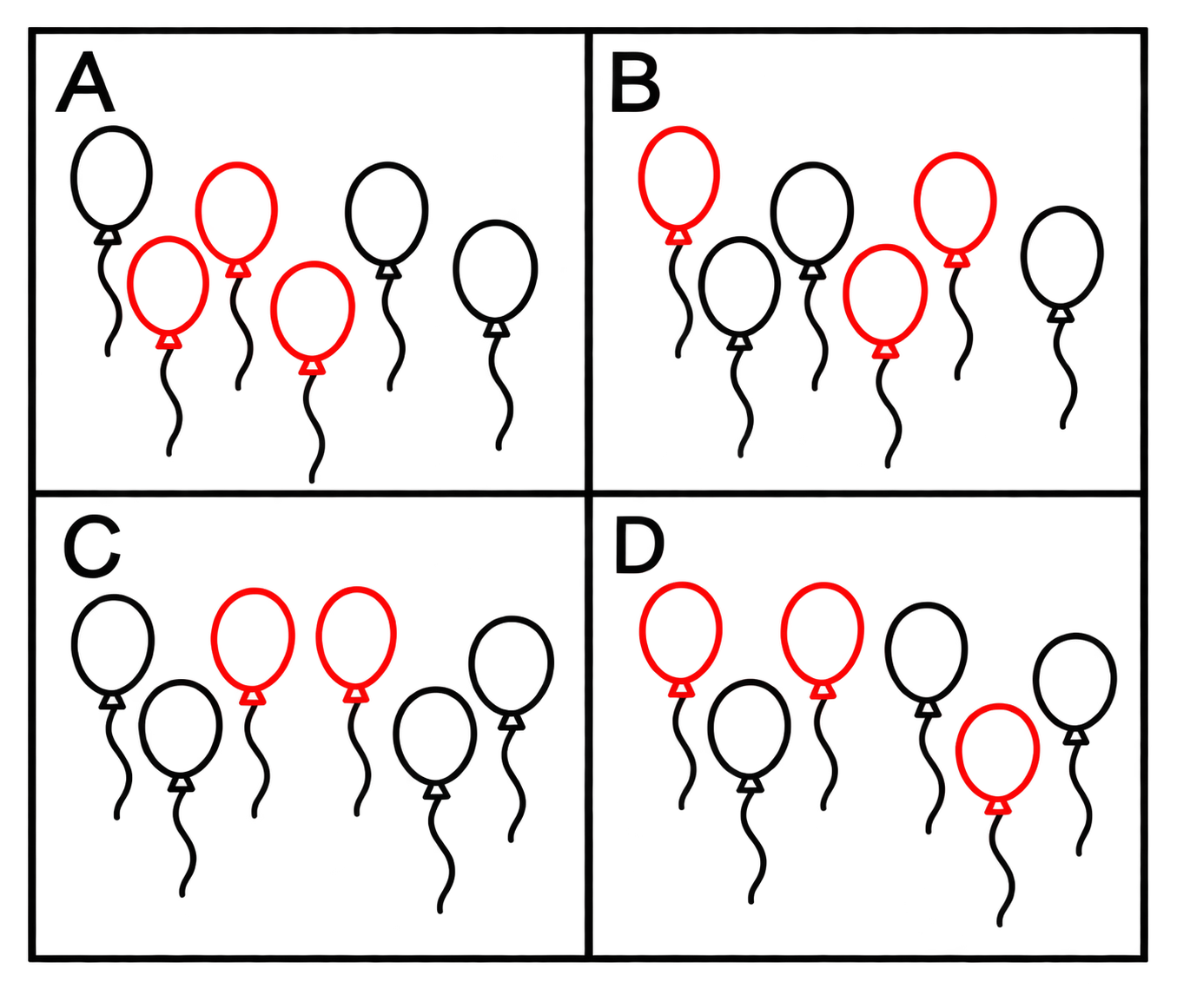
The task is to identify which figure among the options does not follow the same pattern as the others. Each figure contains a set of balloons with different orientations.
By identifying the consistent pattern in Figures A, B, and C, and recognizing the deviation in Figure D, we can determine that Figure D is the one that does not belong to the group.
Correct Option: D) Figure D is different from the others.
The problem involves calculating the profit or loss Rachna makes by borrowing money at simple interest and lending it at compound interest. We need to calculate the interest Rachna pays, the interest she receives, and then find the difference to determine the profit or loss.
Rachna borrowed Rs. 40,000 at 10% simple interest per annum. She borrowed for a total of 3 years (from the time she borrowed until the end of the third year).
Principal \((P) = \text{Rs. } 40,000\)
Rate \((R) = 10\%\)
Time \((T) = 3 \text{ years}\)
Simple Interest \((SI) = \frac{P \times R \times T}{100}\)
\[ SI = \frac{40000 \times 10 \times 3}{100} = 400 \times 10 \times 3 = \text{Rs. } 12,000 \]Exactly one year later, Rachna lent the principal amount (Rs. 40,000) to her friend at the same rate (10%) but compounded annually. This means the money she lent was for a period of \(3 - 1 = 2\) years.
Principal \((P) = \text{Rs. } 40,000\)
Rate \((R) = 10\%\)
Time \((T) = 2 \text{ years}\)
Compound Interest \[(CI) = P \left[ \left(1 + \frac{R}{100}\right)^T - 1 \right]\]
\[ CI = 40000 \left[ \left(1 + \frac{10}{100}\right)^2 - 1 \right] \]\[ CI = 40000 \left[ \left(1.1\right)^2 - 1 \right] \]\[ CI = 40000 \left[ 1.21 - 1 \right] \]\[ CI = 40000 \left[ 0.21 \right] \]\[ CI = \text{Rs. } 8,400 \]Profit/Loss = Interest Received - Interest Paid
Profit/Loss = \(CI - SI\)
\[ \text{Profit/Loss} = 8400 - 12000 \]\[ \text{Profit/Loss} = -\text{Rs. } 3,600 \]Since the result is negative, it indicates a loss.
Loss = Rs. 3,600
Correct Option: B) Rs. 3,600
To find the principal amount, we will use the formula for simple interest. First, convert the given time into years. Then, substitute the values of simple interest, time, and rate into the simple interest formula to solve for the principal amount.
Since 1 year has 12 months, 6 months can be written as \(\frac{6}{12}\) years.
\[ T = 3 \text{ years} + \frac{6}{12} \text{ years} = 3 + \frac{1}{2} \text{ years} = 3.5 \text{ years} \]The formula for simple interest is:
\[ SI = \frac{P \times R \times T}{100} \]where \(P\) is the Principal amount, \(R\) is the Rate of interest, and \(T\) is the Time.The principal amount is Rs. 1,05,600.
D) Rs. 1,05,600 is the correct amount on which the interest for 3 years 6 months at 5% simple interest per annum will be Rs. 18,480.
To solve this problem, we need to perform addition and subtraction of decimal numbers. It's crucial to align the decimal points correctly when adding or subtracting. We will first add all the positive numbers and then subtract the negative number from the sum.
First, let's add the three positive numbers: \(5.035\), \(50.35\), and \(503.50\).
\[\begin{array}{r} 5.035 \ 50.350 \ + 503.500 \ \hline 558.885 \ \end{array}\]So, \(5.035 + 50.35 + 503.50 = 558.885\).
Now, we subtract \(20.60\) from the sum obtained in the previous step, which is \(558.885\).
\[\begin{array}{r} 558.885 \ - 20.600 \ \hline 538.285 \ \end{array}\]Thus, \(558.885 - 20.60 = 538.285\).
The value of the expression \(5.035 + 50.35 + 503.50 - 20.60\) is \(538.285\).
Correct Option: C) 538.285
The question asks to identify the common name for the elements found in the second group of the periodic table. This requires knowledge of the organization and nomenclature of the periodic table.
Correct Option: C) Alkaline earth metals
The elements of the second group (Group 2) of the periodic table are known as alkaline earth metals. These include Beryllium (Be), Magnesium (Mg), Calcium (Ca), Strontium (Sr), Barium (Ba), and Radium (Ra). They are characterized by having two valence electrons and tend to lose these electrons to form \(+2\) ions. They are reactive metals, though less so than alkali metals, and form alkaline solutions with water.