
The question asks about the specific plan under which the Constituent Assembly of India was established. This is a factual question related to the historical background of the Indian Constitution. We need to identify the correct historical document or proposal.
Correct Option: A) The Constitution of India was framed by a Constituent Assembly set up under the Cabinet Mission Plan of 1946. This plan was proposed by the British Cabinet Mission to India in 1946 to discuss and finalize plans for the transfer of power from the British Raj to Indian leadership, and it included provisions for the formation of a Constituent Assembly.
The question asks to identify the scientist who classified elements and whose work inspired the discovery of new elements. This points to the development of the periodic table.
Correct Option: A) Mendeleev is credited with classifying elements in a way that left gaps for undiscovered elements and accurately predicted their properties, thereby inspiring their discovery.
Find The Mirror Image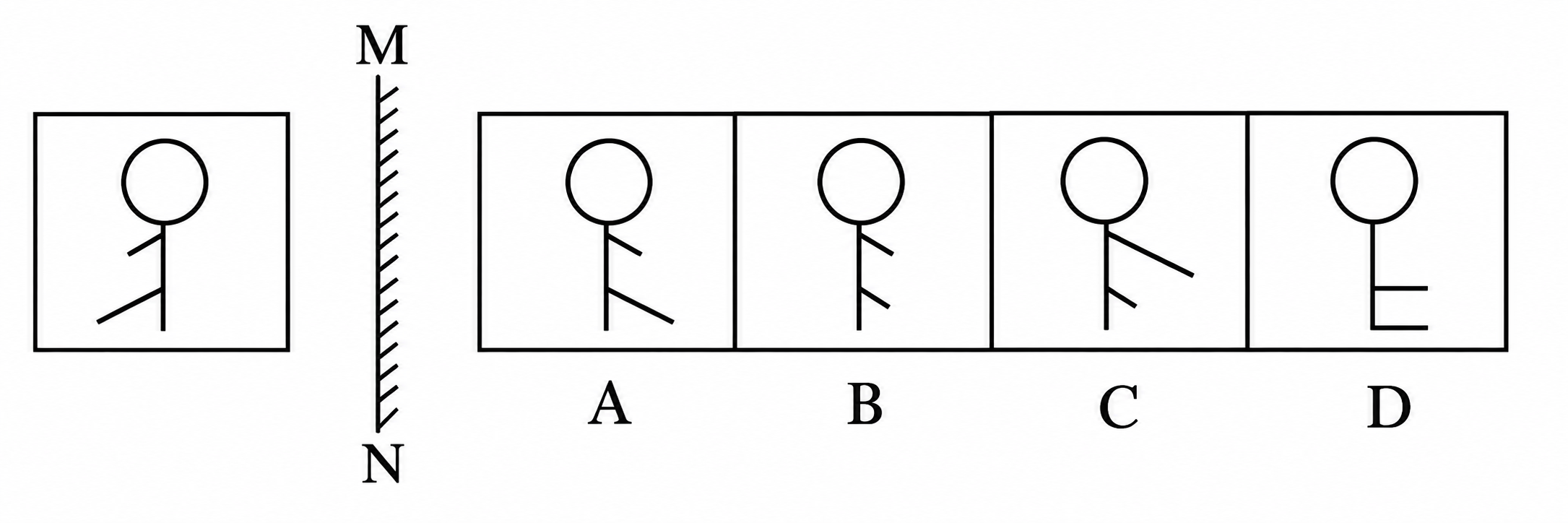
To find the mirror image of a given figure, we need to reflect the elements across the mirror line, which is usually indicated in the diagram. This involves flipping the elements horizontally.
Correct Option: A) The stick figure is correctly flipped horizontally, facing right.
This question asks for the definition of power in terms of work and time. Power is a fundamental concept in physics that describes the rate at which work is done or energy is transferred.
Correct Option: D) Work / Time
The problem involves decoding a word based on a given coding pattern. We need to identify the rule used to transform "KEEN" into "PVVM" and then apply the same rule to "PEAL" to find its code.
The problem asks us to find the angle of incidence given the angle between the incident ray and the reflected ray. We will use the law of reflection, which states that the angle of incidence is equal to the angle of reflection. We will also use the concept of the normal to the surface.
Let the angle of incidence be \(\theta_i\) and the angle of reflection be \(\theta_r\).
According to the law of reflection, the angle of incidence is equal to the angle of reflection. So, \(\theta_i = \theta_r\).
The angle between the incident ray and the reflected ray is the sum of the angle of incidence and the angle of reflection. Let this total angle be \(\theta_{\text{total}}\).
We are given that the angle between the incident ray and the reflected ray is 80°.
\[ \theta_{\text{total}} = \theta_i + \theta_r = 80^\circ \]Since \(\theta_i = \theta_r\), we can substitute \(\theta_i\) for \(\theta_r\) in the equation:
\[ \theta_i + \theta_i = 80^\circ \]This simplifies to:
\[ 2\theta_i = 80^\circ \]Now, solve for \(\theta_i\):
\[ \theta_i = \frac{80^\circ}{2} \]\[ \theta_i = 40^\circ \]Therefore, the angle of incidence is 40°.
A) 40° is the correct answer because, according to the law of reflection, the angle of incidence equals the angle of reflection. The sum of these two angles is the angle between the incident and reflected rays. If this sum is 80°, then each angle must be 40°.
Which country has won the 27th Sultan Azlan Shah Cup?
The question asks to identify the winner of the 27th Sultan Azlan Shah Cup. This requires knowledge of the results of this specific international field hockey tournament.
Correct Option: A) Australia won the 27th Sultan Azlan Shah Cup by defeating England in the final.
When an object is moving with uniform velocity, what is its acceleration?
The question asks about the acceleration of an object moving with uniform velocity. To answer this, we need to recall the definition of acceleration and uniform velocity.
where \(a\) is acceleration, \(\Delta v\) is the change in velocity, \(\Delta t\) is the change in time, \(v_f\) is the final velocity, and \(v_i\) is the initial velocity.
Thus, an object moving with uniform velocity has zero acceleration.
D) Zero — As derived from the definition of acceleration, if velocity is constant (uniform), there is no change in velocity, leading to zero acceleration.
Which of the following statements is/are true/false about the speed of sound in different media at 25°C?
Statements:
A. In oxygen gas, the speed of sound is 316 m/min.
B. In distilled water, the speed of sound is 1498 m/min.
Only B is True
Only A is True
Neither A nor B are True
Both A and B are True
The problem asks us to evaluate the truthfulness of two statements regarding the speed of sound in oxygen gas and distilled water at 25°C. We need to recall or find the standard speeds of sound in these media and convert units if necessary to compare with the given values.
C) Neither A nor B are True
An object of mass 100 kg is accelerated uniformly from a velocity of 5 ms⁻¹ to 15 ms⁻¹ in 5 s. Find the magnitude of force exerted on the object.
To find the magnitude of the force exerted on the object, we need to first calculate its acceleration. Since the object is accelerated uniformly, we can use the first equation of motion to find acceleration and then Newton's second law of motion to find the force.
Using the first equation of motion:
\[ v = u + at \]\[ 15 \text{ m/s} = 5 \text{ m/s} + a \times 5 \text{ s} \]\[ 15 - 5 = 5a \]\[ 10 = 5a \]\[ a = \frac{10}{5} \]\[ a = 2 \text{ m/s}^2 \]Using Newton's second law of motion:
\[ F = ma \]\[ F = 100 \text{ kg} \times 2 \text{ m/s}^2 \]\[ F = 200 \text{ N} \]D) 200 N — The calculated force is 200 Newtons, which is the standard unit for force.